Good morning. Welcome back.
Bună dimineața și bine ați revenit la cea de a doua zi a Forumului Moldova Security. Ieri am vorbit despre de ce. De ce reziliența democratică a devenit o măsură reală de securitate.
De ce o țară mică pe marginea Europei acum vorbește cu întregul continent. Astăzi vom vorbi despre întrebarea cum. Cum anume formăm reziliența în practică?
Cu cine o formăm? Dar înainte ca să mergem înainte, haideți să vedem cum s-a deschis forumul nostru ieri.
Thank you.
Mulțumesc. Și mulțumesc Sanda pentru că ne-ați ghidat prin ziua de ieri cu o mână fermă. Vă mulțumesc, dragi prieteni. Ieri am ajuns la 702 participanți.
Și mulțumim voluntarilor, traducătorilor, întregii echipe de organizatori. Și partenerilor media. Vă mulțumesc. Mi-a rămas de ieri un rând rostit de cineva dintre vorbitori.
În timpurile grele, prietenii nu fac un pas în urmă, aleargă spre tine. Asta este spiritul acestui forum. Cea de-a doua zi va examina mai atent ce se întâmplă în teren.
Cum guvernul rămâne în poziție verticală atunci când criza escaladează? Cum, într-adevăr, operează adversarul? Cum fluxuri financiare ilicite se folosesc pentru realizarea diverselor scopuri? Cum se întâmplă războiul cognitiv și cum inovația și coeziunea socială transformă societatea în dezvoltare și cum societatea devine mai rezilientă și produce securitate?
Nimic din cele numite acum nu se face doar pentru flancul estic al Europei. Uniunea Europeană a creat baza industrială și financiară pentru apărare europeană și pentru NATO, ancorându-se în capacitate de a descuraja și de a apăra. Aceste două momente se aliniează.
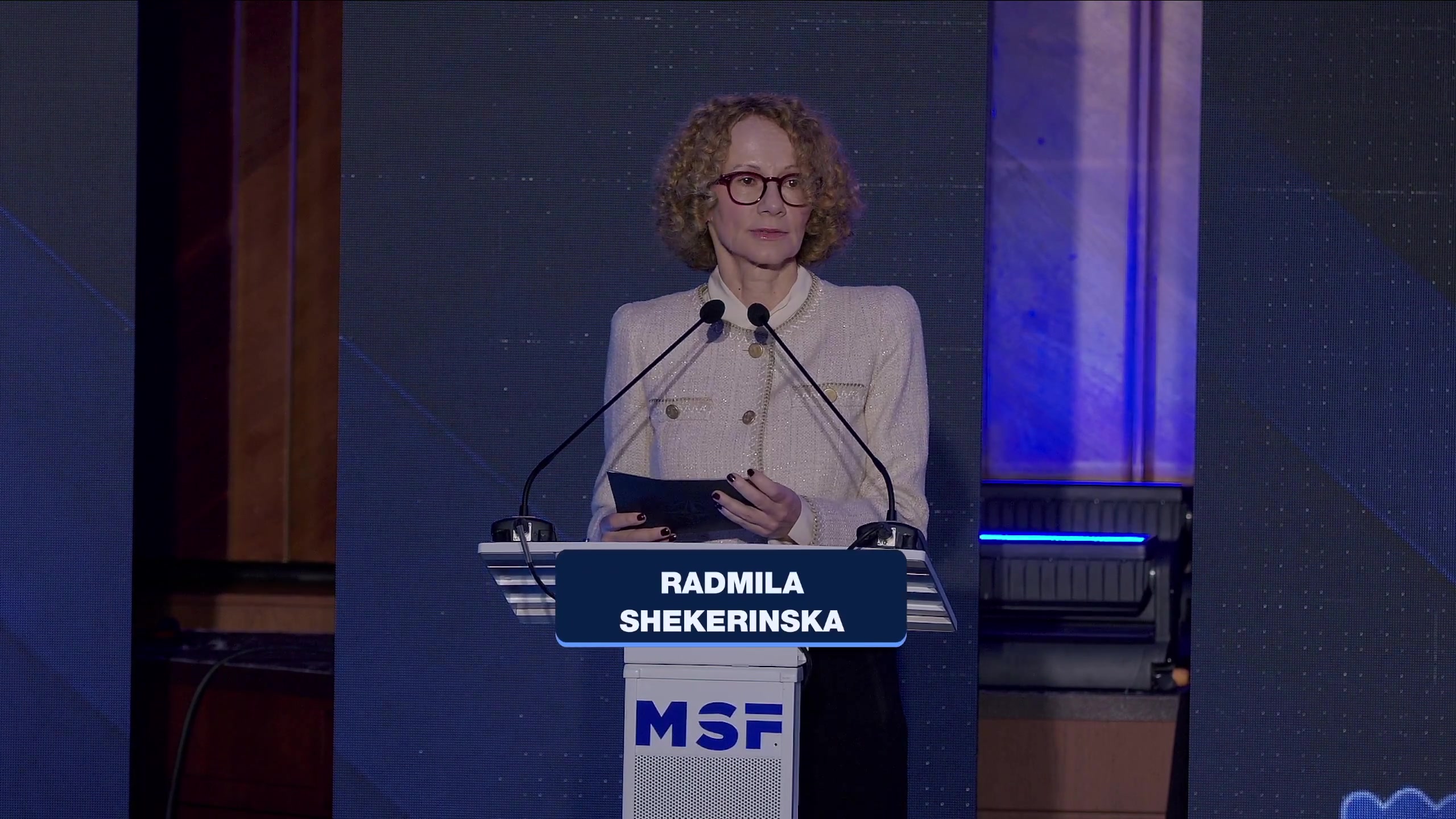
Deci, țările în așa caz devin mai solide. Și ziua a doua a forumului se deschide cu ambele aceste momente și salut aici pe doamna Radmila Șekerinska, vice-secretară generală a NATO. Doamnă, vă rugăm.
Thank you, Iulian, and congratulations on the huge success of the Moldova Security Forum. The pictures and the videos from yesterday say it all.
Distinguished guests, it is an honor to address you today and to speak about the importance of democratic resilience in the face of hybrid threats. Moldova knows these threats better than most. For years, you have stood firm in the face of Russian pressure and intimidation.
Putin's regime has tried to subvert your free and fair elections with disinformation campaigns, vote buying and threats. They have launched cyber-attacks and sabotage against your critical infrastructure. They have violated your airspace with drones and missiles.
They have cut off your energy supplies and they continue to station troops on your land against your will. Despite these hostile actions, Moldova has stood firm and stood strong. You have shown the world that a small state cannot be bullied, and it fears no one.
You have written the playbook for how to counter these aggressions with your own ingenuity and by resisting the pressure tactics. In short, that's what resilience is all about. And let me start by saying we have a lot to learn from you.
Today, NATO allies are facing a surge in the same hybrid attacks that Moldova has endured for years. Russia is failing on the battlefield in Ukraine. It has gained no ground and is losing on average almost 40,000 soldiers per month.
A desperate regime is often a more aggressive one. This is why Putin is launching even more brutal attacks against Ukrainian civilians, cities and critical infrastructure. This is also why Russia has become more aggressive in its hybrid actions against NATO allies.
Cyber attacks, sabotage, arson attempts, airspace violations, drone incidents. Putin is trying to intimidate us and divide us. His aim is to deter us from continuing our support to Ukraine, but he will not succeed. We remain united.
NATO will remain calm, carry on, and continue to support Ukraine. We remain calm because we have what it takes to protect every inch of our territory. We carry on by continuing to invest in our defense, so we can remain stronger in our ability to deter and defend our territory.
And we will continue to support Ukraine. Our response to Russia's reckless actions is to provide even more support to Ukraine. The 32 NATO allies are working hand in hand, and with over 30 partners across Europe and beyond.
We are learning together, cooperating, supporting each other and learning how to build our resilience. Moldova is an important part of this wider network. NATO and Moldova have had a strong partnership for years.
This partnership is based on a strong and meaningful political dialogue, as we have seen with the recent visit of NATO's political committee in August, when we celebrated together 35 years of Moldova's independence. Our partnership is also based on strong practical cooperation that builds your resilience and strengthens your defense institutions. I'm proud to say that Moldova is the biggest single recipient of funding from our Defense Capacity Building Initiative.
You have received support with the value of nearly 50 million euros. We provided 12 million euros for state of the art equipment for your armed forces, 8 million for ammunition depots, and 4 million for IT and software equipment to protect the integrity of your electoral process from cyber attacks. And we have also established a cyber defense facility at the Technical University of Moldova, and a cyber incident response team in your armed forces.
Hundreds of Moldovan scientists have participated in NATO's science programs, developing mutually beneficial projects in areas such as counterterrorism, cyber defense, CBRN and many others. We have also done joint exercises to improve Moldova's ability to deal with natural and man-made disasters. And we have helped to build good governance in your armed forces and defense institutions, strengthening institutional resistance to the risk of corruption.
This support from NATO has helped to support Moldova. But this is not charity on our part or any other part. A strong, stable, and resilient Moldova contributes to NATO's stability and resilience. It is important for all of us.
Moreover, we see our partnership as a two-way street. As I said, we have what to learn from you. Moldova is making NATO stronger by sharing valuable lessons learned from your first-hand experience in countering hybrid threats, and we value your cooperation in this sense. Moldova is also a direct security provider.
Since 2014, Moldova has deployed peacekeepers to our KFOR mission in Kosovo under the UN mandate. Moldovan troops have been working alongside NATO allies and other partners, helping to maintain peace and stability not just in Kosovo, but also in the wider Western Balkans. In this way, your armed forces gain valuable professional experience and develop interoperability with NATO allies and partners.
I would like to take this opportunity to thank Moldova for your contribution to our KFOR mission and to other international missions. We appreciate this long-standing and consistent involvement. We also thank you very much for your continuous and steadfast support to Ukraine as it defends itself against Russia's war of aggression.
The people of Moldova, not just the institutions, have shown enormous compassion and solidarity. You have hosted hundreds of thousands of Ukrainian refugees. Your work to ensure transport corridors for Ukrainian exports benefits the Ukrainian economy, but also global trade.
Your cooperation with Ukraine has helped to build resilience against hybrid threats on both sides. And Moldova's participation in the coalition of the willing will help to ensure a lasting peace in Ukraine with strong security guarantees. That's exactly what Ukraine needs.
Many of these activities have been carried out in cooperation with our partners from the European Union. The people of Moldova have chosen a future in Europe and you can count on our support as you progress on your EU path. We will support you practically by supporting your reforms, because strong institutions are the key to a strong and resilient country.
This is exactly what NATO, the European Union, and the Moldovan authorities are trying to achieve. At the same time, we fully respect Moldova's constitutional neutrality. National sovereignty is at the very heart of what we in NATO believe in.
As an alliance of democracies, we strongly believe in the sovereign right of free people to choose their own future. We support our own right, but also the right of other countries to make their own sovereign choices. This is why we support Moldova's democratic resilience against Russian interference.
This is why we support Ukraine's brave resistance against Russia's war. This is also why we are deeply concerned by the growing links between Russia, China, North Korea, and Iran. They are cooperating more and more, and we see that in many places around the world.
And we, those who believe in the sovereign right of people to choose their own future, those who believe in democracy, we also have to cooperate. We have to stand together in promoting peace, in protecting our shared security, and in defending our democratic values. This is why I'm here not just as NATO's Deputy Secretary General.
I'm a proud citizen of North Macedonia, a country that has been in your shoes and we are still there. We have been on a path of greater integration with other democracies and we have seen how hard it is, how frustrating it can be. It was not easy, but it has always brought us more security, more stability, and more opportunities.
More opportunities for our citizens. So I salute, appreciate and applaud the progress Moldova has made on this path. Finally, I want to share with you something that I discovered yesterday, as I was visiting Moldova.
I first noticed that some of the nicest things in Chișinău are named after Făt-Frumos. I saw a restaurant, I saw a bookstore, and I know that he's even on your currency. My team here in Moldova then told me that the character you celebrate in your daily life is not actually the biggest, the strongest one as many of the monsters and the dragons that he's fighting.
That's not Făt-Frumos. But he's resourceful, he's brave, and with the help of his friends, he wins over bigger evil. And I understood why this character is so important for Moldova.
Moldova is not a big country, but it's a smart country. I've seen that you are resilient, that you are brave, and that you have many friends in NATO. And you have all the ingredients that can make you say nothing can beat us. So thank you for showing us the way.
Thank you, Madam Deputy Secretary General.
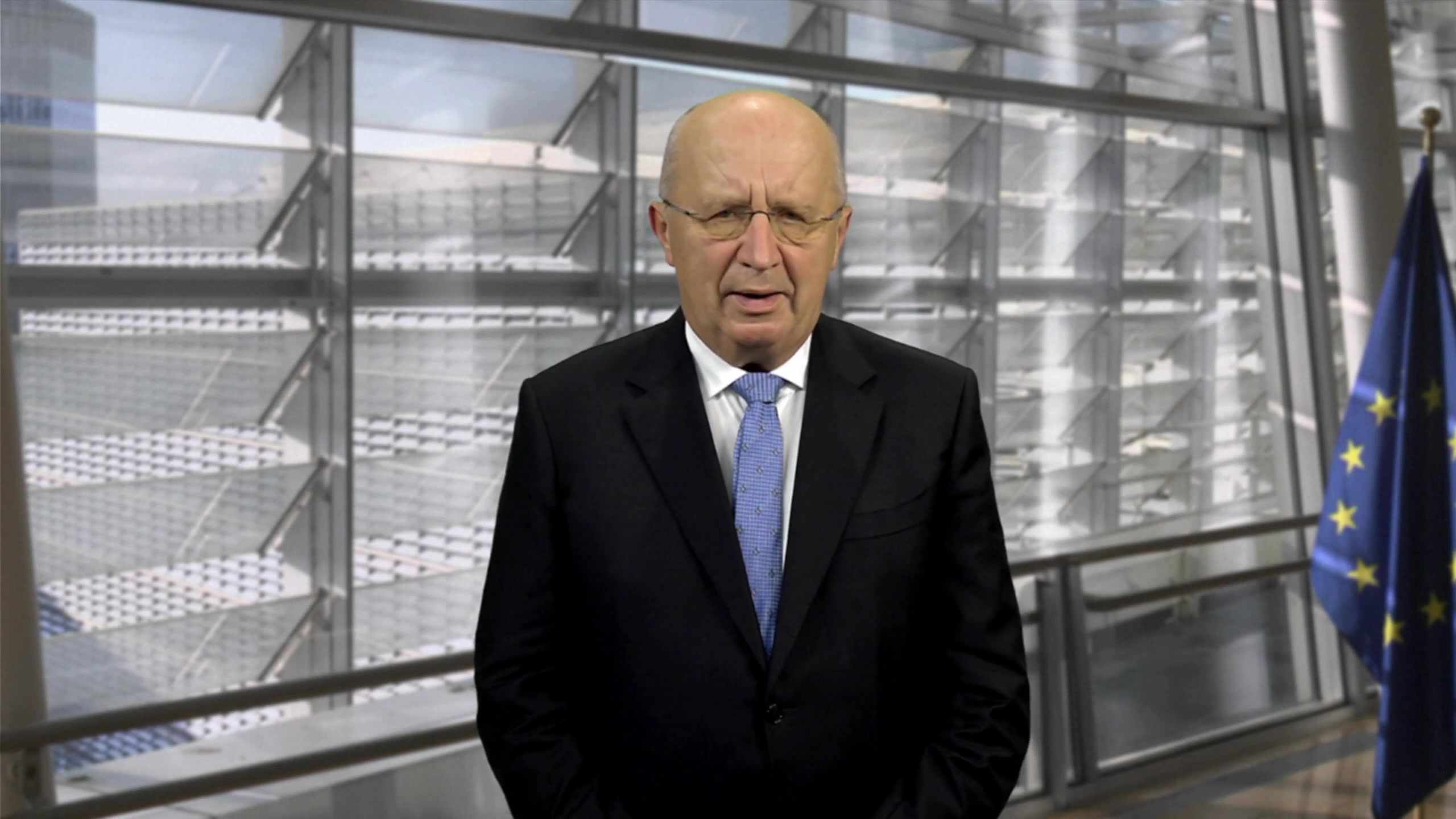
Deci, de la alianță spre uniune. La Bruxelles, am onoare să vă prezint video mesajul al comisarului european pentru apărare și spațiu, Andrius Kubilius.
My dear Moldovan friends, when I look to Moldova, I recognize and feel a lot. My country Lithuania and Moldova were under the same occupation of the Soviet Union since 1940 after the Molotov-Ribbentrop Pact. Your parliament was the first to recognize the independence of Lithuania in 1990.
Now we have almost the same size of population. We are on the eastern frontier and we have the same big and aggressive neighbor. 17 drones fell in Moldova in August alone. This is almost the same number as in the whole previous year.
The last elections in Moldova saw shameless interference from Russia with information warfare, vote buying in order to undermine your sovereignty, independence and your European future. But you resisted, you won, and due to your strength and resilience and concrete actions, the European Union can learn from Moldova. You can count on our support.
Moldova was the first country to conclude a Security and Defense Partnership with the European Union with real results. The EU partnership mission in Moldova, the hybrid rapid response team, a military advisor to the delegation, support to stronger institutions such as the National Crisis Management Center. After Ukraine, Moldova has received the most money for defense and security, 317 million in total under the European Peace Facility.
This includes 120 million for your air defense announced in June. You are a close ally in our foreign and security policy, and you are a frontrunner in enlargement, moving towards the accession to the European Union and the European future of Moldova and Ukraine is the biggest guarantee of peace in Europe. Because you will be protected by the European family and you will be able to create a success story in the family, as we did when we joined. And because of the success of Moldova and Ukraine, ordinary Russians will see that there is a better way than Putin's way.
So let's continue to work together in security and defense for a common European future.
Am auzit discursuri din partea secretarului general adjunct și din partea comisarului european Kubilius despre fundațiile și despre strategii. Și acum vom testa aceste lucruri. Atunci când apare o criză, rareori respectă un singur mandat al unui guvern sau frontierele.
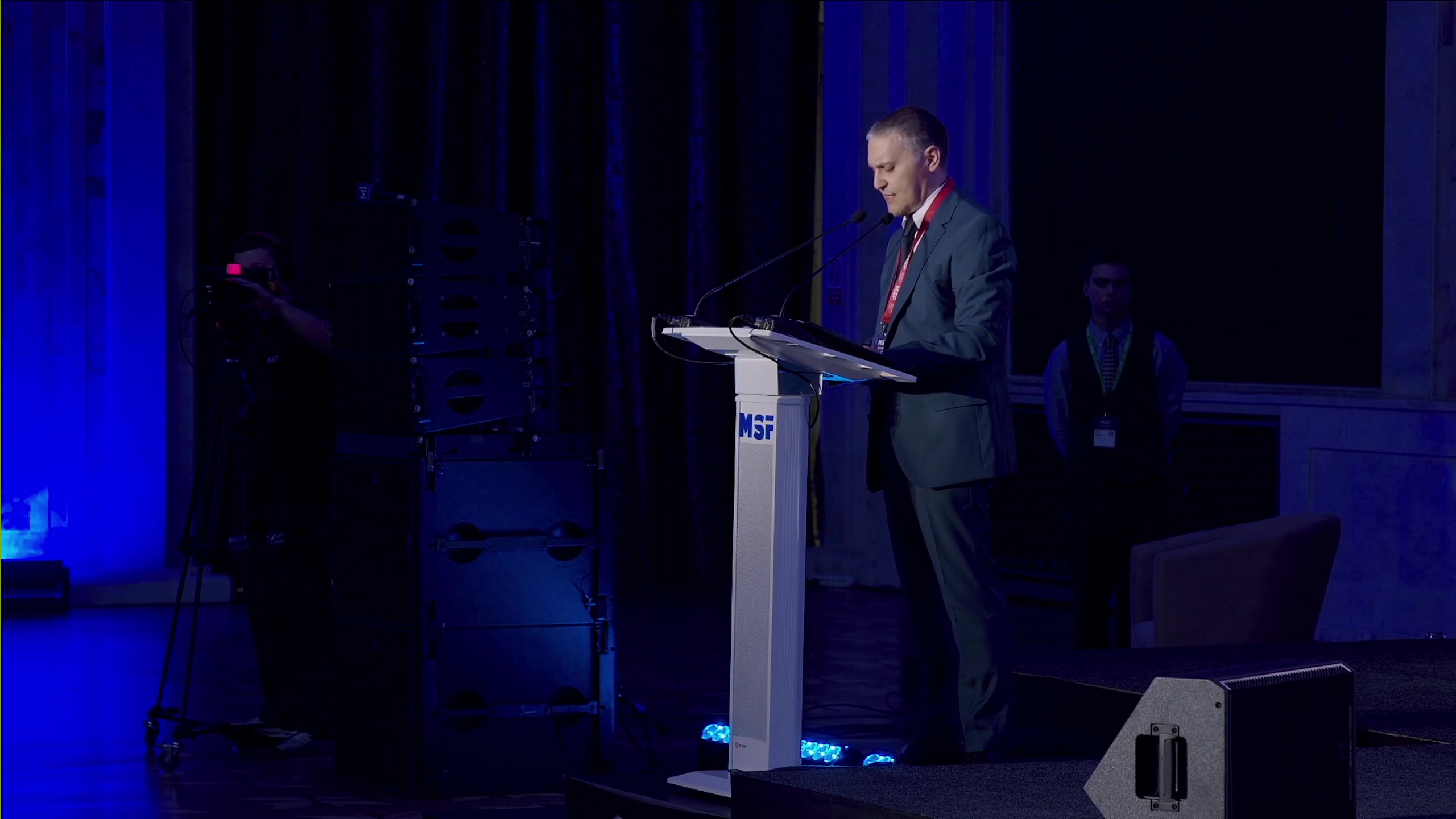
Secetele, inundațiile, șocurile energetice, perturbările cibernetice escaladează și se țin în lanț și trebuie să se răspundă la acestea și noi trebuie să fim pregătiți pentru acestea. Ca să deschidem cea de a doua sesiune din plenară privind gestionarea crizelor și pregătirea civilă, aș vrea să invit vorbitorul principal sau unul din vorbitorii din această sesiune, Serghei Diaconu, directorul Centrului Național de gestionare a crizelor. Vă rugăm.
Mulțumesc. Distinși oaspeți, colegi, doamnelor și domnilor, nu mai lucrăm într-un mediu de crize izolate. Perturbările nu mai respectă frontierele și restricțiile instituționale sau termene birocratice.
Adesea, dezastrele sunt și naturale și cibernetice și cetățenii le resimt într-un mod holistic, le resimt atunci când infrastructura critică eșuează, se închid școlile sau serviciile esențiale se prăbușesc. Pentru că vulnerabilitățile sunt strâns interconectate și răspunsul nostru strategic trebuie să fie integrat. Prin reziliența națiunilor nu este caracterizată doar prin prevenirea șocurilor, ci și prin capacitatea sistemică de a menține funcțiile de bază atunci când eșecurile în lanț apar simultan.
De-a lungul anului 2026, Moldova a servit drept un teren de exemplu de interconectivitate și riscuri transfrontaliere. Atacurile kinetice din Ucraina asupra infrastructurii au testat anumite frontiere și s-a dovedit că securitatea noastră este influențată direct.
În același timp, contaminarea râului Nistru și afectarea apei potabile a necesitat intervenții în domeniul serviciilor de urgență, de siguranță alimentară, deci a mai multor instituții. Și crizele nu mai reprezintă o problemă tehnică pentru o singură agenție. Este vorba de o provocare de alocare a resurselor din mai multe instituții și noi trebuie să fim pregătiți pentru a răspunde la această realitate.
Moldova și-a restructurat cadrul de guvernanță a crizelor la Centrul de gestionare a crizelor, care funcționează sub autoritatea directă a prim-ministrului. Și servește drept o chestiune strategică, nu înlocuiește sectoarele și asigurăm că există un tablou general sub decizii executive. Astăzi, platforma națională conectează peste 70 de instituții și conectează punțile dintre decidenți, specialiști tehnici și centre locale teritoriale pentru a asigura că politicile teritoriale se transformă în acțiuni imediate.
Și această arhitectură necesită cooperare dintre civil și militar. Prin crearea acestor punți, prin desfășurarea exercițiilor comune și capacități comune, asigurăm cicluri comune de decizii atunci când timpul este critic. Noi ne creăm sistemul pe trei capacități de bază.
Cunoașterea situației, înlocuirea evaluărilor instituționale fragmentate cu un flux de date în timp real. Luarea deciziilor coordonate, cartografierea resurselor atunci când se suprapun crizele și sunt servicii esențiale compromise. Statul trebuie să își mențină funcțiile de bază chiar și sub perturbări, în contexte de perturbări.
Capacitățile de stat reprezintă doar jumătate din ecuația de reziliență. În timpul perturbărilor la scară largă, guvernul central nu mai poate răspunde de unul singur. E nevoie de implicarea autorităților locale, operatorilor privați, furnizorilor de servicii.
Și strategia noastră este în strictă aliniere cu cele din Uniunea Europeană, integrând o metodologie care ține care ține cont de întreaga societate și acest cadru schimbă accentul și ne concentrăm acum pe nivelul de pregătire al populației ca să poată fi pregătită pentru primele 72 de ore de criză. Trecerea la un nivel de pregătire activă a populației este importantă și vreau să spun că avem un un program național de trei ani pentru pregătirea civilă și această inițiativă va abilita gospodăriile cu protocoale. Va consolida guvernanța locală pentru sporirea capacităților pentru regiuni pentru vulnerabilități regionale.
Și asta se va referi la întreprinderile private, mass media și rețele voluntare. Ca un jalon important în această inițiativă, vom desfășura în noiembrie anul acesta o campanie de pregătire pentru primele 72 de ore după o urgență, pentru că acestea sunt esențiale pentru stabilizarea infrastructurii. Atunci când gospodăriile se confruntă cu aceste probleme, serviciile de urgență trebuie să se concentreze pe prioritățile de salvare a vieților.
Și asta nu înseamnă că subminăm instituțiile. Societatea e ceva ce face societatea și statul mai puternice împreună. Reziliența nu este definită de absența crizelor, ci de capacitățile de a anticipa riscurile, absorbirea șocurilor și menținerea serviciilor și redresarea rapidă.
Prin cadrul de pregătire a Moldovei, noi trecem de la un sistem de răspuns la urgență la o cultură de pregătire națională. Noi investim în încrederea de lungă durată exprimată de către națiunea noastră și mulțumesc.
Mulțumesc, domnule director. Mulțumim pentru acest anunț. Așteptăm cu nerăbdare să participăm la acel exercițiu de pregătire pentru primele 72 de ore de urgență și mulțumesc că veți rămâne în acest panel pentru a răspunde la întrebările pe care s-ar putea să le aibă cei din public. Fără să mă lungesc, aș vrea să o invit pe Teodora Huior de la Centrul de la Geneva pentru guvernarea sectorului de securitate ca să preia cuvântul pentru următorul panel. Vă rugăm, Teodora.
Hello, can you hear me? Good morning everyone. My name is Theodora Fuior and I'm the one who is heading the activities of the Geneva Center for Security Sector Governance in Moldova. We at DCAF are very glad that this is the third year in a row we're having this discussion about crisis management at the Moldova Security Forum together with our Moldovan partners.
I think it's interesting to reflect about how the discussion on crisis management has evolved over these three years. This was also reflected in the speech of Mr. Diacono. In 2024, we were talking about the need to shift from reactive responses to a prevention paradigm in Moldova. Last year, we were talking about the benefits of having a risk-informed and integrated institutional system in Moldova.
And today, we will have a conversation about how our crisis management systems are tested in reality, in real life. And I hope we will be able to identify also some solutions and lessons learned that can improve the effectiveness of our systems. In opening the forum yesterday, the Deputy Secretary General of NATO, Mircea Geoană, said something that stuck with me.
He asked, can democracies deliver the best responses to people's problems? I think this is a very important question, and ultimately, this is the fundamental question we will try to answer today in this panel, but also throughout the discussions we will have. I think that crisis management is one area where we can do this analysis in very concrete terms.
We can identify what characteristics of a democracy make our societies respond to crises, go through crises in a different way, and we can compare the way democracies respond to crises and the way citizens go through these crises in comparison to the situation in other political systems. The speakers in this panel will help us give concrete answers to these questions. And now I will invite everyone on stage.
We will start with Davide Sanders from NATO, resilience advisor at the Euro-Atlantic Disaster Response Coordination Center at NATO. Please, Davide. I think it's better if you just sit there so you're aligned with the picture on the screen.
Next, we have my colleague from DCAF, Filip Butino, Security and Strategy Advisor at the Geneva Center for Security Sector Governance, Major General. Next, we have Dr. Elena Marzac, Executive Director at PISA Moldova, the platform for security and defense initiative. The former Prime Minister of Moldova, Mr. Recean, said yesterday that we all know that the Nordic countries are the champions when it comes to resilience and civil preparedness.
And we are lucky to have two representatives of Nordic countries, Finland and Sweden. First, I would like to invite Mr. Carl Toring from Sweden, from the Swedish Agency for Civil Defense and Resilience, MSB, one of the implementing partners here in Moldova. Thank you very much for being here.
And we have Mr. Axel Hegelstam from Finland. Thank you very much for being here. Deputy Director General for International Affairs and Analysis at the National Emergency Supply Agency in Finland. Thank you all for joining.
Let me remind you of the question I mentioned that was also asked in the opening of the forum. Can democracies deliver the best response to people's problems? I think this is what we will try to answer, but I want us to move away from abstract and theoretical discussions.
I have discussed and prepared with the speakers very concrete responses and information that they will present, about crises, real life crises that took place in their countries in the last year, especially. We have seen how climate change has become a very important factor in the risk environment. We have seen last summer extreme weather events, extreme heat, wildfires, droughts and other extreme weather events that are affecting our communities and our countries.
Some of the speakers today will reflect on these concrete situations. Let's start with Filip Butino, who has a rich and extensive experience that he accumulated in his capacity as the former head of the Paris Firefighter Service. At a time when France was going through turbulent times.
You have operational experience. When a severe crisis disrupts several services at the same time, what decision-making and accountability arrangements help society to be effective in its response to the crisis?
Thank you very much, Theodora. Good morning to everybody. Thank you for the invitation to participate for the second time in this so important forum. I want to be clear. I was commander of the firefighter brigade in 2015 when the first terrorist attack happened in Paris.
And I say that because there are some specificities in Paris. The firefighters are a military unit of 8,700 men and women. I was, I am a French general, and this is the specificity of the firefighter department in Paris. The principles are almost the same as in the law of war.
We need to have freedom of action, first of all. And the second one is concentration of the effort and capacities. And the third one is the economy of means. And when you think about reacting to crisis, crises always affect different services at different events. And you have to manage things at the local level.
When the crisis affects several services, the most important thing, in my opinion, is to understand who is in charge of what. The leadership, therefore, must know very clearly what are the layers in the management of the crisis. And when this is clearly explained, what is important also is to understand what are the responsibilities of each level. And when you think about the freedom of maneuver, you need to think that at the local level, everything must be solved before it is escalated to the upper level, to the other layer.
And coordination must be permanent. There is also a clear responsibility that must be established, meaning that each level of responsibility must know precisely who must take the decision about what. For example, and also, as we are working in a crisis environment, you must have clearly stated who is replacing who in case the person is not able to take the decision for a reason or another.
I will give you an example. In 1995 in Kobe, Japan, there was a terrible earthquake at about 6 a.m. in the morning, magnitude 7.2 on the Richter scale. And normally in the regulation, it was the responsibility of the prefect of Kobe, the mayor of Kobe, to ask for reinforcements, for external reinforcements coming from other cities in Japan and even from abroad.
But the prefect was killed in this earthquake. And it took four days to the Japanese authorities to understand that there was nobody to ask for reinforcements. More than 6,000 people were killed in this earthquake. And this led to strengthening the capacity for disaster preparedness in Japan.
And this is an indication that it was one detail in the text. It was not mentioned who will replace the prefect in case he dies. It is about responsibility between the different levels of leadership. And another important aspect is to understand that you must coordinate. You must coordinate between services.
And sometimes these crises affect the police service, the energy supplies and so on. And to coordinate all these things, it was already yesterday that we saw that very clearly, so the only solution is to train people. And it was said yesterday by the special envoy of the President for development and resilience, it was clearly stated that. And I am glad to let you know that we will organize an exercise on that in November.
So train. You have written a regulation and if you want to test it, put a stamp on it. It's very important. You check after two or three months, and only 20 to 30% of the people who are involved in case it is necessary will have read the regulation.
So exercise. You will understand how many details are not written in the regulation and you will have to fill the gaps. For example, the phone book is it up to date or not? The radio frequencies not to have the same frequency between police and firefighters. And this kind of things must be written in your contingency plan or whatever the name you give it.
And the last point I would like to tell you. During a crisis, if you are very well trained, you lose 70% of your thinking and knowledge capabilities and you will react with the 30% left. And with these 30%, you will be able to find the solution if people on all channels were trained.
Thank you, Filip, for starting this conversation. I retained that it is very important to have a clear mandate, especially in the context of the hierarchy of decision making, but it's also very important to have flexibility, to adapt, to react quickly, to be prepared, and preparedness is achieved only through exercise.
Now, I'm turning to Mr. Carl Toring. Carl, you told me that you wanted to talk about a recent event in Sweden and to tell us what this revealed in terms of preparedness and civil defense capabilities and in general supply.
Yes, thank you. I want to thank Major General Butino for his presentation and for stressing the importance of exercises. It is a very important part of our defense structure. And I want to say just a few words about that to set the scene, so to say.
In Sweden, we strongly believe in a resilient civil defense. We are organized in a structure including the defense agency and 67 different civil defense agencies and my agency is coordinating their work. They are divided into 12 thematic structures. For instance, energy supply, water supply, food supply.
And each sector has a leader. And on top of that, we also have six geographical areas in Sweden. So it's a large structure, a lot of coordination, but it's what we strongly believe in. And we all work in accordance with a national plan.
This plan was developed by my agency and the defense agency. And it's based on seven assumptions, seven threats or planning assumptions. It corresponds with the NATO mandate and our role in NATO. And to briefly present them.
It's about hybrid attacks, a limited attack on the north of Sweden, protection of the northern flank, protection of the Baltic area, and attack on the island of Gotland, which is the biggest island in the Baltic Sea, and our role as a host nation in case of a stand-off attack.
So these are the planning scenarios we have started from when we started our planning. So we thought that if we have a bad weather situation, four out of these seven assumptions that we have made were affected. And I will talk a little bit about the floodings that took place in the north of Sweden in Västernorrland.
In September it was, for two days we had 100 millimeters of rain in a limited area and the grounds were already saturated with water because we had a lot of rain there and it meant that suddenly 600 kilometers of roads were not possible to use. Two trains derailed on separate train lines.
The north of Sweden was practically disconnected from the south from a logistic point of view. It had huge repercussions on our ability to manage our daily needs. Critical supply lines were cut off. So, from Norway to Belgium and the south of Europe, we had difficulties.
Our crisis management system was involved. We managed to reroute some of the traffic. We used an old train line as well, but the capacity of that line was much smaller than what we needed. So, it had huge repercussions, this flooding situation. Practically, we had to build a new road to reach the railway to start to repair the railway line.
And imagine now if we also had a threat on top of that. So, we have the mandate to support the northern flank and Finland in a crisis situation. And it would not have been possible. So, there is a very strong link between the effects of climate change and our ability to have a fully functioning total defense system.
So, we must consider when we build up our total defense system that we are also preparing for a changing climate. Yes, we do climate adaptation, but it's a holistic activity. We do that in the entire country and we must consider also the needs of the total defense when we do climate adaptation. That's it so far.
Thank you. It's a useful introduction to a very complex system in Sweden. I retained that good preparedness and good planning very much depend on good communication with the private sector. Without this communication, it's not possible to set the priorities and the urgencies that need to be addressed in a crisis situation.
Now, I would like to come back to Moldova to Elena. Yesterday, the Minister of Foreign Affairs, Popșoi, said that Moldova implements reforms as if the future depended on this. And he suggested that the scale and the pace of reforms are very impressive.
But let's see how can civil society engage in this process in a meaningful way? How can the authorities ensure that the preparedness arrangements are relevant and they actually reflect people's needs?
Thank you, Theodora. The presence of civil society representatives in this panel already tells us that we are mature enough to understand their importance, that everything is done for the people and we need to be present at the table when things are planned.
And to refer to what you said. We are here with DCAF and other organizations to promote good governance in the security sector, and we see that the European approach is more about preparedness, about the resilience of the government together with the community. And this is valid before the crisis, after the crisis, and during the crisis.
And Director Diacono promoted the importance of this 72-hour exercise for citizens. I think it's a bit late, but it's good that this discussion has started because we need this information. The most recent sociological survey presented a few days ago tells us that there is little information about how we react in a crisis situation.
So we need to work to ensure public trust. Citizens must be prepared to know what to do when we are all panicked. We need to have mutual trust, to know that we will resist and that there will be continuity of services.
And when I talk about decision-makers, I actually mean government institutions. Yes, the public sector is important, but I am also talking here about women's organizations, organizations of vulnerable people who represent the region. The government now does not have access, does not have the possibility to access them and respectively we must collaborate in this sense.
And I want to use this opportunity to stress the role of women in crisis management. We must use women's ability to manage crises at the local level, at the regional level, to react to vulnerabilities, to understand the different needs of different parts of society, men, women, girls, of vulnerable segments of our society.
You talked about possible gaps currently. Yes, but you should know that the Crisis Management Center is already working on this subject. And civil society must be involved. We need to have resources and the ability to manage independently.
And we don't have to wait 72 hours to act. We need to know what to do, to have what is necessary stored. And that survey I mentioned tells us that we could work together with the government, with the decision-makers. And the authorities have a very important role here.
But we must instruct the representatives of local authorities, so that they understand how to use alternative communication channels, how to help people access information about the crisis, and we must work on that. People need to understand who is the trusted issuer, who to believe.
Our sociological surveys say that in case of a crisis and emergency situation, first and foremost, people trust the General Inspectorate for Emergency Situations. But besides that, the mayor and those who represent local authorities, and here we must certainly collaborate.
Thank you. This is a good introduction for a very complex system. And the Swedish example I think demonstrates well. And you mentioned that good preparedness and good planning very much depend on good communication with the private sector. Without this communication, it is not possible to set the priorities and the urgencies that need to be addressed in a crisis situation.
And now I come back to Moldova, to Elena. Yesterday, the Minister of Foreign Affairs, Popșoi, said that Moldova implements reforms as if the future depended on this. And he suggested that the scale and the pace of reforms are very impressive. But let's see how can civil society engage in this process in a meaningful way? How can the authorities ensure that the preparedness arrangements are relevant and they actually reflect people's needs?
Thank you, Theodora. The presence of civil society representatives in this panel already tells us that we are mature enough to understand their importance, that everything is done for the people and we need to be present at the table when things are planned. And to refer to what you said.
We are here with DCAF and other organizations to promote good governance in the security sector, and we see that the European approach is more about preparedness, about the resilience of the government together with the community. And this is valid before the crisis, after the crisis, and during the crisis. And Director Diacono promoted the importance of this 72-hour exercise for citizens.
I think it's a bit late, but it's good that this discussion has started because we need this information. The most recent sociological survey presented a few days ago tells us that there is little information about how we react in a crisis situation. So we need to work to ensure public trust.
Citizens must be prepared to know what to do when we are all panicked. We need to have mutual trust, to know that we will resist and that there will be continuity of services. And when I talk about decision-makers, I actually mean government institutions.
Yes, the public sector is important, but I am also talking here about women's organizations, organizations of vulnerable people who represent the region. The government now does not have access, does not have the possibility to access them and respectively we must collaborate in this sense. And I want to use this opportunity to stress the role of women in crisis management.
We must use women's ability to manage crises at the local level, at the regional level, to react to vulnerabilities, to understand the different needs of different parts of society, men, women, girls, of vulnerable segments of our society. You talked about possible gaps currently.
Yes, but you should know that the Crisis Management Center is already working on this subject. And civil society must be involved. We need to have resources and the ability to manage independently. And we don't have to wait 72 hours to act.
We need to know what to do, to have what is necessary stored. And that survey I mentioned tells us that we could work together with the government, with the decision-makers. And the authorities have a very important role here.
But we must instruct the representatives of local authorities, so that they understand how to use alternative communication channels, how to help people access information about the crisis, and we must work on that. People need to understand who is the trusted issuer, who to believe. Our sociological surveys say that in case of a crisis and emergency situation, first and foremost, people trust the General Inspectorate for Emergency Situations.
But besides that, the mayor and those who represent local authorities, and here we must certainly collaborate. This 72-hour campaign would be an excellent exercise for us in terms of increasing trust in the government's ability to solve problems. Because people now see drones, they see problems with water, with energy, and people want solutions and information.
Listening to the experience of Finland and Sweden, I remembered my study visit to Finland. I looked with envy and jealousy at what was done in your country, and I realized that we need a lot of planning, a lot of exercises to get here. We are very young, we are just starting, but we already have good practices.
We see how the government works with civil society, how actions are coordinated, how your specialized agency communicates, works with the National Emergency Supply Agency, and with other government institutions. And from the Swedish example, we can also learn. I studied crisis management at the Swedish Defense University.
And for the students of this course, it was an example. We saw that Moldova is implementing many things. There are elements of institutionalization. And we will continue to act and test our ability to collaborate. Thus, we will test the whole-of-society approach that we have in our strategic communication.
It's a very good example of implementing strategic communication as a tool. And yes, I won't repeat, I will just support the idea that we need that trust and people need to trust, to know where to read, where to find information. We need to work, to plan, to prepare, and to have this preparedness everywhere people are, in libraries, including.
To explain to local authorities how this legislation is applied, to go to schools, to do exercises. We will not scare the population, the population is already scared, but uncertainty causes more fear. And I believe this 72-hour program will help people understand that it's normal, that it's already happening in other countries.
In Belgium, in Sweden, at the supermarket, you can even find packages with products, for example, that contain a lot of protein and carbohydrates and help you survive these 72 hours. And organizations that deal with disabilities also could get involved. Yes, it's an extraordinary campaign, but people need to understand how to use it, how to read some things if there is no internet, if there is no electricity.
How to find that shelter, if that shelter exists at all. Who to address, who to trust. It's a subject heavily used by propaganda. And civil society must feel this information gap and not be manipulated.
I stress again, the program must be done together with the citizens. There must be responsibility on the part of the citizens. And it needs funding, without funding it won't work. Preparedness must be exercised. And we need trust through transparency. And sometimes we have to say that the situation is what it is, we need your help, dear citizens, let's solve the problem together.
So, once again, honest communication and a very good understanding of vulnerabilities at all levels, individual, local, national. And before I let the public ask questions, I'm going back to Davide. From your experience, you have probably seen several exercises testing crisis management systems in different countries. We have seen how we could what we could achieve in case of a real crisis.
And now, knowing that climate change is continuing, crises will overlap, what would be the change that you would recommend to different systems now to be able to better react to future crises caused by climate change?
It's probably the most important question. I think the main thing I would focus on would be to prepare for uncertainty. And that would summarize many of the topics we have discussed. We have spoken about the complexity of the environment we live in, the risks we face.
We don't necessarily know what the crisis will look like. We can imagine it, but we don't know for sure. And we need to be prepared, adaptable, flexible to work together at the national level and internationally. Preparing for uncertainty is something difficult, something new, and something that operational personnel always do, not necessarily through written procedures, but when faced with a situation, you have your equipment and you adapt, as the general will tell us.
Being prepared for uncertainty is essential. We must change our mentality and be ready to face the challenges that are thrown our way. Thank you.
I think this mentality is what the military people say, to be prepared for the unthinkable. Let's open the floor for some questions. I can't see very well from here, I'm blinded by the lights, but please raise your hand if you have questions from the public. Go to the microphone.
Yes, please come to the microphone.
Thank you very much for the opportunity. I am from the National Youth Platform for Public Participation. We are talking about civil preparedness and there are unused resources, not only infrastructure but also young people. And in this digital era, young people are the ones who communicate, organize the fastest in a crisis and we have remarkable models in Europe.
In Germany, the Federal Agency for Technical Relief involves young people, thousands of young people, involving them in defense, rescue activities, and in Estonia and other Baltic states, the high school and university curriculum includes some practical training in this sense. How can we ensure that we put young people at the center of national preparedness and transform them from passive recipients of aid to those who help the community, help their families, the elderly, and neighbors?
Thank you. Thank you for the question. It's hard not to agree with you. Young people are our future, and we must ensure that our young people are capable of facing the challenges that lie ahead. And I believe they are capable.
An element to highlight here is the investment in education. Because if you have a good level of education, a high level of general understanding at all levels of the academic environment, this makes you resistant, especially to disinformation. It makes you think critically, it makes you a conscious citizen, and I think it's impossible to over-appreciate the importance of education in our society. Investing in young people, in their ability to take over the reins of the world when their time comes. Thank you.
I think it starts at home. It starts with involving our young people, our children, when they are small, in preparedness activities at home. I will give you an example from my personal life. We have a preparedness brochure that we send to every citizen in Sweden.
And twice a year, I take that brochure off the shelf and use it for a week. And with my partner and my teenage child, we live off reserves for a week. And this is a way to involve them, to prepare them from home. But I would also like to reiterate what Elena mentioned about the importance of society.
It's important to involve civil society organizations. In my country, we have strategic relationships with civil society organizations that can play a role in crisis management. For example, when it comes to providing first aid and first psychological aid to victims of a crisis, something that the Red Cross offers, and we work at a strategic level with them. These things are important.
But I also think they play a role in the civil defense system. When you turn 18 in my country, you have a legal obligation to be part of the total defense structure. And then you go to the recruitment office for military services in the past and now also for civil defense services. And there is this civil role.
Young people can get involved and play an official role in the entire civil defense system. It is an important resource in the entire defense structure. And also, Elena mentioned that young people can be volunteers who help government institutions work with vulnerable groups or communities. Or they can even provide explanations.
I'm looking at Mr. Diacono, they can create applications. And maybe you can provide more details. In this case, they have digital skills and can explain to older parents or grandparents or even neighbors how the technology works, how to use it. And this level of understanding among young people can be of help. Thank you.
Thank you for the questions. This was clearly explained by the colleagues here. It is a matter of putting these things into practice. In the last two or three years, I have come to Moldova and I see that you now have a crisis management center, which is essential. Sometimes it is necessary to be pedagogical, so to say, with those at the local level, to explain to them what the expectations are from them.
I don't know what you will do in November exactly in these preparedness exercises, but I suggest you go to different mayoralties, to different regions, and explain to them what the expectations are from them and what needs to be tested. Because you might miss the main objective of this exercise. I'll give you an example.
There is a crisis at a mayoralty 200 kilometers away from Chișinău. Usually, people have the ability to react. The mayor of the city, the mayor, will take the necessary decisions, but she does not know what is happening 2 or 3 kilometers away from her city. It is very important to react.
In case there is an attack and there are consequences, damage to a dam, floods in a certain place, especially in this moment when we have hybrid attacks and threats, it is not impossible to imagine that in one part of the country you have a natural disaster and at the same time, 2 or 3 kilometers away, there is another crisis.
And there must be a clear picture of what is happening. Is it a natural disaster or caused by an attack? Because there could be consequences that have nothing to do with hybrid threats. If you remember, in Spain there was a power outage in two-thirds of the country, and immediately there were rumors saying that it was a hybrid attack by the Russians, but it turned out not to be true. The level of understanding must usually be at the national level.
That is why it is essential, first of all, to have a national crisis management center and to explain to everyone else in the country, at different levels, why it is important for this information flow to exist in a trustworthy way. And what is essential is to teach people to react in these crises in the first 72 hours. If every citizen in the country is able to prepare with water resources, food, and some basic things, they will not be a burden in the first 72 hours.
It is the role of the army to be protected, for example, but if you ask the state to be protected, and this is the mission of public services, that's another thing. And another key word here is anticipation. The level of anticipation is never at the local level, it is usually at the regional and national level. For example, in the case of floods, there is the weather forecast and you know that in the next five days you will have abundant rain.
You don't necessarily have to tell people that the situation will improve. Tell them the truth. And the last thing I want to say, highlighted by my colleagues. We are not alone in Europe. Moldova is not part of the European Union, but it is part of the European family.
And we in Europe have the civil protection mechanism that can be activated by Moldova. And in my country, France, this summer, this was the case. We had extensive wildfires, and we asked for support from many nations in Europe, including Ukraine. They sent firefighters to support our firefighters. We have the chance to live on a continent where there is solidarity between nations.
And the key point in this mechanism, the key point is who will pay? Because these crises cost. At the end, you receive the bill. So who will pay for this EU mechanism is also an important aspect. And I spent a few years at NATO, especially in Brussels, and I had some surprises with the forces sent to Pakistan.
The Spanish sent their forces and the bill came, and the council's response was, you sent your forces, you pay. And in this way, I don't want to criticize NATO, I spent seven years working at NATO, but I want to stress that in the EU this mechanism was created, it is clear, and you can rely on it.
One last point. Communication. Tell the truth to the population and invite the population to prepare. Because we are talking about resilience. And I think the first 72 hours are not resilience but resistance.
You can endure what is happening. Resilience comes after. You continue to live even in a deteriorated environment, but with the support of different services and the state. And this is the role of the state. And this must be tested through exercises. Thank you.
Thank you, Filip. It is not enough to have just a clarity of the mandate and the decision-making process, but from what I understand, it is very important that the people involved in crisis response and crisis management have a clarity on the expectations, what they need to do, what are the expectations of the systems from them. Thank you very much for making this distinction between resilience and resistance. This is a very important distinction indeed.
And thank you for reminding us all about the EU civil protection mechanism. You know, Moldova is a full-fledged member since 2023, I think, in this mechanism. And it's not only a recipient, but also a provider of assistance in emergency cases. And Sweden, the Agency for Civil Defense and Resilience, is helping the General Inspectorate for Emergency Situations to better align their interoperability with the requirements of the EU civil protection mechanism.
And I am turning now to Carl. I am really interested, and I hope also our audience is interested, to hear more about how you adapt, how you implement the lessons learned after such a situation in adjusting the system. How can a total defense system and this climate change adaptation and planning be done in good coordination?
Yes, thank you. I want to thank Major General Butino for his presentation and for stressing the importance of exercises. It is a very important part of our defense structure. And I want to say just a few words about that to set the scene, so to say. In Sweden, we strongly believe in a resilient civil defense.
We are organized in a structure including the defense agency and 67 different civil defense agencies and my agency is coordinating their work. They are divided into 12 thematic structures. For instance, energy supply, water supply, food supply. And each sector has a leader.
And on top of that, we also have six geographical areas in Sweden. So it's a large structure, a lot of coordination, but it's what we strongly believe in. And we all work in accordance with a national plan. This plan was developed by my agency and the defense agency.
And it's based on seven assumptions, seven threats or planning assumptions. It corresponds with the NATO mandate and our role in NATO. And to briefly present them. It's about hybrid attacks, a limited attack on the north of Sweden, protection of the northern flank, protection of the Baltic area, and attack on the island of Gotland, which is the biggest island in the Baltic Sea, and our role as a host nation in case of a stand-off attack.
So these are the planning scenarios we have started from when we started our planning. So we thought that if we have a bad weather situation, four out of these seven assumptions that we have made were affected. And I will talk a little bit about the floodings that took place in the north of Sweden in Västernorrland. In September it was, for two days we had 100 millimeters of rain in a limited area and the grounds were already saturated with water because we had a lot of rain there and it meant that suddenly 600 kilometers of roads were not possible to use.
Two trains derailed on separate train lines. The north of Sweden was practically disconnected from the south from a logistic point of view. It had huge repercussions on our ability to manage our daily needs. Critical supply lines were cut off.
So, from Norway to Belgium and the south of Europe, we had difficulties. Our crisis management system was involved. We managed to reroute some of the traffic. We used an old train line as well, but the capacity of that line was much smaller than what we needed.
So, it had huge repercussions, this flooding situation. Practically, we had to build a new road to reach the railway to start to repair the railway line. And imagine now if we also had a threat on top of that. So, we have the mandate to support the northern flank and Finland in a crisis situation.
And it would not have been possible. So, there is a very strong link between the effects of climate change and our ability to have a fully functioning total defense system. So, we must consider when we build up our total defense system that we are also preparing for a changing climate.
Yes, we do climate adaptation, but it's a holistic activity. We do that in the entire country and we must consider also the needs of the total defense when we do climate adaptation. That's it so far. Thank you for this introduction to a very complex system.
And I understand that good preparedness and good planning very much depend on good communication with the private sector. Without this communication, it is not possible to set the priorities and the urgencies that need to be addressed in a crisis situation. Now I'm coming back to Moldova, to Elena. Yesterday, the Minister of Foreign Affairs, Popșoi, said that Moldova implements reforms as if the future depended on this.
And he suggested that the scale and the pace of reforms are very impressive. But let's see how can civil society engage in this process in a meaningful way? How can the authorities ensure that the preparedness arrangements are relevant and they actually reflect people's needs?
Thank you, Theodora. The presence of civil society representatives in this panel already tells us that we are mature enough to understand their importance, that everything is done for the people and we need to be present at the table when things are planned. And to refer to what you said. We are here with DCAF and other organizations to promote good governance in the security sector, and we see that the European approach is more about preparedness, about the resilience of the government together with the community.
And this is valid before the crisis, after the crisis, and during the crisis. And Director Diacono promoted the importance of this 72-hour exercise for citizens. I think it's a bit late, but it's good that this discussion has started because we need this information.
The most recent sociological survey presented a few days ago tells us that there is little information about how we react in a crisis situation. So we need to work to ensure public trust. Citizens must be prepared to know what to do when we are all panicked.
We need to have mutual trust, to know that we will resist and that there will be continuity of services. And when I talk about decision-makers, I actually mean government institutions. Yes, the public sector is important, but I am also talking here about women's organizations, organizations of vulnerable people who represent the region.
The government now does not have access, does not have the possibility to access them and respectively we must collaborate in this sense. And I want to use this opportunity to stress the role of women in crisis management. We must use women's ability to manage crises at the local level, at the regional level, to react to vulnerabilities, to understand the different needs of different parts of society, men, women, girls, of vulnerable segments of our society.
You talked about possible gaps currently. Yes, but you should know that the Crisis Management Center is already working on this subject. And civil society must be involved. We need to have resources and the ability to manage independently.
And we don't have to wait 72 hours to act. We need to know what to do, to have what is necessary stored. And that survey I mentioned tells us that we could work together with the government, with the decision-makers.
And the authorities have a very important role here. But we must instruct the representatives of local authorities, so that they understand how to use alternative communication channels, how to help people access information about the crisis, and we must work on that. People need to understand who is the trusted issuer, who to believe.
Our sociological surveys say that in case of a crisis and emergency situation, first and foremost, people trust the General Inspectorate for Emergency Situations. But besides that, the mayor and those who represent local authorities, and here we must certainly collaborate. This 72-hour campaign would be an excellent exercise for us in terms of increasing trust in the government's ability to solve problems.
Because people now see drones, they see problems with water, with energy, and people want solutions and information. Listening to the experience of Finland and Sweden, I remembered my study visit to Finland. I looked with envy and jealousy at what was done in your country, and I realized that we need a lot of planning, a lot of exercises to get here.
We are very young, we are just starting, but we already have good practices. We see how the government works with civil society, how actions are coordinated, how your specialized agency communicates, works with the National Emergency Supply Agency, and with other government institutions. And from the Swedish example, we can also learn.
I studied crisis management at the Swedish Defense University. And for the students of this course, it was an example. We saw that Moldova is implementing many things. There are elements of institutionalization. And we will continue to act and test our ability to collaborate.
Thus, we will test the whole-of-society approach that we have in our strategic communication. It's a very good example of implementing strategic communication as a tool. And yes, I won't repeat, I will just support the idea that we need that trust and people need to trust, to know where to read, where to find information.
We need to work, to plan, to prepare, and to have this preparedness everywhere people are, in libraries, including. To explain to local authorities how this legislation is applied, to go to schools, to do exercises. We will not scare the population, the population is already scared, but uncertainty causes more fear.
And I believe this 72-hour program will help people understand that it's normal, that it's already happening in other countries. In Belgium, in Sweden, at the supermarket, you can even find packages with products, for example, that contain a lot of protein and carbohydrates and help you survive these 72 hours. And organizations that deal with disabilities also could get involved.
Yes, it's an extraordinary campaign, but people need to understand how to use it, how to read some things if there is no internet, if there is no electricity. How to find that shelter, if that shelter exists at all. Who to address, who to trust.
It's a subject heavily used by propaganda. And civil society must feel this information gap and not be manipulated. I stress again, the program must be done together with the citizens. There must be responsibility on the part of the citizens.
And it needs funding, without funding it won't work. Preparedness must be exercised. And we need trust through transparency. And sometimes we have to say that the situation is what it is, we need your help, dear citizens, let's solve the problem together.
So, once again, honest communication and a very good understanding of vulnerabilities at all levels, individual, local, national. And now, I would like to turn to Axel. Yesterday, several speakers mentioned the importance for Moldova of the energy transition, especially in the context of the cognitive war. Could you tell us about how Finland is managing this moment?
Thank you for the question. I can tie this very well to what Carl was just saying about the effects of climate change. When we prepare for something, we need to ensure that the short-term solutions are in harmony with our long-term needs.
It's a strategic exercise as well. And the energy transition for me is an excellent example of elements related to preparedness that are in harmony. We need to get rid of our dependence on fossil fuels because we become dependent on Russia. The less dependent we are on fossil fuels from Russia, the better it is for our economy, because Russia has less leverage against us.
But at the same time, this helps us to mitigate the effects of climate change. The shift to electricity-based solutions and other forms of renewable energy is a good step, and we could already expand it to the necessary levels. It's not easy.
And yes, we must not replace dependence on fossil fuels from Russia with dependence on metals from China. This is another challenge regarding the scalability of alternative solutions in Finland. We say it's a matter of...
We say it is a capability based on math skills. There are bots, there are fake accounts, there are clusters of almost identical messages that appear on different platforms at about the same time. This tells us that there are indications of a coordinated campaign.
And then we realize that we can open that message and try to understand what is actually being attempted. That's when we do the analysis, not trying to see if the message is true or false. Yes, the authorities can come out and say that this is true, this is false.
But seeing these coordinated campaigns, you already start to question it. It smells fishy. And you apply critical thinking and think about the possible motivations of this campaign. And decision-makers can also make use of this exercise.
Thank you, Axel. Now I'm turning back to you, Carl. We heard you talking about the recent event in Sweden. How do you adapt? How do you implement the lessons learned after such a situation in adjusting the system? How can a total defense system and this climate change adaptation and planning be done in good coordination?
Yes, thank you. I want to thank Major General Butino for his presentation and for stressing the importance of exercises. It is a very important part of our defense structure. And I want to say just a few words about that to set the scene, so to say. In Sweden, we strongly believe in a resilient civil defense.
We are organized in a structure including the defense agency and 67 different civil defense agencies and my agency is coordinating their work. They are divided into 12 thematic structures. For instance, energy supply, water supply, food supply. And each sector has a leader.
And on top of that, we also have six geographical areas in Sweden. So it's a large structure, a lot of coordination, but it's what we strongly believe in. And we all work in accordance with a national plan. This plan was developed by my agency and the defense agency.
And it's based on seven assumptions, seven threats or planning assumptions. It corresponds with the NATO mandate and our role in NATO. And to briefly present them. It's about hybrid attacks, a limited attack on the north of Sweden, protection of the northern flank, protection of the Baltic area, and attack on the island of Gotland, which is the biggest island in the Baltic Sea, and our role as a host nation in case of a stand-off attack.
So these are the planning scenarios we have started from when we started our planning. So we thought that if we have a bad weather situation, four out of these seven assumptions that we have made were affected. And I will talk a little bit about the floodings that took place in the north of Sweden in Västernorrland. In September it was, for two days we had 100 millimeters of rain in a limited area and the grounds were already saturated with water because we had a lot of rain there and it meant that suddenly 600 kilometers of roads were not possible to use.
Two trains derailed on separate train lines. The north of Sweden was practically disconnected from the south from a logistic point of view. It had huge repercussions on our ability to manage our daily needs. Critical supply lines were cut off.
So, from Norway to Belgium and the south of Europe, we had difficulties. Our crisis management system was involved. We managed to reroute some of the traffic. We used an old train line as well, but the capacity of that line was much smaller than what we needed.
So, it had huge repercussions, this flooding situation. Practically, we had to build a new road to reach the railway to start to repair the railway line. And imagine now if we also had a threat on top of that. So, we have the mandate to support the northern flank and Finland in a crisis situation.
And it would not have been possible. So, there is a very strong link between the effects of climate change and our ability to have a fully functioning total defense system. So, we must consider when we build up our total defense system that we are also preparing for a changing climate.
Yes, we do climate adaptation, but it's a holistic activity. We do that in the entire country and we must consider also the needs of the total defense when we do climate adaptation. That's it so far. Thank you for this introduction to a very complex system.
And I understand that good preparedness and good planning very much depend on good communication with the private sector. Without this communication, it is not possible to set the priorities and the urgencies that need to be addressed in a crisis situation. Now I'm coming back to Moldova, to Elena. Yesterday, the Minister of Foreign Affairs, Popșoi, said that Moldova implements reforms as if the future depended on this.
And he suggested that the scale and the pace of reforms are very impressive. But let's see how can civil society engage in this process in a meaningful way? How can the authorities ensure that the preparedness arrangements are relevant and they actually reflect people's needs?
Thank you, Theodora. The presence of civil society representatives in this panel already tells us that we are mature enough to understand their importance, that everything is done for the people and we need to be present at the table when things are planned. And to refer to what you said. We are here with DCAF and other organizations to promote good governance in the security sector, and we see that the European approach is more about preparedness, about the resilience of the government together with the community.
And this is valid before the crisis, after the crisis, and during the crisis. And Director Diacono promoted the importance of this 72-hour exercise for citizens. I think it's a bit late, but it's good that this discussion has started because we need this information.
The most recent sociological survey presented a few days ago tells us that there is little information about how we react in a crisis situation. So we need to work to ensure public trust. Citizens must be prepared to know what to do when we are all panicked.
We need to have mutual trust, to know that we will resist and that there will be continuity of services. And when I talk about decision-makers, I actually mean government institutions. Yes, the public sector is important, but I am also talking here about women's organizations, organizations of vulnerable people who represent the region.
The government now does not have access, does not have the possibility to access them and respectively we must collaborate in this sense. And I want to use this opportunity to stress the role of women in crisis management. We must use women's ability to manage crises at the local level, at the regional level, to react to vulnerabilities, to understand the different needs of different parts of society, men, women, girls, of vulnerable segments of our society.
You talked about possible gaps currently. Yes, but you should know that the Crisis Management Center is already working on this subject. And civil society must be involved. We need to have resources and the ability to manage independently.
And we don't have to wait 72 hours to act. We need to know what to do, to have what is necessary stored. And that survey I mentioned tells us that we could work together with the government, with the decision-makers.
And the authorities have a very important role here. But we must instruct the representatives of local authorities, so that they understand how to use alternative communication channels, how to help people access information about the crisis, and we must work on that. People need to understand who is the trusted issuer, who to believe.
Our sociological surveys say that in case of a crisis and emergency situation, first and foremost, people trust the General Inspectorate for Emergency Situations. But besides that, the mayor and those who represent local authorities, and here we must certainly collaborate. This 72-hour campaign would be an excellent exercise for us in terms of increasing trust in the government's ability to solve problems.
Because people now see drones, they see problems with water, with energy, and people want solutions and information. Listening to the experience of Finland and Sweden, I remembered my study visit to Finland. I looked with envy and jealousy at what was done in your country, and I realized that we need a lot of planning, a lot of exercises to get here.
We are very young, we are just starting, but we already have good practices. We see how the government works with civil society, how actions are coordinated, how your specialized agency communicates, works with the National Emergency Supply Agency, and with other government institutions. And from the Swedish example, we can also learn.
I studied crisis management at the Swedish Defense University. And for the students of this course, it was an example. We saw that Moldova is implementing many things. There are elements of institutionalization. And we will continue to act and test our ability to collaborate.
Thus, we will test the whole-of-society approach that we have in our strategic communication. It's a very good example of implementing strategic communication as a tool. And yes, I won't repeat, I will just support the idea that we need that trust and people need to trust, to know where to read, where to find information.
We need to work, to plan, to prepare, and to have this preparedness everywhere people are, in libraries, including. To explain to local authorities how this legislation is applied, to go to schools, to do exercises. We will not scare the population, the population is already scared, but uncertainty causes more fear.
And I believe this 72-hour program will help people understand that it's normal, that it's already happening in other countries. In Belgium, in Sweden, at the supermarket, you can even find packages with products, for example, that contain a lot of protein and carbohydrates and help you survive these 72 hours. And organizations that deal with disabilities also could get involved.
Yes, it's an extraordinary campaign, but people need to understand how to use it, how to read some things if there is no internet, if there is no electricity. How to find that shelter, if that shelter exists at all. Who to address, who to trust.
It's a subject heavily used by propaganda. And civil society must feel this information gap and not be manipulated. I stress again, the program must be done together with the citizens. There must be responsibility on the part of the citizens.
And it needs funding, without funding it won't work. Preparedness must be exercised. And we need trust through transparency. And sometimes we have to say that the situation is what it is, we need your help, dear citizens, let's solve the problem together.
So, once again, honest communication and a very good understanding of vulnerabilities at all levels, individual, local, national. And now, I would like to turn to Axel. Yesterday, several speakers mentioned the importance for Moldova of the energy transition, especially in the context of the cognitive war. Could you tell us about how Finland is managing this moment?
Thank you for the question. I can tie this very well to what Carl was just saying about the effects of climate change. When we prepare for something, we need to ensure that the short-term solutions are in harmony with our long-term needs. It's a strategic exercise as well.
And the energy transition for me is an excellent example of elements related to preparedness that are in harmony. We need to get rid of our dependence on fossil fuels because we become dependent on Russia. The less dependent we are on fossil fuels from Russia, the better it is for our economy, because Russia has less leverage against us.
But at the same time, this helps us to mitigate the effects of climate change. The shift to electricity-based solutions and other forms of renewable energy is a good step, and we could already expand it to the necessary levels. It's not easy.
And yes, we must not replace dependence on fossil fuels from Russia with dependence on metals from China. This is another challenge regarding the scalability of alternative solutions in Finland. We say it's a matter of... we say it is a capability based on math skills.
There are bots, there are fake accounts, there are clusters of almost identical messages that appear on different platforms at about the same time. This tells us that there are indications of a coordinated campaign. And then we realize that we can open that message and try to understand what is actually being attempted.
That's when we do the analysis, not trying to see if the message is true or false. Yes, the authorities can come out and say that this is true, this is false. But seeing these coordinated campaigns, you already start to question it.
It smells fishy. And you apply critical thinking and think about the possible motivations of this campaign. And decision-makers can also make use of this exercise. Thank you, Axel.
I think there are a lot of messages, important messages from the speakers in this panel and the next round of questions will be from the audience. We have a lot of time for this. If you have questions, please go to the microphones. Yes, I see a question. Thank you very much for this question. It's a difficult one to answer. I think it starts at home. It starts with involving our young people, our children, when they are small, in preparedness activities at home. I will give you an example from my personal life. We have a preparedness brochure that we send to every citizen in Sweden. And twice a year, I take that brochure off the shelf and use it for a week. And with my partner and my teenage child, we live off reserves for a week. And this is a way to involve them, to prepare them from home. But I would also like to reiterate what Elena mentioned about the importance of society. It's important to involve civil society organizations. In my country, we have strategic relationships with civil society organizations that can play a role in crisis management. For example, when it comes to providing first aid and first psychological aid to victims of a crisis, something that the Red Cross offers, and we work at a strategic level with them. These things are important. But I also think they play a role in the civil defense system. When you turn 18 in my country, you have a legal obligation to be part of the total defense structure. And then you go to the recruitment office for military services in the past and now also for civil defense services. And there is this civil role. Young people can get involved and play an official role in the entire civil defense system. It is an important resource in the entire defense structure. And also, Elena mentioned that young people can be volunteers who help government institutions work with vulnerable groups or communities. Or they can even provide explanations. I'm looking at Mr. Diacono, they can create applications. And maybe you can provide more details. In this case, they have digital skills and can explain to older parents or grandparents or even neighbors how the technology works, how to use it. And this level of understanding among young people can be of help. Thank you. Thank you for the question. This was clearly explained by the colleagues here. It is a matter of putting these things into practice. In the last two or three years, I have come to Moldova and I see that you now have a crisis management center, which is essential. Sometimes it is necessary to be pedagogical, so to say, with those at the local level, to explain to them what the expectations are from them. I don't know what you will do in November exactly in these preparedness exercises, but I suggest you go to different mayoralties, to different regions, and explain to them what the expectations are from them and what needs to be tested. Because you might miss the main objective of this exercise. I'll give you an example. There is a crisis at a mayoralty 200 kilometers away from Chișinău. Usually, people have the ability to react. The mayor of the city, the mayor, will take the necessary decisions, but she does not know what is happening 2 or 3 kilometers away from her city. It is very important to react. In case there is an attack and there are consequences, damage to a dam, floods in a certain place, especially in this moment when we have hybrid attacks and threats, it is not impossible to imagine that in one part of the country you have a natural disaster and at the same time, 2 or 3 kilometers away, there is another crisis. And there must be a clear picture of what is happening. Is it a natural disaster or caused by an attack? Because there could be consequences that have nothing to do with hybrid threats. If you remember, in Spain there was a power outage in two-thirds of the country, and immediately there were rumors saying that it was a hybrid attack by the Russians, but it turned out not to be true. The level of understanding must usually be at the national level. That is why it is essential, first of all, to have a national crisis management center and to explain to everyone else in the country, at different levels, why it is important for this information flow to exist in a trustworthy way. And what is essential is to teach people to react in these crises in the first 72 hours. If every citizen in the country is able to prepare with water resources, food, and some basic things, they will not be a burden in the first 72 hours. It is the role of the army to be protected, for example, but if you ask the state to be protected, and this is the mission of public services, that's another thing. And another key word here is anticipation. The level of anticipation is never at the local level, it is usually at the regional and national level. For example, in the case of floods, there is the weather forecast and you know that in the next five days you will have abundant rain. You don't necessarily have to tell people that the situation will improve. Tell them the truth. And the last thing I want to say, highlighted by my colleagues. We are not alone in Europe. Moldova is not part of the European Union, but it is part of the European family. And we in Europe have the civil protection mechanism that can be activated by Moldova. And in my country, France, this summer, this was the case. We had extensive wildfires, and we asked for support from many nations in Europe, including Ukraine. They sent firefighters to support our firefighters. We have the chance to live on a continent where there is solidarity between nations. And the key point in this mechanism, the key point is who will pay? Because these crises cost. At the end, you receive the bill. So who will pay for this EU mechanism is also an important aspect. And I spent a few years at NATO, especially in Brussels, and I had some surprises with the forces sent to Pakistan. The Spanish sent their forces and the bill came, and the council's response was, you sent your forces, you pay. And in this way, I don't want to criticize NATO, I spent seven years working at NATO, but I want to stress that in the EU this mechanism was created, it is clear, and you can rely on it. One last point. Communication. Tell the truth to the population and invite the population to prepare. Because we are talking about resilience. And I think the first 72 hours are not resilience but resistance. You can endure what is happening. Resilience comes after. You continue to live even in a deteriorated environment, but with the support of different services and the state. And this is the role of the state. And this must be tested through exercises. Thank you. Thank you, Filip. It is not enough to have just a clarity of the mandate and the decision-making process, but from what I understand, it is very important that the people involved in crisis response and crisis management have a clarity on the expectations, what they need to do, what are the expectations of the systems from them. Thank you very much for making this distinction between resilience and resistance. This is a very important distinction indeed. And thank you for reminding us all about the EU civil protection mechanism. You know, Moldova is a full-fledged member since 2023, I think, in this mechanism. And it's not only a recipient, but also a provider of assistance in emergency cases. And Sweden, the Agency for Civil Defense and Resilience, is helping the General Inspectorate for Emergency Situations to better align their interoperability with the requirements of the EU civil protection mechanism. And I am turning now to Carl. I am really interested, and I hope also our audience is interested, to hear more about how you adapt, how you implement the lessons learned after such a situation in adjusting the system. How can a total defense system and this climate change adaptation and planning be done in good coordination? Yes, thank you. I want to thank Major General Butino for his presentation and for stressing the importance of exercises. It is a very important part of our defense structure. And I want to say just a few words about that to set the scene, so to say. In Sweden, we strongly believe in a resilient civil defense. We are organized in a structure including the defense agency and 67 different civil defense agencies and my agency is coordinating their work. They are divided into 12 thematic structures. For instance, energy supply, water supply, food supply. And each sector has a leader. And on top of that, we also have six geographical areas in Sweden. So it's a large structure, a lot of coordination, but it's what we strongly believe in. And we all work in accordance with a national plan. This plan was developed by my agency and the defense agency. And it's based on seven assumptions, seven threats or planning assumptions. It corresponds with the NATO mandate and our role in NATO. And to briefly present them. It's about hybrid attacks, a limited attack on the north of Sweden, protection of the northern flank, protection of the Baltic area, and attack on the island of Gotland, which is the biggest island in the Baltic Sea, and our role as a host nation in case of a stand-off attack. So these are the planning scenarios we have started from when we started our planning. So we thought that if we have a bad weather situation, four out of these seven assumptions that we have made were affected. And I will talk a little bit about the floodings that took place in the north of Sweden in Västernorrland. In September it was, for two days we had 100 millimeters of rain in a limited area and the grounds were already saturated with water because we had a lot of rain there and it meant that suddenly 600 kilometers of roads were not possible to use. Two trains derailed on separate train lines. The north of Sweden was practically disconnected from the south from a logistic point of view. It had huge repercussions on our ability to manage our daily needs. Critical supply lines were cut off. So, from Norway to Belgium and the south of Europe, we had difficulties. Our crisis management system was involved. We managed to reroute some of the traffic. We used an old train line as well, but the capacity of that line was much smaller than what we needed. So, it had huge repercussions, this flooding situation. Practically, we had to build a new road to reach the railway to start to repair the railway line. And imagine now if we also had a threat on top of that. So, we have the mandate to support the northern flank and Finland in a crisis situation. And it would not have been possible. So, there is a very strong link between the effects of climate change and our ability to have a fully functioning total defense system. So, we must consider when we build up our total defense system that we are also preparing for a changing climate. Yes, we do climate adaptation, but it's a holistic activity. We do that in the entire country and we must consider also the needs of the total defense when we do climate adaptation. That's it so far. Thank you for this introduction to a very complex system. And I understand that good preparedness and good planning very much depend on good communication with the private sector. Without this communication, it is not possible to set the priorities and the urgencies that need to be addressed in a crisis situation. Now I'm coming back to Moldova, to Elena. Yesterday, the Minister of Foreign Affairs, Popșoi, said that Moldova implements reforms as if the future depended on this. And he suggested that the scale and the pace of reforms are very impressive. But let's see how can civil society engage in this process in a meaningful way? How can the authorities ensure that the preparedness arrangements are relevant and they actually reflect people's needs? Thank you, Theodora. The presence of civil society representatives in this panel already tells us that we are mature enough to understand their importance, that everything is done for the people and we need to be present at the table when things are planned. And to refer to what you said. We are here with DCAF and other organizations to promote good governance in the security sector, and we see that the European approach is more about preparedness, about the resilience of the government together with the community. And this is valid before the crisis, after the crisis, and during the crisis. And Director Diacono promoted the importance of this 72-hour exercise for citizens. I think it's a bit late, but it's good that this discussion has started because we need this information. The most recent sociological survey presented a few days ago tells us that there is little information about how we react in a crisis situation. So we need to work to ensure public trust. Citizens must be prepared to know what to do when we are all panicked. We need to have mutual trust, to know that we will resist and that there will be continuity of services. And when I talk about decision-makers, I actually mean government institutions. Yes, the public sector is important, but I am also talking here about women's organizations, organizations of vulnerable people who represent the region. The government now does not have access, does not have the possibility to access them and respectively we must collaborate in this sense. And I want to use this opportunity to stress the role of women in crisis management. We must use women's ability to manage crises at the local level, at the regional level, to react to vulnerabilities, to understand the different needs of different parts of society, men, women, girls, of vulnerable segments of our society. You talked about possible gaps currently. Yes, but you should know that the Crisis Management Center is already working on this subject. And civil society must be involved. We need to have resources and the ability to manage independently. And we don't have to wait 72 hours to act. We need to know what to do, to have what is necessary stored. And that survey I mentioned tells us that we could work together with the government, with the decision-makers. And the authorities have a very important role here. But we must instruct the representatives of local authorities, so that they understand how to use alternative communication channels, how to help people access information about the crisis, and we must work on that. People need to understand who is the trusted issuer, who to believe. Our sociological surveys say that in case of a crisis and emergency situation, first and foremost, people trust the General Inspectorate for Emergency Situations. But besides that, the mayor and those who represent local authorities, and here we must certainly collaborate. This 72-hour campaign would be an excellent exercise for us in terms of increasing trust in the government's ability to solve problems. Because people now see drones, they see problems with water, with energy, and people want solutions and information. Listening to the experience of Finland and Sweden, I remembered my study visit to Finland. I looked with envy and jealousy at what was done in your country, and I realized that we need a lot of planning, a lot of exercises to get here. We are very young, we are just starting, but we already have good practices. We see how the government works with civil society, how actions are coordinated, how your specialized agency communicates, works with the National Emergency Supply Agency, and with other government institutions. And from the Swedish example, we can also learn. I studied crisis management at the Swedish Defense University. And for the students of this course, it was an example. We saw that Moldova is implementing many things. There are elements of institutionalization. And we will continue to act and test our ability to collaborate. Thus, we will test the whole-of-society approach that we have in our strategic communication. It's a very good example of implementing strategic communication as a tool. And yes, I won't repeat, I will just support the idea that we need that trust and people need to trust, to know where to read, where to find information. We need to work, to plan, to prepare, and to have this preparedness everywhere people are, in libraries, including. To explain to local authorities how this legislation is applied, to go to schools, to do exercises. We will not scare the population, the population is already scared, but uncertainty causes more fear. And I believe this 72-hour program will help people understand that it's normal, that it's already happening in other countries. In Belgium, in Sweden, at the supermarket, you can even find packages with products, for example, that contain a lot of protein and carbohydrates and help you survive these 72 hours. And organizations that deal with disabilities also could get involved. Yes, it's an extraordinary campaign, but people need to understand how to use it, how to read some things if there is no internet, if there is no electricity. How to find that shelter, if that shelter exists at all. Who to address, who to trust. It's a subject heavily used by propaganda. And civil society must feel this information gap and not be manipulated. I stress again, the program must be done together with the citizens. There must be responsibility on the part of the citizens. And it needs funding, without funding it won't work. Preparedness must be exercised. And we need trust through transparency. And sometimes we have to say that the situation is what it is, we need your help, dear citizens, let's solve the problem together. So, once again, honest communication and a very good understanding of vulnerabilities at all levels, individual, local, national. And now, I would like to turn to Axel. Yesterday, several speakers mentioned the importance for Moldova of the energy transition, especially in the context of the cognitive war. Could you tell us about how Finland is managing this moment? Thank you for the question. I can tie this very well to what Carl was just saying about the effects of climate change. When we prepare for something, we need to ensure that the short-term solutions are in harmony with our long-term needs. It's a strategic exercise as well. And the energy transition for me is an excellent example of elements related to preparedness that are in harmony. We need to get rid of our dependence on fossil fuels because we become dependent on Russia. The less dependent we are on fossil fuels from Russia, the better it is for our economy, because Russia has less leverage against us. But at the same time, this helps us to mitigate the effects of climate change. The shift to electricity-based solutions and other forms of renewable energy is a good step, and we could already expand it to the necessary levels. It's not easy. And yes, we must not replace dependence on fossil fuels from Russia with dependence on metals from China. This is another challenge regarding the scalability of alternative solutions in Finland. We say it's a matter of... we say it is a capability based on math skills. There are bots, there are fake accounts, there are clusters of almost identical messages that appear on different platforms at about the same time. This tells us that there are indications of a coordinated campaign. And then we realize that we can open that message and try to understand what is actually being attempted. That's when we do the analysis, not trying to see if the message is true or false. Yes, the authorities can come out and say that this is true, this is false. But seeing these coordinated campaigns, you already start to question it. It smells fishy. And you apply critical thinking and think about the possible motivations of this campaign. And decision-makers can also make use of this exercise. Thank you, Axel. I think there are a lot of messages, important messages from the speakers in this panel and the next round of questions will be from the audience. We have a lot of time for this. If you have questions, please go to the microphones. Yes, I see a question. Thank you very much for this question. It's a difficult one to answer. I think it starts at home. It starts with involving our young people, our children, when they are small, in preparedness activities at home. I will give you an example from my personal life. We have a preparedness brochure that we send to every citizen in Sweden. And twice a year, I take that brochure off the shelf and use it for a week. And with my partner and my teenage child, we live off reserves for a week. And this is a way to involve them, to prepare them from home. But I would also like to reiterate what Elena mentioned about the importance of society. It's important to involve civil society organizations. In my country, we have strategic relationships with civil society organizations that can play a role in crisis management. For example, when it comes to providing first aid and first psychological aid to victims of a crisis, something that the Red Cross offers, and we work at a strategic level with them. These things are important. But I also think they play a role in the civil defense system. When you turn 18 in my country, you have a legal obligation to be part of the total defense structure. And then you go to the recruitment office for military services in the past and now also for civil defense services. And there is this civil role. Young people can get involved and play an official role in the entire civil defense system. It is an important resource in the entire defense structure. And also, Elena mentioned that young people can be volunteers who help government institutions work with vulnerable groups or communities. Or they can even provide explanations. I'm looking at Mr. Diacono, they can create applications. And maybe you can provide more details. In this case, they have digital skills and can explain to older parents or grandparents or even neighbors how the technology works, how to use it. And this level of understanding among young people can be of help. Thank you. Thank you for the question. This was clearly explained by the colleagues here. It is a matter of putting these things into practice. In the last two or three years, I have come to Moldova and I see that you now have a crisis management center, which is essential. Sometimes it is necessary to be pedagogical, so to say, with those at the local level, to explain to them what the expectations are from them. I don't know what you will do in November exactly in these preparedness exercises, but I suggest you go to different mayoralties, to different regions, and explain to them what the expectations are from them and what needs to be tested. Because you might miss the main objective of this exercise. I'll give you an example. There is a crisis at a mayoralty 200 kilometers away from Chișinău. Usually, people have the ability to react. The mayor of the city, the mayor, will take the necessary decisions, but she does not know what is happening 2 or 3 kilometers away from her city. It is very important to react. In case there is an attack and there are consequences, damage to a dam, floods in a certain place, especially in this moment when we have hybrid attacks and threats, it is not impossible to imagine that in one part of the country you have a natural disaster and at the same time, 2 or 3 kilometers away, there is another crisis. And there must be a clear picture of what is happening. Is it a natural disaster or caused by an attack? Because there could be consequences that have nothing to do with hybrid threats. If you remember, in Spain there was a power outage in two-thirds of the country, and immediately there were rumors saying that it was a hybrid attack by the Russians, but it turned out not to be true. The level of understanding must usually be at the national level. That is why it is essential, first of all, to have a national crisis management center and to explain to everyone else in the country, at different levels, why it is important for this information flow to exist in a trustworthy way. And what is essential is to teach people to react in these crises in the first 72 hours. If every citizen in the country is able to prepare with water resources, food, and some basic things, they will not be a burden in the first 72 hours. It is the role of the army to be protected, for example, but if you ask the state to be protected, and this is the mission of public services, that's another thing. And another key word here is anticipation. The level of anticipation is never at the local level, it is usually at the regional and national level. For example, in the case of floods, there is the weather forecast and you know that in the next five days you will have abundant rain. You don't necessarily have to tell people that the situation will improve. Tell them the truth. And the last thing I want to say, highlighted by my colleagues. We are not alone in Europe. Moldova is not part of the European Union, but it is part of the European family. And we in Europe have the civil protection mechanism that can be activated by Moldova. And in my country, France, this summer, this was the case. We had extensive wildfires, and we asked for support from many nations in Europe, including Ukraine. They sent firefighters to support our firefighters. We have the chance to live on a continent where there is solidarity between nations. And the key point in this mechanism, the key point is who will pay? Because these crises cost. At the end, you receive the bill. So who will pay for this EU mechanism is also an important aspect. And I spent a few years at NATO, especially in Brussels, and I had some surprises with the forces sent to Pakistan. The Spanish sent their forces and the bill came, and the council's response was, you sent your forces, you pay. And in this way, I don't want to criticize NATO, I spent seven years working at NATO, but I want to stress that in the EU this mechanism was created, it is clear, and you can rely on it. One last point. Communication. Tell the truth to the population and invite the population to prepare. Because we are talking about resilience. And I think the first 72 hours are not resilience but resistance. You can endure what is happening. Resilience comes after. You continue to live even in a deteriorated environment, but with the support of different services and the state. And this is the role of the state. And this must be tested through exercises. Thank you. Thank you, Filip. It is not enough to have just a clarity of the mandate and the decision-making process, but from what I understand, it is very important that the people involved in crisis response and crisis management have a clarity on the expectations, what they need to do, what are the expectations of the systems from them. Thank you very much for making this distinction between resilience and resistance. This is a very important distinction indeed. And thank you for reminding us all about the EU civil protection mechanism. You know, Moldova is a full-fledged member since 2023, I think, in this mechanism. And it's not only a recipient, but also a provider of assistance in emergency cases. And Sweden, the Agency for Civil Defense and Resilience, is helping the General Inspectorate for Emergency Situations to better align their interoperability with the requirements of the EU civil protection mechanism. And I am turning now to Carl. I am really interested, and I hope also our audience is interested, to hear more about how you adapt, how you implement the lessons learned after such a situation in adjusting the system. How can a total defense system and this climate change adaptation and planning be done in good coordination? Yes, thank you. I want to thank Major General Butino for his presentation and for stressing the importance of exercises. It is a very important part of our defense structure. And I want to say just a few words about that to set the scene, so to say. In Sweden, we strongly believe in a resilient civil defense. We are organized in a structure including the defense agency and 67 different civil defense agencies and my agency is coordinating their work. They are divided into 12 thematic structures. For instance, energy supply, water supply, food supply. And each sector has a leader. And on top of that, we also have six geographical areas in Sweden. So it's a large structure, a lot of coordination, but it's what we strongly believe in. And we all work in accordance with a national plan. This plan was developed by my agency and the defense agency. And it's based on seven assumptions, seven threats or planning assumptions. It corresponds with the NATO mandate and our role in NATO. And to briefly present them. It's about hybrid attacks, a limited attack on the north of Sweden, protection of the northern flank, protection of the Baltic area, and attack on the island of Gotland, which is the biggest island in the Baltic Sea, and our role as a host nation in case of a stand-off attack. So these are the planning scenarios we have started from when we started our planning. So we thought that if we have a bad weather situation, four out of these seven assumptions that we have made were affected. And I will talk a little bit about the floodings that took place in the north of Sweden in Västernorrland. In September it was, for two days we had 100 millimeters of rain in a limited area and the grounds were already saturated with water because we had a lot of rain there and it meant that suddenly 600 kilometers of roads were not possible to use. Two trains derailed on separate train lines. The north of Sweden was practically disconnected from the south from a logistic point of view. It had huge repercussions on our ability to manage our daily needs. Critical supply lines were cut off. So, from Norway to Belgium and the south of Europe, we had difficulties. Our crisis management system was involved. We managed to reroute some of the traffic. We used an old train line as well, but the capacity of that line was much smaller than what we needed. So, it had huge repercussions, this flooding situation. Practically, we had to build a new road to reach the railway to start to repair the railway line. And imagine now if we also had a threat on top of that. So, we have the mandate to support the northern flank and Finland in a crisis situation. And it would not have been possible. So, there is a very strong link between the effects of climate change and our ability to have a fully functioning total defense system. So, we must consider when we build up our total defense system that we are also preparing for a changing climate. Yes, we do climate adaptation, but it's a holistic activity. We do that in the entire country and we must consider also the needs of the total defense when we do climate adaptation. That's it so far. Thank you for this introduction to a very complex system. And I understand that good preparedness and good planning very much depend on good communication with the private sector. Without this communication, it is not possible to set the priorities and the urgencies that need to be addressed in a crisis situation. Now I'm coming back to Moldova, to Elena. Yesterday, the Minister of Foreign Affairs, Popșoi, said that Moldova implements reforms as if the future depended on this. And he suggested that the scale and the pace of reforms are very impressive. But let's see how can civil society engage in this process in a meaningful way? How can the authorities ensure that the preparedness arrangements are relevant and they actually reflect people's needs? Thank you, Theodora. The presence of civil society representatives in this panel already tells us that we are mature enough to understand their importance, that everything is done for the people and we need to be present at the table when things are planned. And to refer to what you said. We are here with DCAF and other organizations to promote good governance in the security sector, and we see that the European approach is more about preparedness, about the resilience of the government together with the community. And this is valid before the crisis, after the crisis, and during the crisis. And Director Diacono promoted the importance of this 72-hour exercise for citizens. I think it's a bit late, but it's good that this discussion has started because we need this information. The most recent sociological survey presented a few days ago tells us that there is little information about how we react in a crisis situation. So we need to work to ensure public trust. Citizens must be prepared to know what to do when we are all panicked. We need to have mutual trust, to know that we will resist and that there will be continuity of services. And when I talk about decision-makers, I actually mean government institutions. Yes, the public sector is important, but I am also talking here about women's organizations, organizations of vulnerable people who represent the region. The government now does not have access, does not have the possibility to access them and respectively we must collaborate in this sense. And I want to use this opportunity to stress the role of women in crisis management. We must use women's ability to manage crises at the local level, at the regional level, to react to vulnerabilities, to understand the different needs of different parts of society, men, women, girls, of vulnerable segments of our society. You talked about possible gaps currently. Yes, but you should know that the Crisis Management Center is already working on this subject. And civil society must be involved. We need to have resources and the ability to manage independently. And we don't have to wait 72 hours to act. We need to know what to do, to have what is necessary stored. And that survey I mentioned tells us that we could work together with the government, with the decision-makers. And the authorities have a very important role here. But we must instruct the representatives of local authorities, so that they understand how to use alternative communication channels, how to help people access information about the crisis, and we must work on that. People need to understand who is the trusted issuer, who to believe. Our sociological surveys say that in case of a crisis and emergency situation, first and foremost, people trust the General Inspectorate for Emergency Situations. But besides that, the mayor and those who represent local authorities, and here we must certainly collaborate. This 72-hour campaign would be an excellent exercise for us in terms of increasing trust in the government's ability to solve problems. Because people now see drones, they see problems with water, with energy, and people want solutions and information. Listening to the experience of Finland and Sweden, I remembered my study visit to Finland. I looked with envy and jealousy at what was done in your country, and I realized that we need a lot of planning, a lot of exercises to get here. We are very young, we are just starting, but we already have good practices. We see how the government works with civil society, how actions are coordinated, how your specialized agency communicates, works with the National Emergency Supply Agency, and with other government institutions. And from the Swedish example, we can also learn. I studied crisis management at the Swedish Defense University. And for the students of this course, it was an example. We saw that Moldova is implementing many things. There are elements of institutionalization. And we will continue to act and test our ability to collaborate. Thus, we will test the whole-of-society approach that we have in our strategic communication. It's a very good example of implementing strategic communication as a tool. And yes, I won't repeat, I will just support the idea that we need that trust and people need to trust, to know where to read, where to find information. We need to work, to plan, to prepare, and to have this preparedness everywhere people are, in libraries, including. To explain to local authorities how this legislation is applied, to go to schools, to do exercises. We will not scare the population, the population is already scared, but uncertainty causes more fear. And I believe this 72-hour program will help people understand that it's normal, that it's already happening in other countries. In Belgium, in Sweden, at the supermarket, you can even find packages with products, for example, that contain a lot of protein and carbohydrates and help you survive these 72 hours. And organizations that deal with disabilities also could get involved. Yes, it's an extraordinary campaign, but people need to understand how to use it, how to read some things if there is no internet, if there is no electricity. How to find that shelter, if that shelter exists at all. Who to address, who to trust. It's a subject heavily used by propaganda. And civil society must feel this information gap and not be manipulated. I stress again, the program must be done together with the citizens. There must be responsibility on the part of the citizens. And it needs funding, without funding it won't work. Preparedness must be exercised. And we need trust through transparency. And sometimes we have to say that the situation is what it is, we need your help, dear citizens, let's solve the problem together. So, once again, honest communication and a very good understanding of vulnerabilities at all levels, individual, local, national. And now, I would like to turn to Axel. Yesterday, several speakers mentioned the importance for Moldova of the energy transition, especially in the context of the cognitive war. Could you tell us about how Finland is managing this moment? Thank you for the question. I can tie this very well to what Carl was just saying about the effects of climate change. When we prepare for something, we need to ensure that the short-term solutions are in harmony with our long-term needs. It's a strategic exercise as well. And the energy transition for me is an excellent example of elements related to preparedness that are in harmony. We need to get rid of our dependence on fossil fuels because we become dependent on Russia. The less dependent we are on fossil fuels from Russia, the better it is for our economy, because Russia has less leverage against us. But at the same time, this helps us to mitigate the effects of climate change. The shift to electricity-based solutions and other forms of renewable energy is a good step, and we could already expand it to the necessary levels. It's not easy. And yes, we must not replace dependence on fossil fuels from Russia with dependence on metals from China. This is another challenge regarding the scalability of alternative solutions in Finland. We say it's a matter of... we say it is a capability based on math skills. There are bots, there are fake accounts, there are clusters of almost identical messages that appear on different platforms at about the same time. This tells us that there are indications of a coordinated campaign. And then we realize that we can open that message and try to understand what is actually being attempted. That's when we do the analysis, not trying to see if the message is true or false. Yes, the authorities can come out and say that this is true, this is false. But seeing these coordinated campaigns, you already start to question it. It smells fishy. And you apply critical thinking and think about the possible motivations of this campaign. And decision-makers can also make use of this exercise. Thank you, Axel. I think there are a lot of messages, important messages from the speakers in this panel and the next round of questions will be from the audience. We have a lot of time for this. If you have questions, please go to the microphones. Yes, I see a question. Thank you very much for this question. It's a difficult one to answer. I think it starts at home. It starts with involving our young people, our children, when they are small, in preparedness activities at home. I will give you an example from my personal life. We have a preparedness brochure that we send to every citizen in Sweden. And twice a year, I take that brochure off the shelf and use it for a week. And with my partner and my teenage child, we live off reserves for a week. And this is a way to involve them, to prepare them from home. But I would also like to reiterate what Elena mentioned about the importance of society. It's important to involve civil society organizations. In my country, we have strategic relationships with civil society organizations that can play a role in crisis management. For example, when it comes to providing first aid and first psychological aid to victims of a crisis, something that the Red Cross offers, and we work at a strategic level with them. These things are important. But I also think they play a role in the civil defense system. When you turn 18 in my country, you have a legal obligation to be part of the total defense structure. And then you go to the recruitment office for military services in the past and now also for civil defense services. And there is this civil role. Young people can get involved and play an official role in the entire civil defense system. It is an important resource in the entire defense structure. And also, Elena mentioned that young people can be volunteers who help government institutions work with vulnerable groups or communities. Or they can even provide explanations. I'm looking at Mr. Diacono, they can create applications. And maybe you can provide more details. In this case, they have digital skills and can explain to older parents or grandparents or even neighbors how the technology works, how to use it. And this level of understanding among young people can be of help. Thank you. Thank you for the question. This was clearly explained by the colleagues here. It is a matter of putting these things into practice. In the last two or three years, I have come to Moldova and I see that you now have a crisis management center, which is essential. Sometimes it is necessary to be pedagogical, so to say, with those at the local level, to explain to them what the expectations are from them. I don't know what you will do in November exactly in these preparedness exercises, but I suggest you go to different mayoralties, to different regions, and explain to them what the expectations are from them and what needs to be tested. Because you might miss the main objective of this exercise. I'll give you an example. There is a crisis at a mayoralty 200 kilometers away from Chișinău. Usually, people have the ability to react. The mayor of the city, the mayor, will take the necessary decisions, but she does not know what is happening 2 or 3 kilometers away from her city. It is very important to react. In case there is an attack and there are consequences, damage to a dam, floods in a certain place, especially in this moment when we have hybrid attacks and threats, it is not impossible to imagine that in one part of the country you have a natural disaster and at the same time, 2 or 3 kilometers away, there is another crisis. And there must be a clear picture of what is happening. Is it a natural disaster or caused by an attack? Because there could be consequences that have nothing to do with hybrid threats. If you remember, in Spain there was a power outage in two-thirds of the country, and immediately there were rumors saying that it was a hybrid attack by the Russians, but it turned out not to be true. The level of understanding must usually be at the national level. That is why it is essential, first of all, to have a national crisis management center and to explain to everyone else in the country, at different levels, why it is important for this information flow to exist in a trustworthy way. And what is essential is to teach people to react in these crises in the first 72 hours. If every citizen in the country is able to prepare with water resources, food, and some basic things, they will not be a burden in the first 72 hours. It is the role of the army to be protected, for example, but if you ask the state to be protected, and this is the mission of public services, that's another thing. And another key word here is anticipation. The level of anticipation is never at the local level, it is usually at the regional and national level. For example, in the case of floods, there is the weather forecast and you know that in the next five days you will have abundant rain. You don't necessarily have to tell people that the situation will improve. Tell them the truth. And the last thing I want to say, highlighted by my colleagues. We are not alone in Europe. Moldova is not part of the European Union, but it is part of the European family. And we in Europe have the civil protection mechanism that can be activated by Moldova. And in my country, France, this summer, this was the case. We had extensive wildfires, and we asked for support from many nations in Europe, including Ukraine. They sent firefighters to support our firefighters. We have the chance to live on a continent where there is solidarity between nations. And the key point in this mechanism, the key point is who will pay? Because these crises cost. At the end, you receive the bill. So who will pay for this EU mechanism is also an important aspect. And I spent a few years at NATO, especially in Brussels, and I had some surprises with the forces sent to Pakistan. The Spanish sent their forces and the bill came, and the council's response was, you sent your forces, you pay. And in this way, I don't want to criticize NATO, I spent seven years working at NATO, but I want to stress that in the EU this mechanism was created, it is clear, and you can rely on it. One last point. Communication. Tell the truth to the population and invite the population to prepare. Because we are talking about resilience. And I think the first 72 hours are not resilience but resistance. You can endure what is happening. Resilience comes after. You continue to live even in a deteriorated environment, but with the support of different services and the state. And this is the role of the state. And this must be tested through exercises. Thank you. Thank you, Filip. It is not enough to have just a clarity of the mandate and the decision-making process, but from what I understand, it is very important that the people involved in crisis response and crisis management have a clarity on the expectations, what they need to do, what are the expectations of the systems from them. Thank you very much for making this distinction between resilience and resistance. This is a very important distinction indeed. And thank you for reminding us all about the EU civil protection mechanism. You know, Moldova is a full-fledged member since 2023, I think, in this mechanism. And it's not only a recipient, but also a provider of assistance in emergency cases. And Sweden, the Agency for Civil Defense and Resilience, is helping the General Inspectorate for Emergency Situations to better align their interoperability with the requirements of the EU civil protection mechanism. And I am turning now to Carl. I am really interested, and I hope also our audience is interested, to hear more about how you adapt, how you implement the lessons learned after such a situation in adjusting the system. How can a total defense system and this climate change adaptation and planning be done in good coordination? Yes, thank you. I want to thank Major General Butino for his presentation and for stressing the importance of exercises. It is a very important part of our defense structure. And I want to say just a few words about that to set the scene, so to say. In Sweden, we strongly believe in a resilient civil defense. We are organized in a structure including the defense agency and 67 different civil defense agencies and my agency is coordinating their work. They are divided into 12 thematic structures. For instance, energy supply, water supply, food supply. And each sector has a leader. And on top of that, we also have six geographical areas in Sweden. So it's a large structure, a lot of coordination, but it's what we strongly believe in. And we all work in accordance with a national plan. This plan was developed by my agency and the defense agency. And it's based on seven assumptions, seven threats or planning assumptions. It corresponds with the NATO mandate and our role in NATO. And to briefly present them. It's about hybrid attacks, a limited attack on the north of Sweden, protection of the northern flank, protection of the Baltic area, and attack on the island of Gotland, which is the biggest island in the Baltic Sea, and our role as a host nation in case of a stand-off attack. So these are the planning scenarios we have started from when we started our planning. So we thought that if we have a bad weather situation, four out of these seven assumptions that we have made were affected. And I will talk a little bit about the floodings that took place in the north of Sweden in Västernorrland. In September it was, for two days we had 100 millimeters of rain in a limited area and the grounds were already saturated with water because we had a lot of rain there and it meant that suddenly 600 kilometers of roads were not possible to use. Two trains derailed on separate train lines. The north of Sweden was practically disconnected from the south from a logistic point of view. It had huge repercussions on our ability to manage our daily needs. Critical supply lines were cut off. So, from Norway to Belgium and the south of Europe, we had difficulties. Our crisis management system was involved. We managed to reroute some of the traffic. We used an old train line as well, but the capacity of that line was much smaller than what we needed. So, it had huge repercussions, this flooding situation. Practically, we had to build a new road to reach the railway to start to repair the railway line. And imagine now if we also had a threat on top of that. So, we have the mandate to support the northern flank and Finland in a crisis situation. And it would not have been possible. So, there is a very strong link between the effects of climate change and our ability to have a fully functioning total defense system. So, we must consider when we build up our total defense system that we are also preparing for a changing climate. Yes, we do climate adaptation, but it's a holistic activity. We do that in the entire country and we must consider also the needs of the total defense when we do climate adaptation. That's it so far. Thank you for this introduction to a very complex system. And I understand that good preparedness and good planning very much depend on good communication with the private sector. Without this communication, it is not possible to set the priorities and the urgencies that need to be addressed in a crisis situation. Now I'm coming back to Moldova, to Elena. Yesterday, the Minister of Foreign Affairs, Popșoi, said that Moldova implements reforms as if the future depended on this. And he suggested that the scale and the pace of reforms are very impressive. But let's see how can civil society engage in this process in a meaningful way? How can the authorities ensure that the preparedness arrangements are relevant and they actually reflect people's needs? Thank you, Theodora. The presence of civil society representatives in this panel already tells us that we are mature enough to understand their importance, that everything is done for the people and we need to be present at the table when things are planned. And to refer to what you said. We are here with DCAF and other organizations to promote good governance in the security sector, and we see that the European approach is more about preparedness, about the resilience of the government together with the community. And this is valid before the crisis, after the crisis, and during the crisis. And Director Diacono promoted the importance of this 72-hour exercise for citizens. I think it's a bit late, but it's good that this discussion has started because we need this information. The most recent sociological survey presented a few days ago tells us that there is little information about how we react in a crisis situation. So we need to work to ensure public trust. Citizens must be prepared to know what to do when we are all panicked. We need to have mutual trust, to know that we will resist and that there will be continuity of services. And when I talk about decision-makers, I actually mean government institutions. Yes, the public sector is important, but I am also talking here about women's organizations, organizations of vulnerable people who represent the region. The government now does not have access, does not have the possibility to access them and respectively we must collaborate in this sense. And I want to use this opportunity to stress the role of women in crisis management. We must use women's ability to manage crises at the local level, at the regional level, to react to vulnerabilities, to understand the different needs of different parts of society, men, women, girls, of vulnerable segments of our society. You talked about possible gaps currently. Yes, but you should know that the Crisis Management Center is already working on this subject. And civil society must be involved. We need to have resources and the ability to manage independently. And we don't have to wait 72 hours to act. We need to know what to do, to have what is necessary stored. And that survey I mentioned tells us that we could work together with the government, with the decision-makers. And the authorities have a very important role here. But we must instruct the representatives of local authorities, so that they understand how to use alternative communication channels, how to help people access information about the crisis, and we must work on that. People need to understand who is the trusted issuer, who to believe. Our sociological surveys say that in case of a crisis and emergency situation, first and foremost, people trust the General Inspectorate for Emergency Situations. But besides that, the mayor and those who represent local authorities, and here we must certainly collaborate. This 72-hour campaign would be an excellent exercise for us in terms of increasing trust in the government's ability to solve problems. Because people now see drones, they see problems with water, with energy, and people want solutions and information. Listening to the experience of Finland and Sweden, I remembered my study visit to Finland. I looked with envy and jealousy at what was done in your country, and I realized that we need a lot of planning, a lot of exercises to get here. We are very young, we are just starting, but we already have good practices. We see how the government works with civil society, how actions are coordinated, how your specialized agency communicates, works with the National Emergency Supply Agency, and with other government institutions. And from the Swedish example, we can also learn. I studied crisis management at the Swedish Defense University. And for the students of this course, it was an example. We saw that Moldova is implementing many things. There are elements of institutionalization. And we will continue to act and test our ability to collaborate. Thus, we will test the whole-of-society approach that we have in our strategic communication. It's a very good example of implementing strategic communication as a tool. And yes, I won't repeat, I will just support the idea that we need that trust and people need to trust, to know where to read, where to find information. We need to work, to plan, to prepare, and to have this preparedness everywhere people are, in libraries, including. To explain to local authorities how this legislation is applied, to go to schools, to do exercises. We will not scare the population, the population is already scared, but uncertainty causes more fear. And I believe this 72-hour program will help people understand that it's normal, that it's already happening in other countries. In Belgium, in Sweden, at the supermarket, you can even find packages with products, for example, that contain a lot of protein and carbohydrates and help you survive these 72 hours. And organizations that deal with disabilities also could get involved. Yes, it's an extraordinary campaign, but people need to understand how to use it, how to read some things if there is no internet, if there is no electricity. How to find that shelter, if that shelter exists at all. Who to address, who to trust. It's a subject heavily used by propaganda. And civil society must feel this information gap and not be manipulated. I stress again, the program must be done together with the citizens. There must be responsibility on the part of the citizens. And it needs funding, without funding it won't work. Preparedness must be exercised. And we need trust through transparency. And sometimes we have to say that the situation is what it is, we need your help, dear citizens, let's solve the problem together. So, once again, honest communication and a very good understanding of vulnerabilities at all levels, individual, local, national. And now, I would like to turn to Axel. Yesterday, several speakers mentioned the importance for Moldova of the energy transition, especially in the context of the cognitive war. Could you tell us about how Finland is managing this moment? Thank you for the question. I can tie this very well to what Carl was just saying about the effects of climate change. When we prepare for something, we need to ensure that the short-term solutions are in harmony with our long-term needs. It's a strategic exercise as well. And the energy transition for me is an excellent example of elements related to preparedness that are in harmony. We need to get rid of our dependence on fossil fuels because we become dependent on Russia. The less dependent we are on fossil fuels from Russia, the better it is for our economy, because Russia has less leverage against us. But at the same time, this helps us to mitigate the effects of climate change. The shift to electricity-based solutions and other forms of renewable energy is a good step, and we could already expand it to the necessary levels. It's not easy. And yes, we must not replace dependence on fossil fuels from Russia with dependence on metals from China. This is another challenge regarding the scalability of alternative solutions in Finland. We say it's a matter of... we say it is a capability based on math skills. There are bots, there are fake accounts, there are clusters of almost identical messages that appear on different platforms at about the same time. This tells us that there are indications of a coordinated campaign. And then we realize that we can open that message and try to understand what is actually being attempted. That's when we do the analysis, not trying to see if the message is true or false. Yes, the authorities can come out and say that this is true, this is false. But seeing these coordinated campaigns, you already start to question it. It smells fishy. And you apply critical thinking and think about the possible motivations of this campaign. And decision-makers can also make use of this exercise. Thank you, Axel. I think there are a lot of messages, important messages from the speakers in this panel and the next round of questions will be from the audience. We have a lot of time for this. If you have questions, please go to the microphones. Yes, I see a question. Thank you very much for this question. It's a difficult one to answer. I think it starts at home. It starts with involving our young people, our children, when they are small, in preparedness activities at home. I will give you an example from my personal life. We have a preparedness brochure that we send to every citizen in Sweden. And twice a year, I take that brochure off the shelf and use it for a week. And with my partner and my teenage child, we live off reserves for a week. And this is a way to involve them, to prepare them from home. But I would also like to reiterate what Elena mentioned about the importance of society. It's important to involve civil society organizations. In my country, we have strategic relationships with civil society organizations that can play a role in crisis management. For example, when it comes to providing first aid and first psychological aid to victims of a crisis, something that the Red Cross offers, and we work at a strategic level with them. These things are important. But I also think they play a role in the civil defense system. When you turn 18 in my country, you have a legal obligation to be part of the total defense structure. And then you go to the recruitment office for military services in the past and now also for civil defense services. And there is this civil role. Young people can get involved and play an official role in the entire civil defense system. It is an important resource in the entire defense structure. And also, Elena mentioned that young people can be volunteers who help government institutions work with vulnerable groups or communities. Or they can even provide explanations. I'm looking at Mr. Diacono, they can create applications. And maybe you can provide more details. In this case, they have digital skills and can explain to older parents or grandparents or even neighbors how the technology works, how to use it. And this level of understanding among young people can be of help. Thank you. Thank you for the question. This was clearly explained by the colleagues here. It is a matter of putting these things into practice. In the last two or three years, I have come to Moldova and I see that you now have a crisis management center, which is essential. Sometimes it is necessary to be pedagogical, so to say, with those at the local level, to explain to them what the expectations are from them. I don't know what you will do in November exactly in these preparedness exercises, but I suggest you go to different mayoralties, to different regions, and explain to them what the expectations are from them and what needs to be tested. Because you might miss the main objective of this exercise. I'll give you an example. There is a crisis at a mayoralty 200 kilometers away from Chișinău. Usually, people have the ability to react. The mayor of the city, the mayor, will take the necessary decisions, but she does not know what is happening 2 or 3 kilometers away from her city. It is very important to react. In case there is an attack and there are consequences, damage to a dam, floods in a certain place, especially in this moment when we have hybrid attacks and threats, it is not impossible to imagine that in one part of the country you have a natural disaster and at the same time, 2 or 3 kilometers away, there is another crisis. And there must be a clear picture of what is happening. Is it a natural disaster or caused by an attack? Because there could be consequences that have nothing to do with hybrid threats. If you remember, in Spain there was a power outage in two-thirds of the country, and immediately there were rumors saying that it was a hybrid attack by the Russians, but it turned out not to be true. The level of understanding must usually be at the national level. That is why it is essential, first of all, to have a national crisis management center and to explain to everyone else in the country, at different levels, why it is important for this information flow to exist in a trustworthy way. And what is essential is to teach people to react in these crises in the first 72 hours. If every citizen in the country is able to prepare with water resources, food, and some basic things, they will not be a burden in the first 72 hours. It is the role of the army to be protected, for example, but if you ask the state to be protected, and this is the mission of public services, that's another thing. And another key word here is anticipation. The level of anticipation is never at the local level, it is usually at the regional and national level. For example, in the case of floods, there is the weather forecast and you know that in the next five days you will have abundant rain. You don't necessarily have to tell people that the situation will improve. Tell them the truth. And the last thing I want to say, highlighted by my colleagues. We are not alone in Europe. Moldova is not part of the European Union, but it is part of the European family. And we in Europe have the civil protection mechanism that can be activated by Moldova. And in my country, France, this summer, this was the case. We had extensive wildfires, and we asked for support from many nations in Europe, including Ukraine. They sent firefighters to support our firefighters. We have the chance to live on a continent where there is solidarity between nations. And the key point in this mechanism, the key point is who will pay? Because these crises cost. At the end, you receive the bill. So who will pay for this EU mechanism is also an important aspect. And I spent a few years at NATO, especially in Brussels, and I had some surprises with the forces sent to Pakistan. The Spanish sent their forces and the bill came, and the council's response was, you sent your forces, you pay. And in this way, I don't want to criticize NATO, I spent seven years working at NATO, but I want to stress that in the EU this mechanism was created, it is clear, and you can rely on it. One last point. Communication. Tell the truth to the population and invite the population to prepare. Because we are talking about resilience. And I think the first 72 hours are not resilience but resistance. You can endure what is happening. Resilience comes after. You continue to live even in a deteriorated environment, but with the support of different services and the state. And this is the role of the state. And this must be tested through exercises. Thank you. Thank you, Filip. It is not enough to have just a clarity of the mandate and the decision-making process, but from what I understand, it is very important that the people involved in crisis response and crisis management have a clarity on the expectations, what they need to do, what are the expectations of the systems from them. Thank you very much for making this distinction between resilience and resistance. This is a very important distinction indeed. And thank you for reminding us all about the EU civil protection mechanism. You know, Moldova is a full-fledged member since 2023, I think, in this mechanism. And it's not only a recipient, but also a provider of assistance in emergency cases. And Sweden, the Agency for Civil Defense and Resilience, is helping the General Inspectorate for Emergency Situations to better align their interoperability with the requirements of the EU civil protection mechanism. And I am turning now to Carl. I am really interested, and I hope also our audience is interested, to hear more about how you adapt, how you implement the lessons learned after such a situation in adjusting the system. How can a total defense system and this climate change adaptation and planning be done in good coordination? Yes, thank you. I want to thank Major General Butino for his presentation and for stressing the importance of exercises. It is a very important part of our defense structure. And I want to say just a few words about that to set the scene, so to say. In Sweden, we strongly believe in a resilient civil defense. We are organized in a structure including the defense agency and 67 different civil defense agencies and my agency is coordinating their work. They are divided into 12 thematic structures. For instance, energy supply, water supply, food supply. And each sector has a leader. And on top of that, we also have six geographical areas in Sweden. So it's a large structure, a lot of coordination, but it's what we strongly believe in. And we all work in accordance with a national plan. This plan was developed by my agency and the defense agency. And it's based on seven assumptions, seven threats or planning assumptions. It corresponds with the NATO mandate and our role in NATO. And to briefly present them. It's about hybrid attacks, a limited attack on the north of Sweden, protection of the northern flank, protection of the Baltic area, and attack on the island of Gotland, which is the biggest island in the Baltic Sea, and our role as a host nation in case of a stand-off attack. So these are the planning scenarios we have started from when we started our planning. So we thought that if we have a bad weather situation, four out of these seven assumptions that we have made were affected. And I will talk a little bit about the floodings that took place in the north of Sweden in Västernorrland. In September it was, for two days we had 100 millimeters of rain in a limited area and the grounds were already saturated with water because we had a lot of rain there and it meant that suddenly 600 kilometers of roads were not possible to use. Two trains derailed on separate train lines. The north of Sweden was practically disconnected from the south from a logistic point of view. It had huge repercussions on our ability to manage our daily needs. Critical supply lines were cut off. So, from Norway to Belgium and the south of Europe, we had difficulties. Our crisis management system was involved. We managed to reroute some of the traffic. We used an old train line as well, but the capacity of that line was much smaller than what we needed. So, it had huge repercussions, this flooding situation. Practically, we had to build a new road to reach the railway to start to repair the railway line. And imagine now if we also had a threat on top of that. So, we have the mandate to support the northern flank and Finland in a crisis situation. And it would not have been possible. So, there is a very strong link between the effects of climate change and our ability to have a fully functioning total defense system. So, we must consider when we build up our total defense system that we are also preparing for a changing climate. Yes, we do climate adaptation, but it's a holistic activity. We do that in the entire country and we must consider also the needs of the total defense when we do climate adaptation. That's it so far. Thank you for this introduction to a very complex system. And I understand that good preparedness and good planning very much depend on good communication with the private sector. Without this communication, it is not possible to set the priorities and the urgencies that need to be addressed in a crisis situation. Now I'm coming back to Moldova, to Elena. Yesterday, the Minister of Foreign Affairs, Popșoi, said that Moldova implements reforms as if the future depended on this. And he suggested that the scale and the pace of reforms are very impressive. But let's see how can civil society engage in this process in a meaningful way? How can the authorities ensure that the preparedness arrangements are relevant and they actually reflect people's needs? Thank you, Theodora. The presence of civil society representatives in this panel already tells us that we are mature enough to understand their importance, that everything is done for the people and we need to be present at the table when things are planned. And to refer to what you said. We are here with DCAF and other organizations to promote good governance in the security sector, and we see that the European approach is more about preparedness, about the resilience of the government together with the community. And this is valid before the crisis, after the crisis, and during the crisis. And Director Diacono promoted the importance of this 72-hour exercise for citizens. I think it's a bit late, but it's good that this discussion has started because we need this information. The most recent sociological survey presented a few days ago tells us that there is little information about how we react in a crisis situation. So we need to work to ensure public trust. Citizens must be prepared to know what to do when we are all panicked. We need to have mutual trust, to know that we will resist and that there will be continuity of services. And when I talk about decision-makers, I actually mean government institutions. Yes, the public sector is important, but I am also talking here about women's organizations, organizations of vulnerable people who represent the region. The government now does not have access, does not have the possibility to access them and respectively we must collaborate in this sense. And I want to use this opportunity to stress the role of women in crisis management. We must use women's ability to manage crises at the local level, at the regional level, to react to vulnerabilities, to understand the different needs of different parts of society, men, women, girls, of vulnerable segments of our society. You talked about possible gaps currently. Yes, but you should know that the Crisis Management Center is already working on this subject. And civil society must be involved. We need to have resources and the ability to manage independently. And we don't have to wait 72 hours to act. We need to know what to do, to have what is necessary stored. And that survey I mentioned tells us that we could work together with the government, with the decision-makers. And the authorities have a very important role here. But we must instruct the representatives of local authorities, so that they understand how to use alternative communication channels, how to help people access information about the crisis, and we must work on that. People need to understand who is the trusted issuer, who to believe. Our sociological surveys say that in case of a crisis and emergency situation, first and foremost, people trust the General Inspectorate for Emergency Situations. But besides that, the mayor and those who represent local authorities, and here we must certainly collaborate. This 72-hour campaign would be an excellent exercise for us in terms of increasing trust in the government's ability to solve problems. Because people now see drones, they see problems with water, with energy, and people want solutions and information. Listening to the experience of Finland and Sweden, I remembered my study visit to Finland. I looked with envy and jealousy at what was done in your country, and I realized that we need a lot of planning, a lot of exercises to get here. We are very young, we are just starting, but we already have good practices. We see how the government works with civil society, how actions are coordinated, how your specialized agency communicates, works with the National Emergency Supply Agency, and with other government institutions. And from the Swedish example, we can also learn. I studied crisis management at the Swedish Defense University. And for the students of this course, it was an example. We saw that Moldova is implementing many things. There are elements of institutionalization. And we will continue to act and test our ability to collaborate. Thus, we will test the whole-of-society approach that we have in our strategic communication. It's a very good example of implementing strategic communication as a tool. And yes, I won't repeat, I will just support the idea that we need that trust and people need to trust, to know where to read, where to find information. We need to work, to plan, to prepare, and to have this preparedness everywhere people are, in libraries, including. To explain to local authorities how this legislation is applied, to go to schools, to do exercises. We will not scare the population, the population is already scared, but uncertainty causes more fear. And I believe this 72-hour program will help people understand that it's normal, that it's already happening in other countries. In Belgium, in Sweden, at the supermarket, you can even find packages with products, for example, that contain a lot of protein and carbohydrates and help you survive these 72 hours. And organizations that deal with disabilities also could get involved. Yes, it's an extraordinary campaign, but people need to understand how to use it, how to read some things if there is no internet, if there is no electricity. How to find that shelter, if that shelter exists at all. Who to address, who to trust. It's a subject heavily used by propaganda. And civil society must feel this information gap and not be manipulated. I stress again, the program must be done together with the citizens. There must be responsibility on the part of the citizens. And it needs funding, without funding it won't work. Preparedness must be exercised. And we need trust through transparency. And sometimes we have to say that the situation is what it is, we need your help, dear citizens, let's solve the problem together. So, once again, honest communication and a very good understanding of vulnerabilities at all levels, individual, local, national. And now, I would like to turn to Axel. Yesterday, several speakers mentioned the importance for Moldova of the energy transition, especially in the context of the cognitive war. Could you tell us about how Finland is managing this moment? Thank you for the question. I can tie this very well to what Carl was just saying about the effects of climate change. When we prepare for something, we need to ensure that the short-term solutions are in harmony with our long-term needs. It's a strategic exercise as well. And the energy transition for me is an excellent example of elements related to preparedness that are in harmony. We need to get rid of our dependence on fossil fuels because we become dependent on Russia. The less dependent we are on fossil fuels from Russia, the better it is for our economy, because Russia has less leverage against us. But at the same time, this helps us to mitigate the effects of climate change. The shift to electricity-based solutions and other forms of renewable energy is a good step, and we could already expand it to the necessary levels. It's not easy. And yes, we must not replace dependence on fossil fuels from Russia with dependence on metals from China. This is another challenge regarding the scalability of alternative solutions in Finland. We say it's a matter of... we say it is a capability based on math skills. There are bots, there are fake accounts, there are clusters of almost identical messages that appear on different platforms at about the same time. This tells us that there are indications of a coordinated campaign. And then we realize that we can open that message and try to understand what is actually being attempted. That's when we do the analysis, not trying to see if the message is true or false. Yes, the authorities can come out and say that this is true, this is false. But seeing these coordinated campaigns, you already start to question it. It smells fishy. And you apply critical thinking and think about the possible motivations of this campaign. And decision-makers can also make use of this exercise. Thank you, Axel. I think there are a lot of messages, important messages from the speakers in this panel and the next round of questions will be from the audience. We have a lot of time for this. If you have questions, please go to the microphones. Yes, I see a question. Thank you very much for this question. It's a difficult one to answer. I think it starts at home. It starts with involving our young people, our children, when they are small, in preparedness activities at home. I will give you an example from my personal life. We have a preparedness brochure that we send to every citizen in Sweden. And twice a year, I take that brochure off the shelf and use it for a week. And with my partner and my teenage child, we live off reserves for a week. And this is a way to involve them, to prepare them from home. But I would also like to reiterate what Elena mentioned about the importance of society. It's important to involve civil society organizations. In my country, we have strategic relationships with civil society organizations that can play a role in crisis management. For example, when it comes to providing first aid and first psychological aid to victims of a crisis, something that the Red Cross offers, and we work at a strategic level with them. These things are important. But I also think they play a role in the civil defense system. When you turn 18 in my country, you have a legal obligation to be part of the total defense structure. And then you go to the recruitment office for military services in the past and now also for civil defense services. And there is this civil role. Young people can get involved and play an official role in the entire civil defense system. It is an important resource in the entire defense structure. And also, Elena mentioned that young people can be volunteers who help government institutions work with vulnerable groups or communities. Or they can even provide explanations. I'm looking at Mr. Diacono, they can create applications. And maybe you can provide more details. In this case, they have digital skills and can explain to older parents or grandparents or even neighbors how the technology works, how to use it. And this level of understanding among young people can be of help. Thank you. Thank you for the question. This was clearly explained by the colleagues here. It is a matter of putting these things into practice. In the last two or three years, I have come to Moldova and I see that you now have a crisis management center, which is essential. Sometimes it is necessary to be pedagogical, so to say, with those at the local level, to explain to them what the expectations are from them. I don't know what you will do in November exactly in these preparedness exercises, but I suggest you go to different mayoralties, to different regions, and explain to them what the expectations are from them and what needs to be tested. Because you might miss the main objective of this exercise. I'll give you an example. There is a crisis at a mayoralty 200 kilometers away from Chișinău. Usually, people have the ability to react. The mayor of the city, the mayor, will take the necessary decisions, but she does not know what is happening 2 or 3 kilometers away from her city. It is very important to react. In case there is an attack and there are consequences, damage to a dam, floods in a certain place, especially in this moment when we have hybrid attacks and threats, it is not impossible to imagine that in one part of the country you have a natural disaster and at the same time, 2 or 3 kilometers away, there is another crisis. And there must be a clear picture of what is happening. Is it a natural disaster or caused by an attack? Because there could be consequences that have nothing to do with hybrid threats. If you remember, in Spain there was a power outage in two-thirds of the country, and immediately there were rumors saying that it was a hybrid attack by the Russians, but it turned out not to be true. The level of understanding must usually be at the national level. That is why it is essential, first of all, to have a national crisis management center and to explain to everyone else in the country, at different levels, why it is important for this information flow to exist in a trustworthy way. And what is essential is to teach people to react in these crises in the first 72 hours. If every citizen in the country is able to prepare with water resources, food, and some basic things, they will not be a burden in the first 72 hours. It is the role of the army to be protected, for example, but if you ask the state to be protected, and this is the mission of public services, that's another thing. And another key word here is anticipation. The level of anticipation is never at the local level, it is usually at the regional and national level. For example, in the case of floods, there is the weather forecast and you know that in the next five days you will have abundant rain. You don't necessarily have to tell people that the situation will improve. Tell them the truth. And the last thing I want to say, highlighted by my colleagues. We are not alone in Europe. Moldova is not part of the European Union, but it is part of the European family. And we in Europe have the civil protection mechanism that can be activated by Moldova. And in my country, France, this summer, this was the case. We had extensive wildfires, and we asked for support from many nations in Europe, including Ukraine. They sent firefighters to support our firefighters. We have the chance to live on a continent where there is solidarity between nations. And the key point in this mechanism, the key point is who will pay? Because these crises cost. At the end, you receive the bill. So who will pay for this EU mechanism is also an important aspect. And I spent a few years at NATO, especially in Brussels, and I had some surprises with the forces sent to Pakistan. The Spanish sent their forces and the bill came, and the council's response was, you sent your forces, you pay. And in this way, I don't want to criticize NATO, I spent seven years working at NATO, but I want to stress that in the EU this mechanism was created, it is clear, and you can rely on it. One last point. Communication. Tell the truth to the population and invite the population to prepare. Because we are talking about resilience. And I think the first 72 hours are not resilience but resistance. You can endure what is happening. Resilience comes after. You continue to live even in a deteriorated environment, but with the support of different services and the state. And this is the role of the state. And this must be tested through exercises. Thank you. Thank you, Filip. It is not enough to have just a clarity of the mandate and the decision-making process, but from what I understand, it is very important that the people involved in crisis response and crisis management have a clarity on the expectations, what they need to do, what are the expectations of the systems from them. Thank you very much for making this distinction between resilience and resistance. This is a very important distinction indeed. And thank you for reminding us all about the EU civil protection mechanism. You know, Moldova is a full-fledged member since 2023, I think, in this mechanism. And it's not only a recipient, but also a provider of assistance in emergency cases. And Sweden, the Agency for Civil Defense and Resilience, is helping the General Inspectorate for Emergency Situations to better align their interoperability with the requirements of the EU civil protection mechanism. And I am turning now to Carl. I am really interested, and I hope also our audience is interested, to hear more about how you adapt, how you implement the lessons learned after such a situation in adjusting the system. How can a total defense system and this climate change adaptation and planning be done in good coordination? Yes, thank you. I want to thank Major General Butino for his presentation and for stressing the importance of exercises. It is a very important part of our defense structure. And I want to say just a few words about that to set the scene, so to say. In Sweden, we strongly believe in a resilient civil defense. We are organized in a structure including the defense agency and 67 different civil defense agencies and my agency is coordinating their work. They are divided into 12 thematic structures. For instance, energy supply, water supply, food supply. And each sector has a leader. And on top of that, we also have six geographical areas in Sweden. So it's a large structure, a lot of coordination, but it's what we strongly believe in. And we all work in accordance with a national plan. This plan was developed by my agency and the defense agency. And it's based on seven assumptions, seven threats or planning assumptions. It corresponds with the NATO mandate and our role in NATO. And to briefly present them. It's about hybrid attacks, a limited attack on the north of Sweden, protection of the northern flank, protection of the Baltic area, and attack on the island of Gotland, which is the biggest island in the Baltic Sea, and our role as a host nation in case of a stand-off attack. So these are the planning scenarios we have started from when we started our planning. So we thought that if we have a bad weather situation, four out of these seven assumptions that we have made were affected. And I will talk a little bit about the floodings that took place in the north of Sweden in Västernorrland. In September it was, for two days we had 100 millimeters of rain in a limited area and the grounds were already saturated with water because we had a lot of rain there and it meant that suddenly 600 kilometers of roads were not possible to use. Two trains derailed on separate train lines. The north of Sweden was practically disconnected from the south from a logistic point of view. It had huge repercussions on our ability to manage our daily needs. Critical supply lines were cut off. So, from Norway to Belgium and the south of Europe, we had difficulties. Our crisis management system was involved. We managed to reroute some of the traffic. We used an old train line as well, but the capacity of that line was much smaller than what we needed. So, it had huge repercussions, this flooding situation. Practically, we had to build a new road to reach the railway to start to repair the railway line. And imagine now if we also had a threat on top of that. So, we have the mandate to support the northern flank and Finland in a crisis situation. And it would not have been possible. So, there is a very strong link between the effects of climate change and our ability to have a fully functioning total defense system. So, we must consider when we build up our total defense system that we are also preparing for a changing climate. Yes, we do climate adaptation, but it's a holistic activity. We do that in the entire country and we must consider also the needs of the total defense when we do climate adaptation. That's it so far. Thank you for this introduction to a very complex system. And I understand that good preparedness and good planning very much depend on good communication with the private sector. Without this communication, it is not possible to set the priorities and the urgencies that need to be addressed in a crisis situation. Now I'm coming back to Moldova, to Elena. Yesterday, the Minister of Foreign Affairs, Popșoi, said that Moldova implements reforms as if the future depended on this. And he suggested that the scale and the pace of reforms are very impressive. But let's see how can civil society engage in this process in a meaningful way? How can the authorities ensure that the preparedness arrangements are relevant and they actually reflect people's needs? Thank you, Theodora. The presence of civil society representatives in this panel already tells us that we are mature enough to understand their importance, that everything is done for the people and we need to be present at the table when things are planned. And to refer to what you said. We are here with DCAF and other organizations to promote good governance in the security sector, and we see that the European approach is more about preparedness, about the resilience of the government together with the community. And this is valid before the crisis, after the crisis, and during the crisis. And Director Diacono promoted the importance of this 72-hour exercise for citizens. I think it's a bit late, but it's good that this discussion has started because we need this information. The most recent sociological survey presented a few days ago tells us that there is little information about how we react in a crisis situation. So we need to work to ensure public trust. Citizens must be prepared to know what to do when we are all panicked. We need to have mutual trust, to know that we will resist and that there will be continuity of services. And when I talk about decision-makers, I actually mean government institutions. Yes, the public sector is important, but I am also talking here about women's organizations, organizations of vulnerable people who represent the region. The government now does not have access, does not have the possibility to access them and respectively we must collaborate in this sense. And I want to use this opportunity to stress the role of women in crisis management. We must use women's ability to manage crises at the local level, at the regional level, to react to vulnerabilities, to understand the different needs of different parts of society, men, women, girls, of vulnerable segments of our society. You talked about possible gaps currently. Yes, but you should know that the Crisis Management Center is already working on this subject. And civil society must be involved. We need to have resources and the ability to manage independently. And we don't have to wait 72 hours to act. We need to know what to do, to have what is necessary stored. And that survey I mentioned tells us that we could work together with the government, with the decision-makers. And the authorities have a very important role here. But we must instruct the representatives of local authorities, so that they understand how to use alternative communication channels, how to help people access information about the crisis, and we must work on that. People need to understand who is the trusted issuer, who to believe. Our sociological surveys say that in case of a crisis and emergency situation, first and foremost, people trust the General Inspectorate for Emergency Situations. But besides that, the mayor and those who represent local authorities, and here we must certainly collaborate. This 72-hour campaign would be an excellent exercise for us in terms of increasing trust in the government's ability to solve problems. Because people now see drones, they see problems with water, with energy, and people want solutions and information. Listening to the experience of Finland and Sweden, I remembered my study visit to Finland. I looked with envy and jealousy at what was done in your country, and I realized that we need a lot of planning, a lot of exercises to get here. We are very young, we are just starting, but we already have good practices. We see how the government works with civil society, how actions are coordinated, how your specialized agency communicates, works with the National Emergency Supply Agency, and with other government institutions. And from the Swedish example, we can also learn. I studied crisis management at the Swedish Defense University. And for the students of this course, it was an example. We saw that Moldova is implementing many things. There are elements of institutionalization. And we will continue to act and test our ability to collaborate. Thus, we will test the whole-of-society approach that we have in our strategic communication. It's a very good example of implementing strategic communication as a tool. And yes, I won't repeat, I will just support the idea that we need that trust and people need to trust, to know where to read, where to find information. We need to work, to plan, to prepare, and to have this preparedness everywhere people are, in libraries, including. To explain to local authorities how this legislation is applied, to go to schools, to do exercises. We will not scare the population, the population is already scared, but uncertainty causes more fear. And I believe this 72-hour program will help people understand that it's normal, that it's already happening in other countries. In Belgium, in Sweden, at the supermarket, you can even find packages with products, for example, that contain a lot of protein and carbohydrates and help you survive these 72 hours. And organizations that deal with disabilities also could get involved. Yes, it's an extraordinary campaign, but people need to understand how to use it, how to read some things if there is no internet, if there is no electricity. How to find that shelter, if that shelter exists at all. Who to address, who to trust. It's a subject heavily used by propaganda. And civil society must feel this information gap and not be manipulated. I stress again, the program must be done together with the citizens. There must be responsibility on the part of the citizens. And it needs funding, without funding it won't work. Preparedness must be exercised. And we need trust through transparency. And sometimes we have to say that the situation is what it is, we need your help, dear citizens, let's solve the problem together. So, once again, honest communication and a very good understanding of vulnerabilities at all levels, individual, local, national. And now, I would like to turn to Axel. Yesterday, several speakers mentioned the importance for Moldova of the energy transition, especially in the context of the cognitive war. Could you tell us about how Finland is managing this moment? Thank you for the question. I can tie this very well to what Carl was just saying about the effects of climate change. When we prepare for something, we need to ensure that the short-term solutions are in harmony with our long-term needs. It's a strategic exercise as well. And the energy transition for me is an excellent example of elements related to preparedness that are in harmony. We need to get rid of our dependence on fossil fuels because we become dependent on Russia. The less dependent we are on fossil fuels from Russia, the better it is for our economy, because Russia has less leverage against us. But at the same time, this helps us to mitigate the effects of climate change. The shift to electricity-based solutions and other forms of renewable energy is a good step, and we could already expand it to the necessary levels. It's not easy. And yes, we must not replace dependence on fossil fuels from Russia with dependence on metals from China. This is another challenge regarding the scalability of alternative solutions in Finland. We say it's a matter of... we say it is a capability based on math skills. There are bots, there are fake accounts, there are clusters of almost identical messages that appear on different platforms at about the same time. This tells us that there are indications of a coordinated campaign. And then we realize that we can open that message and try to understand what is actually being attempted. That's when we do the analysis, not trying to see if the message is true or false. Yes, the authorities can come out and say that this is true, this is false. But seeing these coordinated campaigns, you already start to question it. It smells fishy. And you apply critical thinking and think about the possible motivations of this campaign. And decision-makers can also make use of this exercise. Thank you, Axel. I think there are a lot of messages, important messages from the speakers in this panel and the next round of questions will be from the audience. We have a lot of time for this. If you have questions, please go to the microphones. Yes, I see a question. Thank you very much for this question. It's a difficult one to answer. I think it starts at home. It starts with involving our young people, our children, when they are small, in preparedness activities at home. I will give you an example from my personal life. We have a preparedness brochure that we send to every citizen in Sweden. And twice a year, I take that brochure off the shelf and use it for a week. And with my partner and my teenage child, we live off reserves for a week. And this is a way to involve them, to prepare them from home. But I would also like to reiterate what Elena mentioned about the importance of society. It's important to involve civil society organizations. In my country, we have strategic relationships with civil society organizations that can play a role in crisis management. For example, when it comes to providing first aid and first psychological aid to victims of a crisis, something that the Red Cross offers, and we work at a strategic level with them. These things are important. But I also think they play a role in the civil defense system. When you turn 18 in my country, you have a legal obligation to be part of the total defense structure. And then you go to the recruitment office for military services in the past and now also for civil defense services. And there is this civil role. Young people can get involved and play an official role in the entire civil defense system. It is an important resource in the entire defense structure. And also, Elena mentioned that young people can be volunteers who help government institutions work with vulnerable groups or communities. Or they can even provide explanations. I'm looking at Mr. Diacono, they can create applications. And maybe you can provide more details. In this case, they have digital skills and can explain to older parents or grandparents or even neighbors how the technology works, how to use it. And this level of understanding among young people can be of help. Thank you. Thank you for the question. This was clearly explained by the colleagues here. It is a matter of putting these things into practice. In the last two or three years, I have come to Moldova and I see that you now have a crisis management center, which is essential. Sometimes it is necessary to be pedagogical, so to say, with those at the local level, to explain to them what the expectations are from them. I don't know what you will do in November exactly in these preparedness exercises, but I suggest you go to different mayoralties, to different regions, and explain to them what the expectations are from them and what needs to be tested. Because you might miss the main objective of this exercise. I'll give you an example. There is a crisis at a mayoralty 200 kilometers away from Chișinău. Usually, people have the ability to react. The mayor of the city, the mayor, will take the necessary decisions, but she does not know what is happening 2 or 3 kilometers away from her city. It is very important to react. In case there is an attack and there are consequences, damage to a dam, floods in a certain place, especially in this moment when we have hybrid attacks and threats, it is not impossible to imagine that in one part of the country you have a natural disaster and at the same time, 2 or 3 kilometers away, there is another crisis. And there must be a clear picture of what is happening. Is it a natural disaster or caused by an attack? Because there could be consequences that have nothing to do with hybrid threats. If you remember, in Spain there was a power outage in two-thirds of the country, and immediately there were rumors saying that it was a hybrid attack by the Russians, but it turned out not to be true. The level of understanding must usually be at the national level. That is why it is essential, first of all, to have a national crisis management center and to explain to everyone else in the country, at different levels, why it is important for this information flow to exist in a trustworthy way. And what is essential is to teach people to react in these crises in the first 72 hours. If every citizen in the country is able to prepare with water resources, food, and some basic things, they will not be a burden in the first 72 hours. It is the role of the army to be protected, for example, but if you ask the state to be protected, and this is the mission of public services, that's another thing. And another key word here is anticipation. The level of anticipation is never at the local level, it is usually at the regional and national level. For example, in the case of floods, there is the weather forecast and you know that in the next five days you will have abundant rain. You don't necessarily have to tell people that the situation will improve. Tell them the truth. And the last thing I want to say, highlighted by my colleagues. We are not alone in Europe. Moldova is not part of the European Union, but it is part of the European family. And we in Europe have the civil protection mechanism that can be activated by Moldova. And in my country, France, this summer, this was the case. We had extensive wildfires, and we asked for support from many nations in Europe, including Ukraine. They sent firefighters to support our firefighters. We have the chance to live on a continent where there is solidarity between nations. And the key point in this mechanism, the key point is who will pay? Because these crises cost. At the end, you receive the bill. So who will pay for this EU mechanism is also an important aspect. And I spent a few years at NATO, especially in Brussels, and I had some surprises with the forces sent to Pakistan. The Spanish sent their forces and the bill came, and the council's response was, you sent your forces, you pay. And in this way, I don't want to criticize NATO, I spent seven years working at NATO, but I want to stress that in the EU this mechanism was created, it is clear, and you can rely on it. One last point. Communication. Tell the truth to the population and invite the population to prepare. Because we are talking about resilience. And I think the first 72 hours are not resilience but resistance. You can endure what is happening. Resilience comes after. You continue to live even in a deteriorated environment, but with the support of different services and the state. And this is the role of the state. And this must be tested through exercises. Thank you. Thank you, Filip. It is not enough to have just a clarity of the mandate and the decision-making process, but from what I understand, it is very important that the people involved in crisis response and crisis management have a clarity on the expectations, what they need to do, what are the expectations of the systems from them. Thank you very much for making this distinction between resilience and resistance. This is a very important distinction indeed. And thank you for reminding us all about the EU civil protection mechanism. You know, Moldova is a full-fledged member since 2023, I think, in this mechanism. And it's not only a recipient, but also a provider of assistance in emergency cases. And Sweden, the Agency for Civil Defense and Resilience, is helping the General Inspectorate for Emergency Situations to better align their interoperability with the requirements of the EU civil protection mechanism. And I am turning now to Carl. I am really interested, and I hope also our audience is interested, to hear more about how you adapt, how you implement the lessons learned after such a situation in adjusting the system. How can a total defense system and this climate change adaptation and planning be done in good coordination? Yes, thank you. I want to thank Major General Butino for his presentation and for stressing the importance of exercises. It is a very important part of our defense structure. And I want to say just a few words about that to set the scene, so to say. In Sweden, we strongly believe in a resilient civil defense. We are organized in a structure including the defense agency and 67 different civil defense agencies and my agency is coordinating their work. They are divided into 12 thematic structures. For instance, energy supply, water supply, food supply. And each sector has a leader. And on top of that, we also have six geographical areas in Sweden. So it's a large structure, a lot of coordination, but it's what we strongly believe in. And we all work in accordance with a national plan. This plan was developed by my agency and the defense agency. And it's based on seven assumptions, seven threats or planning assumptions. It corresponds with the NATO mandate and our role in NATO. And to briefly present them. It's about hybrid attacks, a limited attack on the north of Sweden, protection of the northern flank, protection of the Baltic area, and attack on the island of Gotland, which is the biggest island in the Baltic Sea, and our role as a host nation in case of a stand-off attack. So these are the planning scenarios we have started from when we started our planning. So we thought that if we have a bad weather situation, four out of these seven assumptions that we have made were affected. And I will talk a little bit about the floodings that took place in the north of Sweden in Västernorrland. In September it was, for two days we had 100 millimeters of rain in a limited area and the grounds were already saturated with water because we had a lot of rain there and it meant that suddenly 600 kilometers of roads were not possible to use. Two trains derailed on separate train lines. The north of Sweden was practically disconnected from the south from a logistic point of view. It had huge repercussions on our ability to manage our daily needs. Critical supply lines were cut off. So, from Norway to Belgium and the south of Europe, we had difficulties. Our crisis management system was involved. We managed to reroute some of the traffic. We used an old train line as well, but the capacity of that line was much smaller than what we needed. So, it had huge repercussions, this flooding situation. Practically, we had to build a new road to reach the railway to start to repair the railway line. And imagine now if we also had a threat on top of that. So, we have the mandate to support the northern flank and Finland in a crisis situation. And it would not have been possible. So, there is a very strong link between the effects of climate change and our ability to have a fully functioning total defense system. So, we must consider when we build up our total defense system that we are also preparing for a changing climate. Yes, we do climate adaptation, but it's a holistic activity. We do that in the entire country and we must consider also the needs of the total defense when we do climate adaptation. That's it so far. Thank you for this introduction to a very complex system. And I understand that good preparedness and good planning very much depend on good communication with the private sector. Without this communication, it is not possible to set the priorities and the urgencies that need to be addressed in a crisis situation. Now I'm coming back to Moldova, to Elena. Yesterday, the Minister of Foreign Affairs, Popșoi, said that Moldova implements reforms as if the future depended on this. And he suggested that the scale and the pace of reforms are very impressive. But let's see how can civil society engage in this process in a meaningful way? How can the authorities ensure that the preparedness arrangements are relevant and they actually reflect people's needs? Thank you, Theodora. The presence of civil society representatives in this panel already tells us that we are mature enough to understand their importance, that everything is done for the people and we need to be present at the table when things are planned. And to refer to what you said. We are here with DCAF and other organizations to promote good governance in the security sector, and we see that the European approach is more about preparedness, about the resilience of the government together with the community. And this is valid before the crisis, after the crisis, and during the crisis. And Director Diacono promoted the importance of this 72-hour exercise for citizens. I think it's a bit late, but it's good that this discussion has started because we need this information. The most recent sociological survey presented a few days ago tells us that there is little information about how we react in a crisis situation. So we need to work to ensure public trust. Citizens must be prepared to know what to do when we are all panicked. We need to have mutual trust, to know that we will resist and that there will be continuity of services. And when I talk about decision-makers, I actually mean government institutions. Yes, the public sector is important, but I am also talking here about women's organizations, organizations of vulnerable people who represent the region. The government now does not have access, does not have the possibility to access them and respectively we must collaborate in this sense. And I want to use this opportunity to stress the role of women in crisis management. We must use women's ability to manage crises at the local level, at the regional level, to react to vulnerabilities, to understand the different needs of different parts of society, men, women, girls, of vulnerable segments of our society. You talked about possible gaps currently. Yes, but you should know that the Crisis Management Center is already working on this subject. And civil society must be involved. We need to have resources and the ability to manage independently. And we don't have to wait 72 hours to act. We need to know what to do, to have what is necessary stored. And that survey I mentioned tells us that we could work together with the government, with the decision-makers. And the authorities have a very important role here. But we must instruct the representatives of local authorities, so that they understand how to use alternative communication channels, how to help people access information about the crisis, and we must work on that. People need to understand who is the trusted issuer, who to believe. Our sociological surveys say that in case of a crisis and emergency situation, first and foremost, people trust the General Inspectorate for Emergency Situations. But besides that, the mayor and those who represent local authorities, and here we must certainly collaborate. This 72-hour campaign would be an excellent exercise for us in terms of increasing trust in the government's ability to solve problems. Because people now see drones, they see problems with water, with energy, and people want solutions and information. Listening to the experience of Finland and Sweden, I remembered my study visit to Finland. I looked with envy and jealousy at what was done in your country, and I realized that we need a lot of planning, a lot of exercises to get here. We are very young, we are just starting, but we already have good practices. We see how the government works with civil society, how actions are coordinated, how your specialized agency communicates, works with the National Emergency Supply Agency, and with other government institutions. And from the Swedish example, we can also learn. I studied crisis management at the Swedish Defense University. And for the students of this course, it was an example. We saw that Moldova is implementing many things. There are elements of institutionalization. And we will continue to act and test our ability to collaborate. Thus, we will test the whole-of-society approach that we have in our strategic communication. It's a very good example of implementing strategic communication as a tool. And yes, I won't repeat, I will just support the idea that we need that trust and people need to trust, to know where to read, where to find information. We need to work, to plan, to prepare, and to have this preparedness everywhere people are, in libraries, including. To explain to local authorities how this legislation is applied, to go to schools, to do exercises. We will not scare the population, the population is already scared, but uncertainty causes more fear. And I believe this 72-hour program will help people understand that it's normal, that it's already happening in other countries. In Belgium, in Sweden, at the supermarket, you can even find packages with products, for example, that contain a lot of protein and carbohydrates and help you survive these 72 hours. And organizations that deal with disabilities also could get involved. Yes, it's an extraordinary campaign, but people need to understand how to use it, how to read some things if there is no internet, if there is no electricity. How to find that shelter, if that shelter exists at all. Who to address, who to trust. It's a subject heavily used by propaganda. And civil society must feel this information gap and not be manipulated. I stress again, the program must be done together with the citizens. There must be responsibility on the part of the citizens. And it needs funding, without funding it won't work. Preparedness must be exercised. And we need trust through transparency. And sometimes we have to say that the situation is what it is, we need your help, dear citizens, let's solve the problem together. So, once again, honest communication and a very good understanding of vulnerabilities at all levels, individual, local, national. And now, I would like to turn to Axel. Yesterday, several speakers mentioned the importance for Moldova of the energy transition, especially in the context of the cognitive war. Could you tell us about how Finland is managing this moment? Thank you for the question. I can tie this very well to what Carl was just saying about the effects of climate change. When we prepare for something, we need to ensure that the short-term solutions are in harmony with our long-term needs. It's a strategic exercise as well. And the energy transition for me is an excellent example of elements related to preparedness that are in harmony. We need to get rid of our dependence on fossil fuels because we become dependent on Russia. The less dependent we are on fossil fuels from Russia, the better it is for our economy, because Russia has less leverage against us. But at the same time, this helps us to mitigate the effects of climate change. The shift to electricity-based solutions and other forms of renewable energy is a good step, and we could already expand it to the necessary levels. It's not easy. And yes, we must not replace dependence on fossil fuels from Russia with dependence on metals from China. This is another challenge regarding the scalability of alternative solutions in Finland. We say it's a matter of... we say it is a capability based on math skills. There are bots, there are fake accounts, there are clusters of almost identical messages that appear on different platforms at about the same time. This tells us that there are indications of a coordinated campaign. And then we realize that we can open that message and try to understand what is actually being attempted. That's when we do the analysis, not trying to see if the message is true or false. Yes, the authorities can come out and say that this is true, this is false. But seeing these coordinated campaigns, you already start to question it. It smells fishy. And you apply critical thinking and think about the possible motivations of this campaign. And decision-makers can also make use of this exercise. Thank you, Axel. I think there are a lot of messages, important messages from the speakers in this panel and the next round of questions will be from the audience. We have a lot of time for this. If you have questions, please go to the microphones. Yes, I see a question. Thank you very much for this question. It's a difficult one to answer. I think it starts at home. It starts with involving our young people, our children, when they are small, in preparedness activities at home. I will give you an example from my personal life. We have a preparedness brochure that we send to every citizen in Sweden. And twice a year, I take that brochure off the shelf and use it for a week. And with my partner and my teenage child, we live off reserves for a week. And this is a way to involve them, to prepare them from home. But I would also like to reiterate what Elena mentioned about the importance of society. It's important to involve civil society organizations. In my country, we have strategic relationships with civil society organizations that can play a role in crisis management. For example, when it comes to providing first aid and first psychological aid to victims of a crisis, something that the Red Cross offers, and we work at a strategic level with them. These things are important. But I also think they play a role in the civil defense system. When you turn 18 in my country, you have a legal obligation to be part of the total defense structure. And then you go to the recruitment office for military services in the past and now also for civil defense services. And there is this civil role. Young people can get involved and play an official role in the entire civil defense system. It is an important resource in the entire defense structure. And also, Elena mentioned that young people can be volunteers who help government institutions work with vulnerable groups or communities. Or they can even provide explanations. I'm looking at Mr. Diacono, they can create applications. And maybe you can provide more details. In this case, they have digital skills and can explain to older parents or grandparents or even neighbors how the technology works, how to use it. And this level of understanding among young people can be of help. Thank you. Thank you for the question. This was clearly explained by the colleagues here. It is a matter of putting these things into practice. In the last two or three years, I have come to Moldova and I see that you now have a crisis management center, which is essential. Sometimes it is necessary to be pedagogical, so to say, with those at the local level, to explain to them what the expectations are from them. I don't know what you will do in November exactly in these preparedness exercises, but I suggest you go to different mayoralties, to different regions, and explain to them what the expectations are from them and what needs to be tested. Because you might miss the main objective of this exercise. I'll give you an example. There is a crisis at a mayoralty 200 kilometers away from Chișinău. Usually, people have the ability to react. The mayor of the city, the mayor, will take the necessary decisions, but she does not know what is happening 2 or 3 kilometers away from her city. It is very important to react. In case there is an attack and there are consequences, damage to a dam, floods in a certain place, especially in this moment when we have hybrid attacks and threats, it is not impossible to imagine that in one part of the country you have a natural disaster and at the same time, 2 or 3 kilometers away, there is another crisis. And there must be a clear picture of what is happening. Is it a natural disaster or caused by an attack? Because there could be consequences that have nothing to do with hybrid threats. If you remember, in Spain there was a power outage in two-thirds of the country, and immediately there were rumors saying that it was a hybrid attack by the Russians, but it turned out not to be true. The level of understanding must usually be at the national level. That is why it is essential, first of all, to have a national crisis management center and to explain to everyone else in the country, at different levels, why it is important for this information flow to exist in a trustworthy way. And what is essential is to teach people to react in these crises in the first 72 hours. If every citizen in the country is able to prepare with water resources, food, and some basic things, they will not be a burden in the first 72 hours. It is the role of the army to be protected, for example, but if you ask the state to be protected, and this is the mission of public services, that's another thing. And another key word here is anticipation. The level of anticipation is never at the local level, it is usually at the regional and national level. For example, in the case of floods, there is the weather forecast and you know that in the next five days you will have abundant rain. You don't necessarily have to tell people that the situation will improve. Tell them the truth. And the last thing I want to say, highlighted by my colleagues. We are not alone in Europe. Moldova is not part of the European Union, but it is part of the European family. And we in Europe have the civil protection mechanism that can be activated by Moldova. And in my country, France, this summer, this was the case. We had extensive wildfires, and we asked for support from many nations in Europe, including Ukraine. They sent firefighters to support our firefighters. We have the chance to live on a continent where there is solidarity between nations. And the key point in this mechanism, the key point is who will pay? Because these crises cost. At the end, you receive the bill. So who will pay for this EU mechanism is also an important aspect. And I spent a few years at NATO, especially in Brussels, and I had some surprises with the forces sent to Pakistan. The Spanish sent their forces and the bill came, and the council's response was, you sent your forces, you pay. And in this way, I don't want to criticize NATO, I spent seven years working at NATO, but I want to stress that in the EU this mechanism was created, it is clear, and you can rely on it. One last point. Communication. Tell the truth to the population and invite the population to prepare. Because we are talking about resilience. And I think the first 72 hours are not resilience but resistance. You can endure what is happening. Resilience comes after. You continue to live even in a deteriorated environment, but with the support of different services and the state. And this is the role of the state. And this must be tested through exercises. Thank you. Thank you, Filip. It is not enough to have just a clarity of the mandate and the decision-making process, but from what I understand, it is very important that the people involved in crisis response and crisis management have a clarity on the expectations, what they need to do, what are the expectations of the systems from them. Thank you very much for making this distinction between resilience and resistance. This is a very important distinction indeed. And thank you for reminding us all about the EU civil protection mechanism. You know, Moldova is a full-fledged member since 2023, I think, in this mechanism. And it's not only a recipient, but also a provider of assistance in emergency cases. And Sweden, the Agency for Civil Defense and Resilience, is helping the General Inspectorate for Emergency Situations to better align their interoperability with the requirements of the EU civil protection mechanism. And I am turning now to Carl. I am really interested, and I hope also our audience is interested, to hear more about how you adapt, how you implement the lessons learned after such a situation in adjusting the system. How can a total defense system and this climate change adaptation and planning be done in good coordination? Yes, thank you. I want to thank Major General Butino for his presentation and for stressing the importance of exercises. It is a very important part of our defense structure. And I want to say just a few words about that to set the scene, so to say. In Sweden, we strongly believe in a resilient civil defense. We are organized in a structure including the defense agency and 67 different civil defense agencies and my agency is coordinating their work. They are divided into 12 thematic structures. For instance, energy supply, water supply, food supply. And each sector has a leader. And on top of that, we also have six geographical areas in Sweden. So it's a large structure, a lot of coordination, but it's what we strongly believe in. And we all work in accordance with a national plan. This plan was developed by my agency and the defense agency. And it's based on seven assumptions, seven threats or planning assumptions. It corresponds with the NATO mandate and our role in NATO. And to briefly present them. It's about hybrid attacks, a limited attack on the north of Sweden, protection of the northern flank, protection of the Baltic area, and attack on the island of Gotland, which is the biggest island in the Baltic Sea, and our role as a host nation in case of a stand-off attack. So these are the planning scenarios we have started from when we started our planning. So we thought that if we have a bad weather situation, four out of these seven assumptions that we have made were affected. And I will talk a little bit about the floodings that took place in the north of Sweden in Västernorrland. In September it was, for two days we had 100 millimeters of rain in a limited area and the grounds were already saturated with water because we had a lot of rain there and it meant that suddenly 600 kilometers of roads were not possible to use. Two trains derailed on separate train lines. The north of Sweden was practically disconnected from the south from a logistic point of view. It had huge repercussions on our ability to manage our daily needs. Critical supply lines were cut off. So, from Norway to Belgium and the south of Europe, we had difficulties. Our crisis management system was involved. We managed to reroute some of the traffic. We used an old train line as well, but the capacity of that line was much smaller than what we needed. So, it had huge repercussions, this flooding situation. Practically, we had to build a new road to reach the railway to start to repair the railway line. And imagine now if we also had a threat on top of that. So, we have the mandate to support the northern flank and Finland in a crisis situation. And it would not have been possible. So, there is a very strong link between the effects of climate change and our ability to have a fully functioning total defense system. So, we must consider when we build up our total defense system that we are also preparing for a changing climate. Yes, we do climate adaptation, but it's a holistic activity. We do that in the entire country and we must consider also the needs of the total defense when we do climate adaptation. That's it so far. Thank you for this introduction to a very complex system. And I understand that good preparedness and good planning very much depend on good communication with the private sector. Without this communication, it is not possible to set the priorities and the urgencies that need to be addressed in a crisis situation. Now I'm coming back to Moldova, to Elena. Yesterday, the Minister of Foreign Affairs, Popșoi, said that Moldova implements reforms as if the future depended on this. And he suggested that the scale and the pace of reforms are very impressive. But let's see how can civil society engage in this process in a meaningful way? How can the authorities ensure that the preparedness arrangements are relevant and they actually reflect people's needs? Thank you, Theodora. The presence of civil society representatives in this panel already tells us that we are mature enough to understand their importance, that everything is done for the people and we need to be present at the table when things are planned. And to refer to what you said. We are here with DCAF and other organizations to promote good governance in the security sector, and we see that the European approach is more about preparedness, about the resilience of the government together with the community. And this is valid before the crisis, after the crisis, and during the crisis. And Director Diacono promoted the importance of this 72-hour exercise for citizens. I think it's a bit late, but it's good that this discussion has started because we need this information. The most recent sociological survey presented a few days ago tells us that there is little information about how we react in a crisis situation. So we need to work to ensure public trust. Citizens must be prepared to know what to do when we are all panicked. We need to have mutual trust, to know that we will resist and that there will be continuity of services. And when I talk about decision-makers, I actually mean government institutions. Yes, the public sector is important, but I am also talking here about women's organizations, organizations of vulnerable people who represent the region. The government now does not have access, does not have the possibility to access them and respectively we must collaborate in this sense. And I want to use this opportunity to stress the role of women in crisis management. We must use women's ability to manage crises at the local level, at the regional level, to react to vulnerabilities, to understand the different needs of different parts of society, men, women, girls, of vulnerable segments of our society. You talked about possible gaps currently. Yes, but you should know that the Crisis Management Center is already working on this subject. And civil society must be involved. We need to have resources and the ability to manage independently. And we don't have to wait 72 hours to act. We need to know what to do, to have what is necessary stored. And that survey I mentioned tells us that we could work together with the government, with the decision-makers. And the authorities have a very important role here. But we must instruct the representatives of local authorities, so that they understand how to use alternative communication channels, how to help people access information about the crisis, and we must work on that. People need to understand who is the trusted issuer, who to believe. Our sociological surveys say that in case of a crisis and emergency situation, first and foremost, people trust the General Inspectorate for Emergency Situations. But besides that, the mayor and those who represent local authorities, and here we must certainly collaborate. This 72-hour campaign would be an excellent exercise for us in terms of increasing trust in the government's ability to solve problems. Because people now see drones, they see problems with water, with energy, and people want solutions and information. Listening to the experience of Finland and Sweden, I remembered my study visit to Finland. I looked with envy and jealousy at what was done in your country, and I realized that we need a lot of planning, a lot of exercises to get here. We are very young, we are just starting, but we already have good practices. We see how the government works with civil society, how actions are coordinated, how your specialized agency communicates, works with the National Emergency Supply Agency, and with other government institutions. And from the Swedish example, we can also learn. I studied crisis management at the Swedish Defense University. And for the students of this course, it was an example. We saw that Moldova is implementing many things. There are elements of institutionalization. And we will continue to act and test our ability to collaborate. Thus, we will test the whole-of-society approach that we have in our strategic communication. It's a very good example of implementing strategic communication as a tool. And yes, I won't repeat, I will just support the idea that we need that trust and people need to trust, to know where to read, where to find information. We need to work, to plan, to prepare, and to have this preparedness everywhere people are, in libraries, including. To explain to local authorities how this legislation is applied, to go to schools, to do exercises. We will not scare the population, the population is already scared, but uncertainty causes more fear. And I believe this 72-hour program will help people understand that it's normal, that it's already happening in other countries. In Belgium, in Sweden, at the supermarket, you can even find packages with products, for example, that contain a lot of protein and carbohydrates and help you survive these 72 hours. And organizations that deal with disabilities also could get involved. Yes, it's an extraordinary campaign, but people need to understand how to use it, how to read some things if there is no internet, if there is no electricity. How to find that shelter, if that shelter exists at all. Who to address, who to trust. It's a subject heavily used by propaganda. And civil society must feel this information gap and not be manipulated. I stress again, the program must be done together with the citizens. There must be responsibility on the part of the citizens. And it needs funding, without funding it won't work. Preparedness must be exercised. And we need trust through transparency. And sometimes we have to say that the situation is what it is, we need your help, dear citizens, let's solve the problem together. So, once again, honest communication and a very good understanding of vulnerabilities at all levels, individual, local, national. And now, I would like to turn to Axel. Yesterday, several speakers mentioned the importance for Moldova of the energy transition, especially in the context of the cognitive war. Could you tell us about how Finland is managing this moment? Thank you for the question. I can tie this very well to what Carl was just saying about the effects of climate change. When we prepare for something, we need to ensure that the short-term solutions are in harmony with our long-term needs. It's a strategic exercise as well. And the energy transition for me is an excellent example of elements related to preparedness that are in harmony. We need to get rid of our dependence on fossil fuels because we become dependent on Russia. The less dependent we are on fossil fuels from Russia, the better it is for our economy, because Russia has less leverage against us. But at the same time, this helps us to mitigate the effects of climate change. The shift to electricity-based solutions and other forms of renewable energy is a good step, and we could already expand it to the necessary levels. It's not easy. And yes, we must not replace dependence on fossil fuels from Russia with dependence on metals from China. This is another challenge regarding the scalability of alternative solutions in Finland. We say it's a matter of... we say it is a capability based on math skills. There are bots, there are fake accounts, there are clusters of almost identical messages that appear on different platforms at about the same time. This tells us that there are indications of a coordinated campaign. And then we realize that we can open that message and try to understand what is actually being attempted. That's when we do the analysis, not trying to see if the message is true or false. Yes, the authorities can come out and say that this is true, this is false. But seeing these coordinated campaigns, you already start to question it. It smells fishy. And you apply critical thinking and think about the possible motivations of this campaign. And decision-makers can also make use of this exercise. Thank you, Axel. I think there are a lot of messages, important messages from the speakers in this panel and the next round of questions will be from the audience. We have a lot of time for this. If you have questions, please go to the microphones. Yes, I see a question. Thank you very much for this question. It's a difficult one to answer. I think it starts at home. It starts with involving our young people, our children, when they are small, in preparedness activities at home. I will give you an example from my personal life. We have a preparedness brochure that we send to every citizen in Sweden. And twice a year, I take that brochure off the shelf and use it for a week. And with my partner and my teenage child, we live off reserves for a week. And this is a way to involve them, to prepare them from home. But I would also like to reiterate what Elena mentioned about the importance of society. It's important to involve civil society organizations. In my country, we have strategic relationships with civil society organizations that can play a role in crisis management. For example, when it comes to providing first aid and first psychological aid to victims of a crisis, something that the Red Cross offers, and we work at a strategic level with them. These things are important. But I also think they play a role in the civil defense system. When you turn 18 in my country, you have a legal obligation to be part of the total defense structure. And then you go to the recruitment office for military services in the past and now also for civil defense services. And there is this civil role. Young people can get involved and play an official role in the entire civil defense system. It is an important resource in the entire defense structure. And also, Elena mentioned that young people can be volunteers who help government institutions work with vulnerable groups or communities. Or they can even provide explanations. I'm looking at Mr. Diacono, they can create applications. And maybe you can provide more details. In this case, they have digital skills and can explain to older parents or grandparents or even neighbors how the technology works, how to use it. And this level of understanding among young people can be of help. Thank you. Thank you for the question. This was clearly explained by the colleagues here. It is a matter of putting these things into practice. In the last two or three years, I have come to Moldova and I see that you now have a crisis management center, which is essential. Sometimes it is necessary to be pedagogical, so to say, with those at the local level, to explain to them what the expectations are from them. I don't know what you will do in November exactly in these preparedness exercises, but I suggest you go to different mayoralties, to different regions, and explain to them what the expectations are from them and what needs to be tested. Because you might miss the main objective of this exercise. I'll give you an example. There is a crisis at a mayoralty 200 kilometers away from Chișinău. Usually, people have the ability to react. The mayor of the city, the mayor, will take the necessary decisions, but she does not know what is happening 2 or 3 kilometers away from her city. It is very important to react. In case there is an attack and there are consequences, damage to a dam, floods in a certain place, especially in this moment when we have hybrid attacks and threats, it is not impossible to imagine that in one part of the country you have a natural disaster and at the same time, 2 or 3 kilometers away, there is another crisis. And there must be a clear picture of what is happening. Is it a natural disaster or caused by an attack? Because there could be consequences that have nothing to do with hybrid threats. If you remember, in Spain there was a power outage in two-thirds of the country, and immediately there were rumors saying that it was a hybrid attack by the Russians, but it turned out not to be true. The level of understanding must usually be at the national level. That is why it is essential, first of all, to have a national crisis management center and to explain to everyone else in the country, at different levels, why it is important for this information flow to exist in a trustworthy way. And what is essential is to teach people to react in these crises in the first 72 hours. If every citizen in the country is able to prepare with water resources, food, and some basic things, they will not be a burden in the first 72 hours. It is the role of the army to be protected, for example, but if you ask the state to be protected, and this is the mission of public services, that's another thing. And another key word here is anticipation. The level of anticipation is never at the local level, it is usually at the regional and national level. For example, in the case of floods, there is the weather forecast and you know that in the next five days you will have abundant rain. You don't necessarily have to tell people that the situation will improve. Tell them the truth. And the last thing I want to say, highlighted by my colleagues. We are not alone in Europe. Moldova is not part of the European Union, but it is part of the European family. And we in Europe have the civil protection mechanism that can be activated by Moldova. And in my country, France, this summer, this was the case. We had extensive wildfires, and we asked for support from many nations in Europe, including Ukraine. They sent firefighters to support our firefighters. We have the chance to live on a continent where there is solidarity between nations. And the key point in this mechanism, the key point is who will pay? Because these crises cost. At the end, you receive the bill. So who will pay for this EU mechanism is also an important aspect. And I spent a few years at NATO, especially in Brussels, and I had some surprises with the forces sent to Pakistan. The Spanish sent their forces and the bill came, and the council's response was, you sent your forces, you pay. And in this way, I don't want to criticize NATO, I spent seven years working at NATO, but I want to stress that in the EU this mechanism was created, it is clear, and you can rely on it. One last point. Communication. Tell the truth to the population and invite the population to prepare. Because we are talking about resilience. And I think the first 72 hours are not resilience but resistance. You can endure what is happening. Resilience comes after. You continue to live even in a deteriorated environment, but with the support of different services and the state. And this is the role of the state. And this must be tested through exercises. Thank you. Thank you, Filip. It is not enough to have just a clarity of the mandate and the decision-making process, but from what I understand, it is very important that the people involved in crisis response and crisis management have a clarity on the expectations, what they need to do, what are the expectations of the systems from them. Thank you very much for making this distinction between resilience and resistance. This is a very important distinction indeed. And thank you for reminding us all about the EU civil protection mechanism. You know, Moldova is a full-fledged member since 2023, I think, in this mechanism. And it's not only a recipient, but also a provider of assistance in emergency cases. And Sweden, the Agency for Civil Defense and Resilience, is helping the General Inspectorate for Emergency Situations to better align their interoperability with the requirements of the EU civil protection mechanism. And I am turning now to Carl. I am really interested, and I hope also our audience is interested, to hear more about how you adapt, how you implement the lessons learned after such a situation in adjusting the system. How can a total defense system and this climate change adaptation and planning be done in good coordination? Yes, thank you. I want to thank Major General Butino for his presentation and for stressing the importance of exercises. It is a very important part of our defense structure. And I want to say just a few words about that to set the scene, so to say. In Sweden, we strongly believe in a resilient civil defense. We are organized in a structure including the defense agency and 67 different civil defense agencies and my agency is coordinating their work. They are divided into 12 thematic structures. For instance, energy supply, water supply, food supply. And each sector has a leader. And on top of that, we also have six geographical areas in Sweden. So it's a large structure, a lot of coordination, but it's what we strongly believe in. And we all work in accordance with a national plan. This plan was developed by my agency and the defense agency. And it's based on seven assumptions, seven threats or planning assumptions. It corresponds with the NATO mandate and our role in NATO. And to briefly present them. It's about hybrid attacks, a limited attack on the north of Sweden, protection of the northern flank, protection of the Baltic area, and attack on the island of Gotland, which is the biggest island in the Baltic Sea, and our role as a host nation in case of a stand-off attack. So these are the planning scenarios we have started from when we started our planning. So we thought that if we have a bad weather situation, four out of these seven assumptions that we have made were affected. And I will talk a little bit about the floodings that took place in the north of Sweden in Västernorrland. In September it was, for two days we had 100 millimeters of rain in a limited area and the grounds were already saturated with water because we had a lot of rain there and it meant that suddenly 600 kilometers of roads were not possible to use. Two trains derailed on separate train lines. The north of Sweden was practically disconnected from the south from a logistic point of view. It had huge repercussions on our ability to manage our daily needs. Critical supply lines were cut off. So, from Norway to Belgium and the south of Europe, we had difficulties. Our crisis management system was involved. We managed to reroute some of the traffic. We used an old train line as well, but the capacity of that line was much smaller than what we needed. So, it had huge repercussions, this flooding situation. Practically, we had to build a new road to reach the railway to start to repair the railway line. And imagine now if we also had a threat on top of that. So, we have the mandate to support the northern flank and Finland in a crisis situation. And it would not have been possible. So, there is a very strong link between the effects of climate change and our ability to have a fully functioning total defense system. So, we must consider when we build up our total defense system that we are also preparing for a changing climate. Yes, we do climate adaptation, but it's a holistic activity. We do that in the entire country and we must consider also the needs of the total defense when we do climate adaptation. That's it so far. Thank you for this introduction to a very complex system. And I understand that good preparedness and good planning very much depend on good communication with the private sector. Without this communication, it is not possible to set the priorities and the urgencies that need to be addressed in a crisis situation. Now I'm coming back to Moldova, to Elena. Yesterday, the Minister of Foreign Affairs, Popșoi, said that Moldova implements reforms as if the future depended on this. And he suggested that the scale and the pace of reforms are very impressive. But let's see how can civil society engage in this process in a meaningful way? How can the authorities ensure that the preparedness arrangements are relevant and they actually reflect people's needs? Thank you, Theodora. The presence of civil society representatives in this panel already tells us that we are mature enough to understand their importance, that everything is done for the people and we need to be present at the table when things are planned. And to refer to what you said. We are here with DCAF and other organizations to promote good governance in the security sector, and we see that the European approach is more about preparedness, about the resilience of the government together with the community. And this is valid before the crisis, after the crisis, and during the crisis. And Director Diacono promoted the importance of this 72-hour exercise for citizens. I think it's a bit late, but it's good that this discussion has started because we need this information. The most recent sociological survey presented a few days ago tells us that there is little information about how we react in a crisis situation. So we need to work to ensure public trust. Citizens must be prepared to know what to do when we are all panicked. We need to have mutual trust, to know that we will resist and that there will be continuity of services. And when I talk about decision-makers, I actually mean government institutions. Yes, the public sector is important, but I am also talking here about women's organizations, organizations of vulnerable people who represent the region. The government now does not have access, does not have the possibility to access them and respectively we must collaborate in this sense. And I want to use this opportunity to stress the role of women in crisis management. We must use women's ability to manage crises at the local level, at the regional level, to react to vulnerabilities, to understand the different needs of different parts of society, men, women, girls, of vulnerable segments of our society. You talked about possible gaps currently. Yes, but you should know that the Crisis Management Center is already working on this subject. And civil society must be involved. We need to have resources and the ability to manage independently. And we don't have to wait 72 hours to act. We need to know what to do, to have what is necessary stored. And that survey I mentioned tells us that we could work together with the government, with the decision-makers. And the authorities have a very important role here. But we must instruct the representatives of local authorities, so that they understand how to use alternative communication channels, how to help people access information about the crisis, and we must work on that. People need to understand who is the trusted issuer, who to believe. Our sociological surveys say that in case of a crisis and emergency situation, first and foremost, people trust the General Inspectorate for Emergency Situations. But besides that, the mayor and those who represent local authorities, and here we must certainly collaborate. This 72-hour campaign would be an excellent exercise for us in terms of increasing trust in the government's ability to solve problems. Because people now see drones, they see problems with water, with energy, and people want solutions and information. Listening to the experience of Finland and Sweden, I remembered my study visit to Finland. I looked with envy and jealousy at what was done in your country, and I realized that we need a lot of planning, a lot of exercises to get here. We are very young, we are just starting, but we already have good practices. We see how the government works with civil society, how actions are coordinated, how your specialized agency communicates, works with the National Emergency Supply Agency, and with other government institutions. And from the Swedish example, we can also learn. I studied crisis management at the Swedish Defense University. And for the students of this course, it was an example. We saw that Moldova is implementing many things. There are elements of institutionalization. And we will continue to act and test our ability to collaborate. Thus, we will test the whole-of-society approach that we have in our strategic communication. It's a very good example of implementing strategic communication as a tool. And yes, I won't repeat, I will just support the idea that we need that trust and people need to trust, to know where to read, where to find information. We need to work, to plan, to prepare, and to have this preparedness everywhere people are, in libraries, including. To explain to local authorities how this legislation is applied, to go to schools, to do exercises. We will not scare the population, the population is already scared, but uncertainty causes more fear. And I believe this 72-hour program will help people understand that it's normal, that it's already happening in other countries. In Belgium, in Sweden, at the supermarket, you can even find packages with products, for example, that contain a lot of protein and carbohydrates and help you survive these 72 hours. And organizations that deal with disabilities also could get involved. Yes, it's an extraordinary campaign, but people need to understand how to use it, how to read some things if there is no internet, if there is no electricity. How to find that shelter, if that shelter exists at all. Who to address, who to trust. It's a subject heavily used by propaganda. And civil society must feel this information gap and not be manipulated. I stress again, the program must be done together with the citizens. There must be responsibility on the part of the citizens. And it needs funding, without funding it won't work. Preparedness must be exercised. And we need trust through transparency. And sometimes we have to say that the situation is what it is, we need your help, dear citizens, let's solve the problem together. So, once again, honest communication and a very good understanding of vulnerabilities at all levels, individual, local, national. And now, I would like to turn to Axel. Yesterday, several speakers mentioned the importance for Moldova of the energy transition, especially in the context of the cognitive war. Could you tell us about how Finland is managing this moment? Thank you for the question. I can tie this very well to what Carl was just saying about the effects of climate change. When we prepare for something, we need to ensure that the short-term solutions are in harmony with our long-term needs. It's a strategic exercise as well. And the energy transition for me is an excellent example of elements related to preparedness that are in harmony. We need to get rid of our dependence on fossil fuels because we become dependent on Russia. The less dependent we are on fossil fuels from Russia, the better it is for our economy, because Russia has less leverage against us. But at the same time, this helps us to mitigate the effects of climate change. The shift to electricity-based solutions and other forms of renewable energy is a good step, and we could already expand it to the necessary levels. It's not easy. And yes, we must not replace dependence on fossil fuels from Russia with dependence on metals from China. This is another challenge regarding the scalability of alternative solutions in Finland. We say it's a matter of... we say it is a capability based on math skills. There are bots, there are fake accounts, there are clusters of almost identical messages that appear on different platforms at about the same time. This tells us that there are indications of a coordinated campaign. And then we realize that we can open that message and try to understand what is actually being attempted. That's when we do the analysis, not trying to see if the message is true or false. Yes, the authorities can come out and say that this is true, this is false. But seeing these coordinated campaigns, you already start to question it. It smells fishy. And you apply critical thinking and think about the possible motivations of this campaign. And decision-makers can also make use of this exercise. Thank you, Axel. I think there are a lot of messages, important messages from the speakers in this panel and the next round of questions will be from the audience. We have a lot of time for this. If you have questions, please go to the microphones. Yes, I see a question. Thank you very much for this question. It's a difficult one to answer. I think it starts at home. It starts with involving our young people, our children, when they are small, in preparedness activities at home. I will give you an example from my personal life. We have a preparedness brochure that we send to every citizen in Sweden. And twice a year, I take that brochure off the shelf and use it for a week. And with my partner and my teenage child, we live off reserves for a week. And this is a way to involve them, to prepare them from home. But I would also like to reiterate what Elena mentioned about the importance of society. It's important to involve civil society organizations. In my country, we have strategic relationships with civil society organizations that can play a role in crisis management. For example, when it comes to providing first aid and first psychological aid to victims of a crisis, something that the Red Cross offers, and we work at a strategic level with them. These things are important. But I also think they play a role in the civil defense system. When you turn 18 in my country, you have a legal obligation to be part of the total defense structure. And then you go to the recruitment office for military services in the past and now also for civil defense services. And there is this civil role. Young people can get involved and play an official role in the entire civil defense system. It is an important resource in the entire defense structure. And also, Elena mentioned that young people can be volunteers who help government institutions work with vulnerable groups or communities. Or they can even provide explanations. I'm looking at Mr. Diacono, they can create applications. And maybe you can provide more details. In this case, they have digital skills and can explain to older parents or grandparents or even neighbors how the technology works, how to use it. And this level of understanding among young people can be of help. Thank you. Thank you for the question. This was clearly explained by the colleagues here. It is a matter of putting these things into practice. In the last two or three years, I have come to Moldova and I see that you now have a crisis management center, which is essential. Sometimes it is necessary to be pedagogical, so to say, with those at the local level, to explain to them what the expectations are from them. I don't know what you will do in November exactly in these preparedness exercises, but I suggest you go to different mayoralties, to different regions, and explain to them what the expectations are from them and what needs to be tested. Because you might miss the main objective of this exercise. I'll give you an example. There is a crisis at a mayoralty 200 kilometers away from Chișinău. Usually, people have the ability to react. The mayor of the city, the mayor, will take the necessary decisions, but she does not know what is happening 2 or 3 kilometers away from her city. It is very important to react. In case there is an attack and there are consequences, damage to a dam, floods in a certain place, especially in this moment when we have hybrid attacks and threats, it is not impossible to imagine that in one part of the country you have a natural disaster and at the same time, 2 or 3 kilometers away, there is another crisis. And there must be a clear picture of what is happening. Is it a natural disaster or caused by an attack? Because there could be consequences that have nothing to do with hybrid threats. If you remember, in Spain there was a power outage in two-thirds of the country, and immediately there were rumors saying that it was a hybrid attack by the Russians, but it turned out not to be true. The level of understanding must usually be at the national level. That is why it is essential, first of all, to have a national crisis management center and to explain to everyone else in the country, at different levels, why it is important for this information flow to exist in a trustworthy way. And what is essential is to teach people to react in these crises in the first 72 hours. If every citizen in the country is able to prepare with water resources, food, and some basic things, they will not be a burden in the first 72 hours. It is the role of the army to be protected, for example, but if you ask the state to be protected, and this is the mission of public services, that's another thing. And another key word here is anticipation. The level of anticipation is never at the local level, it is usually at the regional and national level. For example, in the case of floods, there is the weather forecast and you know that in the next five days you will have abundant rain. You don't necessarily have to tell people that the situation will improve. Tell them the truth. And the last thing I want to say, highlighted by my colleagues. We are not alone in Europe. Moldova is not part of the European Union, but it is part of the European family. And we in Europe have the civil protection mechanism that can be activated by Moldova. And in my country, France, this summer, this was the case. We had extensive wildfires, and we asked for support from many nations in Europe, including Ukraine. They sent firefighters to support our firefighters. We have the chance to live on a continent where there is solidarity between nations. And the key point in this mechanism, the key point is who will pay? Because these crises cost. At the end, you receive the bill. So who will pay for this EU mechanism is also an important aspect. And I spent a few years at NATO, especially in Brussels, and I had some surprises with the forces sent to Pakistan. The Spanish sent their forces and the bill came, and the council's response was, you sent your forces, you pay. And in this way, I don't want to criticize NATO, I spent seven years working at NATO, but I want to stress that in the EU this mechanism was created, it is clear, and you can rely on it. One last point. Communication. Tell the truth to the population and invite the population to prepare. Because we are talking about resilience. And I think the first 72 hours are not resilience but resistance. You can endure what is happening. Resilience comes after. You continue to live even in a deteriorated environment, but with the support of different services and the state. And this is the role of the state. And this must be tested through exercises. Thank you. Thank you, Filip. It is not enough to have just a clarity of the mandate and the decision-making process, but from what I understand, it is very important that the people involved in crisis response and crisis management have a clarity on the expectations, what they need to do, what are the expectations of the systems from them. Thank you very much for making this distinction between resilience and resistance. This is a very important distinction indeed. And thank you for reminding us all about the EU civil protection mechanism. You know, Moldova is a full-fledged member since 2023, I think, in this mechanism. And it's not only a recipient, but also a provider of assistance in emergency cases. And Sweden, the Agency for Civil Defense and Resilience, is helping the General Inspectorate for Emergency Situations to better align their interoperability with the requirements of the EU civil protection mechanism. And I am turning now to Carl. I am really interested, and I hope also our audience is interested, to hear more about how you adapt, how you implement the lessons learned after such a situation in adjusting the system. How can a total defense system and this climate change adaptation and planning be done in good coordination? Yes, thank you. I want to thank Major General Butino for his presentation and for stressing the importance of exercises. It is a very important part of our defense structure. And I want to say just a few words about that to set the scene, so to say. In Sweden, we strongly believe in a resilient civil defense. We are organized in a structure including the defense agency and 67 different civil defense agencies and my agency is coordinating their work. They are divided into 12 thematic structures. For instance, energy supply, water supply, food supply. And each sector has a leader. And on top of that, we also have six geographical areas in Sweden. So it's a large structure, a lot of coordination, but it's what we strongly believe in. And we all work in accordance with a national plan. This plan was developed by my agency and the defense agency. And it's based on seven assumptions, seven threats or planning assumptions. It corresponds with the NATO mandate and our role in NATO. And to briefly present them. It's about hybrid attacks, a limited attack on the north of Sweden, protection of the northern flank, protection of the Baltic area, and attack on the island of Gotland, which is the biggest island in the Baltic Sea, and our role as a host nation in case of a stand-off attack. So these are the planning scenarios we have started from when we started our planning. So we thought that if we have a bad weather situation, four out of these seven assumptions that we have made were affected. And I will talk a little bit about the floodings that took place in the north of Sweden in Västernorrland. In September it was, for two days we had 100 millimeters of rain in a limited area and the grounds were already saturated with water because we had a lot of rain there and it meant that suddenly 600 kilometers of roads were not possible to use. Two trains derailed on separate train lines. The north of Sweden was practically disconnected from the south from a logistic point of view. It had huge repercussions on our ability to manage our daily needs. Critical supply lines were cut off. So, from Norway to Belgium and the south of Europe, we had difficulties. Our crisis management system was involved. We managed to reroute some of the traffic. We used an old train line as well, but the capacity of that line was much smaller than what we needed. So, it had huge repercussions, this flooding situation. Practically, we had to build a new road to reach the railway to start to repair the railway line. And imagine now if we also had a threat on top of that. So, we have the mandate to support the northern flank and Finland in a crisis situation. And it would not have been possible. So, there is a very strong link between the effects of climate change and our ability to have a fully functioning total defense system. So, we must consider when we build up our total defense system that we are also preparing for a changing climate. Yes, we do climate adaptation, but it's a holistic activity. We do that in the entire country and we must consider also the needs of the total defense when we do climate adaptation. That's it so far. Thank you for this introduction to a very complex system. And I understand that good preparedness and good planning very much depend on good communication with the private sector. Without this communication, it is not possible to set the priorities and the urgencies that need to be addressed in a crisis situation. Now I'm coming back to Moldova, to Elena. Yesterday, the Minister of Foreign Affairs, Popșoi, said that Moldova implements reforms as if the future depended on this. And he suggested that the scale and the pace of reforms are very impressive. But let's see how can civil society engage in this process in a meaningful way? How can the authorities ensure that the preparedness arrangements are relevant and they actually reflect people's needs? Thank you, Theodora. The presence of civil society representatives in this panel already tells us that we are mature enough to understand their importance, that everything is done for the people and we need to be present at the table when things are planned. And to refer to what you said. We are here with DCAF and other organizations to promote good governance in the security sector, and we see that the European approach is more about preparedness, about the resilience of the government together with the community. And this is valid before the crisis, after the crisis, and during the crisis. And Director Diacono promoted the importance of this 72-hour exercise for citizens. I think it's a bit late, but it's good that this discussion has started because we need this information. The most recent sociological survey presented a few days ago tells us that there is little information about how we react in a crisis situation. So we need to work to ensure public trust. Citizens must be prepared to know what to do when we are all panicked. We need to have mutual trust, to know that we will resist and that there will be continuity of services. And when I talk about decision-makers, I actually mean government institutions. Yes, the public sector is important, but I am also talking here about women's organizations, organizations of vulnerable people who represent the region. The government now does not have access, does not have the possibility to access them and respectively we must collaborate in this sense. And I want to use this opportunity to stress the role of women in crisis management. We must use women's ability to manage crises at the local level, at the regional level, to react to vulnerabilities, to understand the different needs of different parts of society, men, women, girls, of vulnerable segments of our society. You talked about possible gaps currently. Yes, but you should know that the Crisis Management Center is already working on this subject. And civil society must be involved. We need to have resources and the ability to manage independently. And we don't have to wait 72 hours to act. We need to know what to do, to have what is necessary stored. And that survey I mentioned tells us that we could work together with the government, with the decision-makers. And the authorities have a very important role here. But we must instruct the representatives of local authorities, so that they understand how to use alternative communication channels, how to help people access information about the crisis, and we must work on that. People need to understand who is the trusted issuer, who to believe. Our sociological surveys say that in case of a crisis and emergency situation, first and foremost, people trust the General Inspectorate for Emergency Situations. But besides that, the mayor and those who represent local authorities, and here we must certainly collaborate. This 72-hour campaign would be an excellent exercise for us in terms of increasing trust in the government's ability to solve problems. Because people now see drones, they see problems with water, with energy, and people want solutions and information. Listening to the experience of Finland and Sweden, I remembered my study visit to Finland. I looked with envy and jealousy at what was done in your country, and I realized that we need a lot of planning, a lot of exercises to get here. We are very young, we are just starting, but we already have good practices. We see how the government works with civil society, how actions are coordinated, how your specialized agency communicates, works with the National Emergency Supply Agency, and with other government institutions. And from the Swedish example, we can also learn. I studied crisis management at the Swedish Defense University. And for the students of this course, it was an example. We saw that Moldova is implementing many things. There are elements of institutionalization. And we will continue to act and test our ability to collaborate. Thus, we will test the whole-of-society approach that we have in our strategic communication. It's a very good example of implementing strategic communication as a tool. And yes, I won't repeat, I will just support the idea that we need that trust and people need to trust, to know where to read, where to find information. We need to work, to plan, to prepare, and to have this preparedness everywhere people are, in libraries, including. To explain to local authorities how this legislation is applied, to go to schools, to do exercises. We will not scare the population, the population is already scared, but uncertainty causes more fear. And I believe this 72-hour program will help people understand that it's normal, that it's already happening in other countries. In Belgium, in Sweden, at the supermarket, you can even find packages with products, for example, that contain a lot of protein and carbohydrates and help you survive these 72 hours. And organizations that deal with disabilities also could get involved. Yes, it's an extraordinary campaign, but people need to understand how to use it, how to read some things if there is no internet, if there is no electricity. How to find that shelter, if that shelter exists at all. Who to address, who to trust. It's a subject heavily used by propaganda. And civil society must feel this information gap and not be manipulated. I stress again, the program must be done together with the citizens. There must be responsibility on the part of the citizens. And it needs funding, without funding it won't work. Preparedness must be exercised. And we need trust through transparency. And sometimes we have to say that the situation is what it is, we need your help, dear citizens, let's solve the problem together. So, once again, honest communication and a very good understanding of vulnerabilities at all levels, individual, local, national. And now, I would like to turn to Axel. Yesterday, several speakers mentioned the importance for Moldova of the energy transition, especially in the context of the cognitive war. Could you tell us about how Finland is managing this moment? Thank you for the question. I can tie this very well to what Carl was just saying about the effects of climate change. When we prepare for something, we need to ensure that the short-term solutions are in harmony with our long-term needs. It's a strategic exercise as well. And the energy transition for me is an excellent example of elements related to preparedness that are in harmony. We need to get rid of our dependence on fossil fuels because we become dependent on Russia. The less dependent we are on fossil fuels from Russia, the better it is for our economy, because Russia has less leverage against us. But at the same time, this helps us to mitigate the effects of climate change. The shift to electricity-based solutions and other forms of renewable energy is a good step, and we could already expand it to the necessary levels. It's not easy. And yes, we must not replace dependence on fossil fuels from Russia with dependence on metals from China. This is another challenge regarding the scalability of alternative solutions in Finland. We say it's a matter of... we say it is a capability based on math skills. There are bots, there are fake accounts, there are clusters of almost identical messages that appear on different platforms at about the same time. This tells us that there are indications of a coordinated campaign. And then we realize that we can open that message and try to understand what is actually being attempted. That's when we do the analysis, not trying to see if the message is true or false. Yes, the authorities can come out and say that this is true, this is false. But seeing these coordinated campaigns, you already start to question it. It smells fishy. And you apply critical thinking and think about the possible motivations of this campaign. And decision-makers can also make use of this exercise. Thank you, Axel. I think there are a lot of messages, important messages from the speakers in this panel and the next round of questions will be from the audience. We have a lot of time for this. If you have questions, please go to the microphones. Yes, I see a question. Thank you very much for this question. It's a difficult one to answer. I think it starts at home. It starts with involving our young people, our children, when they are small, in preparedness activities at home. I will give you an example from my personal life. We have a preparedness brochure that we send to every citizen in Sweden. And twice a year, I take that brochure off the shelf and use it for a week. And with my partner and my teenage child, we live off reserves for a week. And this is a way to involve them, to prepare them from home. But I would also like to reiterate what Elena mentioned about the importance of society. It's important to involve civil society organizations. In my country, we have strategic relationships with civil society organizations that can play a role in crisis management. For example, when it comes to providing first aid and first psychological aid to victims of a crisis, something that the Red Cross offers, and we work at a strategic level with them. These things are important. But I also think they play a role in the civil defense system. When you turn 18 in my country, you have a legal obligation to be part of the total defense structure. And then you go to the recruitment office for military services in the past and now also for civil defense services. And there is this civil role. Young people can get involved and play an official role in the entire civil defense system. It is an important resource in the entire defense structure. And also, Elena mentioned that young people can be volunteers who help government institutions work with vulnerable groups or communities. Or they can even provide explanations. I'm looking at Mr. Diacono, they can create applications. And maybe you can provide more details. In this case, they have digital skills and can explain to older parents or grandparents or even neighbors how the technology works, how to use it. And this level of understanding among young people can be of help. Thank you. Thank you for the question. This was clearly explained by the colleagues here. It is a matter of putting these things into practice. In the last two or three years, I have come to Moldova and I see that you now have a crisis management center, which is essential. Sometimes it is necessary to be pedagogical, so to say, with those at the local level, to explain to them what the expectations are from them. I don't know what you will do in November exactly in these preparedness exercises, but I suggest you go to different mayoralties, to different regions, and explain to them what the expectations are from them and what needs to be tested. Because you might miss the main objective of this exercise. I'll give you an example. There is a crisis at a mayoralty 200 kilometers away from Chișinău. Usually, people have the ability to react. The mayor of the city, the mayor, will take the necessary decisions, but she does not know what is happening 2 or 3 kilometers away from her city. It is very important to react. In case there is an attack and there are consequences, damage to a dam, floods in a certain place, especially in this moment when we have hybrid attacks and threats, it is not impossible to imagine that in one part of the country you have a natural disaster and at the same time, 2 or 3 kilometers away, there is another crisis. And there must be a clear picture of what is happening. Is it a natural disaster or caused by an attack? Because there could be consequences that have nothing to do with hybrid threats. If you remember, in Spain there was a power outage in two-thirds of the country, and immediately there were rumors saying that it was a hybrid attack by the Russians, but it turned out not to be true. The level of understanding must usually be at the national level. That is why it is essential, first of all, to have a national crisis management center and to explain to everyone else in the country, at different levels, why it is important for this information flow to exist in a trustworthy way. And what is essential is to teach people to react in these crises in the first 72 hours. If every citizen in the country is able to prepare with water resources, food, and some basic things, they will not be a burden in the first 72 hours. It is the role of the army to be protected, for example, but if you ask the state to be protected, and this is the mission of public services, that's another thing. And another key word here is anticipation. The level of anticipation is never at the local level, it is usually at the regional and national level. For example, in the case of floods, there is the weather forecast and you know that in the next five days you will have abundant rain. You don't necessarily have to tell people that the situation will improve. Tell them the truth. And the last thing I want to say, highlighted by my colleagues. We are not alone in Europe. Moldova is not part of the European Union, but it is part of the European family. And we in Europe have the civil protection mechanism that can be activated by Moldova. And in my country, France, this summer, this was the case. We had extensive wildfires, and we asked for support from many nations in Europe, including Ukraine. They sent firefighters to support our firefighters. We have the chance to live on a continent where there is solidarity between nations. And the key point in this mechanism, the key point is who will pay? Because these crises cost. At the end, you receive the bill. So who will pay for this EU mechanism is also an important aspect. And I spent a few years at NATO, especially in Brussels, and I had some surprises with the forces sent to Pakistan. The Spanish sent their forces and the bill came, and the council's response was, you sent your forces, you pay. And in this way, I don't want to criticize NATO, I spent seven years working at NATO, but I want to stress that in the EU this mechanism was created, it is clear, and you can rely on it. One last point. Communication. Tell the truth to the population and invite the population to prepare. Because we are talking about resilience. And I think the first 72 hours are not resilience but resistance. You can endure what is happening. Resilience comes after. You continue to live even in a deteriorated environment, but with the support of different services and the state. And this is the role of the state. And this must be tested through exercises. Thank you. Thank you, Filip. It is not enough to have just a clarity of the mandate and the decision-making process, but from what I understand, it is very important that the people involved in crisis response and crisis management have a clarity on the expectations, what they need to do, what are the expectations of the systems from them. Thank you very much for making this distinction between resilience and resistance. This is a very important distinction indeed. And thank you for reminding us all about the EU civil protection mechanism. You know, Moldova is a full-fledged member since 2023, I think, in this mechanism. And it's not only a recipient, but also a provider of assistance in emergency cases. And Sweden, the Agency for Civil Defense and Resilience, is helping the General Inspectorate for Emergency Situations to better align their interoperability with the requirements of the EU civil protection mechanism. And I am turning now to Carl. I am really interested, and I hope also our audience is interested, to hear more about how you adapt, how you implement the lessons learned after such a situation in adjusting the system. How can a total defense system and this climate change adaptation and planning be done in good coordination? Yes, thank you. I want to thank Major General Butino for his presentation and for stressing the importance of exercises. It is a very important part of our defense structure. And I want to say just a few words about that to set the scene, so to say. In Sweden, we strongly believe in a resilient civil defense. We are organized in a structure including the defense agency and 67 different civil defense agencies and my agency is coordinating their work. They are divided into 12 thematic structures. For instance, energy supply, water supply, food supply. And each sector has a leader. And on top of that, we also have six geographical areas in Sweden. So it's a large structure, a lot of coordination, but it's what we strongly believe in. And we all work in accordance with a national plan. This plan was developed by my agency and the defense agency. And it's based on seven assumptions, seven threats or planning assumptions. It corresponds with the NATO mandate and our role in NATO. And to briefly present them. It's about hybrid attacks, a limited attack on the north of Sweden, protection of the northern flank, protection of the Baltic area, and attack on the island of Gotland, which is the biggest island in the Baltic Sea, and our role as a host nation in case of a stand-off attack. So these are the planning scenarios we have started from when we started our planning. So we thought that if we have a bad weather situation, four out of these seven assumptions that we have made were affected. And I will talk a little bit about the floodings that took place in the north of Sweden in Västernorrland. In September it was, for two days we had 100 millimeters of rain in a limited area and the grounds were already saturated with water because we had a lot of rain there and it meant that suddenly 600 kilometers of roads were not possible to use. Two trains derailed on separate train lines. The north of Sweden was practically disconnected from the south from a logistic point of view. It had huge repercussions on our ability to manage our daily needs. Critical supply lines were cut off. So, from Norway to Belgium and the south of Europe, we had difficulties. Our crisis management system was involved. We managed to reroute some of the traffic. We used an old train line as well, but the capacity of that line was much smaller than what we needed. So, it had huge repercussions, this flooding situation. Practically, we had to build a new road to reach the railway to start to repair the railway line. And imagine now if we also had a threat on top of that. So, we have the mandate to support the northern flank and Finland in a crisis situation. And it would not have been possible. So, there is a very strong link between the effects of climate change and our ability to have a fully functioning total defense system. So, we must consider when we build up our total defense system that we are also preparing for a changing climate. Yes, we do climate adaptation, but it's a holistic activity. We do that in the entire country and we must consider also the needs of the total defense when we do climate adaptation. That's it so far. Thank you for this introduction to a very complex system. And I understand that good preparedness and good planning very much depend on good communication with the private sector. Without this communication, it is not possible to set the priorities and the urgencies that need to be addressed in a crisis situation. Now I'm coming back to Moldova, to Elena. Yesterday, the Minister of Foreign Affairs, Popșoi, said that Moldova implements reforms as if the future depended on this. And he suggested that the scale and the pace of reforms are very impressive. But let's see how can civil society engage in this process in a meaningful way? How can the authorities ensure that the preparedness arrangements are relevant and they actually reflect people's needs? Thank you, Theodora. The presence of civil society representatives in this panel already tells us that we are mature enough to understand their importance, that everything is done for the people and we need to be present at the table when things are planned. And to refer to what you said. We are here with DCAF and other organizations to promote good governance in the security sector, and we see that the European approach is more about preparedness, about the resilience of the government together with the community. And this is valid before the crisis, after the crisis, and during the crisis. And Director Diacono promoted the importance of this 72-hour exercise for citizens. I think it's a bit late, but it's good that this discussion has started because we need this information. The most recent sociological survey presented a few days ago tells us that there is little information about how we react in a crisis situation. So we need to work to ensure public trust. Citizens must be prepared to know what to do when we are all panicked. We need to have mutual trust, to know that we will resist and that there will be continuity of services. And when I talk about decision-makers, I actually mean government institutions. Yes, the public sector is important, but I am also talking here about women's organizations, organizations of vulnerable people who represent the region. The government now does not have access, does not have the possibility to access them and respectively we must collaborate in this sense. And I want to use this opportunity to stress the role of women in crisis management. We must use women's ability to manage crises at the local level, at the regional level, to react to vulnerabilities, to understand the different needs of different parts of society, men, women, girls, of vulnerable segments of our society. You talked about possible gaps currently. Yes, but you should know that the Crisis Management Center is already working on this subject. And civil society must be involved. We need to have resources and the ability to manage independently. And we don't have to wait 72 hours to act. We need to know what to do, to have what is necessary stored. And that survey I mentioned tells us that we could work together with the government, with the decision-makers. And the authorities have a very important role here. But we must instruct the representatives of local authorities, so that they understand how to use alternative communication channels, how to help people access information about the crisis, and we must work on that. People need to understand who is the trusted issuer, who to believe. Our sociological surveys say that in case of a crisis and emergency situation, first and foremost, people trust the General Inspectorate for Emergency Situations. But besides that, the mayor and those who represent local authorities, and here we must certainly collaborate. This 72-hour campaign would be an excellent exercise for us in terms of increasing trust in the government's ability to solve problems. Because people now see drones, they see problems with water, with energy, and people want solutions and information. Listening to the experience of Finland and Sweden, I remembered my study visit to Finland. I looked with envy and jealousy at what was done in your country, and I realized that we need a lot of planning, a lot of exercises to get here. We are very young, we are just starting, but we already have good practices. We see how the government works with civil society, how actions are coordinated, how your specialized agency communicates, works with the National Emergency Supply Agency, and with other government institutions. And from the Swedish example, we can also learn. I studied crisis management at the Swedish Defense University. And for the students of this course, it was an example. We saw that Moldova is implementing many things. There are elements of institutionalization. And we will continue to act and test our ability to collaborate. Thus, we will test the whole-of-society approach that we have in our strategic communication. It's a very good example of implementing strategic communication as a tool. And yes, I won't repeat, I will just support the idea that we need that trust and people need to trust, to know where to read, where to find information. We need to work, to plan, to prepare, and to have this preparedness everywhere people are, in libraries, including. To explain to local authorities how this legislation is applied, to go to schools, to do exercises. We will not scare the population, the population is already scared, but uncertainty causes more fear. And I believe this 72-hour program will help people understand that it's normal, that it's already happening in other countries. In Belgium, in Sweden, at the supermarket, you can even find packages with products, for example, that contain a lot of protein and carbohydrates and help you survive these 72 hours. And organizations that deal with disabilities also could get involved. Yes, it's an extraordinary campaign, but people need to understand how to use it, how to read some things if there is no internet, if there is no electricity. How to find that shelter, if that shelter exists at all. Who to address, who to trust. It's a subject heavily used by propaganda. And civil society must feel this information gap and not be manipulated. I stress again, the program must be done together with the citizens. There must be responsibility on the part of the citizens. And it needs funding, without funding it won't work. Preparedness must be exercised. And we need trust through transparency. And sometimes we have to say that the situation is what it is, we need your help, dear citizens, let's solve the problem together. So, once again, honest communication and a very good understanding of vulnerabilities at all levels, individual, local, national. And now, I would like to turn to Axel. Yesterday, several speakers mentioned the importance for Moldova of the energy transition, especially in the context of the cognitive war. Could you tell us about how Finland is managing this moment? Thank you for the question. I can tie this very well to what Carl was just saying about the effects of climate change. When we prepare for something, we need to ensure that the short-term solutions are in harmony with our long-term needs. It's a strategic exercise as well. And the energy transition for me is an excellent example of elements related to preparedness that are in harmony. We need to get rid of our dependence on fossil fuels because we become dependent on Russia. The less dependent we are on fossil fuels from Russia, the better it is for our economy, because Russia has less leverage against us. But at the same time, this helps us to mitigate the effects of climate change. The shift to electricity-based solutions and other forms of renewable energy is a good step, and we could already expand it to the necessary levels. It's not easy. And yes, we must not replace dependence on fossil fuels from Russia with dependence on metals from China. This is another challenge regarding the scalability of alternative solutions in Finland. We say it's a matter of... we say it is a capability based on math skills. There are bots, there are fake accounts, there are clusters of almost identical messages that appear on different platforms at about the same time. This tells us that there are indications of a coordinated campaign. And then we realize that we can open that message and try to understand what is actually being attempted. That's when we do the analysis, not trying to see if the message is true or false. Yes, the authorities can come out and say that this is true, this is false. But seeing these coordinated campaigns, you already start to question it. It smells fishy. And you apply critical thinking and think about the possible motivations of this campaign. And decision-makers can also make use of this exercise. Thank you, Axel. I think there are a lot of messages, important messages from the speakers in this panel and the next round of questions will be from the audience. We have a lot of time for this. If you have questions, please go to the microphones. Yes, I see a question. Thank you very much for this question. It's a difficult one to answer. I think it starts at home. It starts with involving our young people, our children, when they are small, in preparedness activities at home. I will give you an example from my personal life. We have a preparedness brochure that we send to every citizen in Sweden. And twice a year, I take that brochure off the shelf and use it for a week. And with my partner and my teenage child, we live off reserves for a week. And this is a way to involve them, to prepare them from home. But I would also like to reiterate what Elena mentioned about the importance of society. It's important to involve civil society organizations. In my country, we have strategic relationships with civil society organizations that can play a role in crisis management. For example, when it comes to providing first aid and first psychological aid to victims of a crisis, something that the Red Cross offers, and we work at a strategic level with them. These things are important. But I also think they play a role in the civil defense system. When you turn 18 in my country, you have a legal obligation to be part of the total defense structure. And then you go to the recruitment office for military services in the past and now also for civil defense services. And there is this civil role. Young people can get involved and play an official role in the entire civil defense system. It is an important resource in the entire defense structure. And also, Elena mentioned that young people can be volunteers who help government institutions work with vulnerable groups or communities. Or they can even provide explanations. I'm looking at Mr. Diacono, they can create applications. And maybe you can provide more details. In this case, they have digital skills and can explain to older parents or grandparents or even neighbors how the technology works, how to use it. And this level of understanding among young people can be of help. Thank you. Thank you for the question. This was clearly explained by the colleagues here. It is a matter of putting these things into practice. In the last two or three years, I have come to Moldova and I see that you now have a crisis management center, which is essential. Sometimes it is necessary to be pedagogical, so to say, with those at the local level, to explain to them what the expectations are from them. I don't know what you will do in November exactly in these preparedness exercises, but I suggest you go to different mayoralties, to different regions, and explain to them what the expectations are from them and what needs to be tested. Because you might miss the main objective of this exercise. I'll give you an example. There is a crisis at a mayoralty 200 kilometers away from Chișinău. Usually, people have the ability to react. The mayor of the city, the mayor, will take the necessary decisions, but she does not know what is happening 2 or 3 kilometers away from her city. It is very important to react. In case there is an attack and there are consequences, damage to a dam, floods in a certain place, especially in this moment when we have hybrid attacks and threats, it is not impossible to imagine that in one part of the country you have a natural disaster and at the same time, 2 or 3 kilometers away, there is another crisis. And there must be a clear picture of what is happening. Is it a natural disaster or caused by an attack? Because there could be consequences that have nothing to do with hybrid threats. If you remember, in Spain there was a power outage in two-thirds of the country, and immediately there were rumors saying that it was a hybrid attack by the Russians, but it turned out not to be true. The level of understanding must usually be at the national level. That is why it is essential, first of all, to have a national crisis management center and to explain to everyone else in the country, at different levels, why it is important for this information flow to exist in a trustworthy way. And what is essential is to teach people to react in these crises in the first 72 hours. If every citizen in the country is able to prepare with water resources, food, and some basic things, they will not be a burden in the first 72 hours. It is the role of the army to be protected, for example, but if you ask the state to be protected, and this is the mission of public services, that's another thing. And another key word here is anticipation. The level of anticipation is never at the local level, it is usually at the regional and national level. For example, in the case of floods, there is the weather forecast and you know that in the next five days you will have abundant rain. You don't necessarily have to tell people that the situation will improve. Tell them the truth. And the last thing I want to say, highlighted by my colleagues. We are not alone in Europe. Moldova is not part of the European Union, but it is part of the European family. And we in Europe have the civil protection mechanism that can be activated by Moldova. And in my country, France, this summer, this was the case. We had extensive wildfires, and we asked for support from many nations in Europe, including Ukraine. They sent firefighters to support our firefighters. We have the chance to live on a continent where there is solidarity between nations. And the key point in this mechanism, the key point is who will pay? Because these crises cost. At the end, you receive the bill. So who will pay for this EU mechanism is also an important aspect. And I spent a few years at NATO, especially in Brussels, and I had some surprises with the forces sent to Pakistan. The Spanish sent their forces and the bill came, and the council's response was, you sent your forces, you pay. And in this way, I don't want to criticize NATO, I spent seven years working at NATO, but I want to stress that in the EU this mechanism was created, it is clear, and you can rely on it. One last point. Communication. Tell the truth to the population and invite the population to prepare. Because we are talking about resilience. And I think the first 72 hours are not resilience but resistance. You can endure what is happening. Resilience comes after. You continue to live even in a deteriorated environment, but with the support of different services and the state. And this is the role of the state. And this must be tested through exercises. Thank you. Thank you, Filip. It is not enough to have just a clarity of the mandate and the decision-making process, but from what I understand, it is very important that the people involved in crisis response and crisis management have a clarity on the expectations, what they need to do, what are the expectations of the systems from them. Thank you very much for making this distinction between resilience and resistance. This is a very important distinction indeed. And thank you for reminding us all about the EU civil protection mechanism. You know, Moldova is a full-fledged member since 2023, I think, in this mechanism. And it's not only a recipient, but also a provider of assistance in emergency cases. And Sweden, the Agency for Civil Defense and Resilience, is helping the General Inspectorate for Emergency Situations to better align their interoperability with the requirements of the EU civil protection mechanism. And I am turning now to Carl. I am really interested, and I hope also our audience is interested, to hear more about how you adapt, how you implement the lessons learned after such a situation in adjusting the system. How can a total defense system and this climate change adaptation and planning be done in good coordination? Yes, thank you. I want to thank Major General Butino for his presentation and for stressing the importance of exercises. It is a very important part of our defense structure. And I want to say just a few words about that to set the scene, so to say. In Sweden, we strongly believe in a resilient civil defense. We are organized in a structure including the defense agency and 67 different civil defense agencies and my agency is coordinating their work. They are divided into 12 thematic structures. For instance, energy supply, water supply, food supply. And each sector has a leader. And on top of that, we also have six geographical areas in Sweden. So it's a large structure, a lot of coordination, but it's what we strongly believe in. And we all work in accordance with a national plan. This plan was developed by my agency and the defense agency. And it's based on seven assumptions, seven threats or planning assumptions. It corresponds with the NATO mandate and our role in NATO. And to briefly present them. It's about hybrid attacks, a limited attack on the north of Sweden, protection of the northern flank, protection of the Baltic area, and attack on the island of Gotland, which is the biggest island in the Baltic Sea, and our role as a host nation in case of a stand-off attack. So these are the planning scenarios we have started from when we started our planning. So we thought that if we have a bad weather situation, four out of these seven assumptions that we have made were affected. And I will talk a little bit about the floodings that took place in the north of Sweden in Västernorrland. In September it was, for two days we had 100 millimeters of rain in a limited area and the grounds were already saturated with water because we had a lot of rain there and it meant that suddenly 600 kilometers of roads were not possible to use. Two trains derailed on separate train lines. The north of Sweden was practically disconnected from the south from a logistic point of view. It had huge repercussions on our ability to manage our daily needs. Critical supply lines were cut off. So, from Norway to Belgium and the south of Europe, we had difficulties. Our crisis management system was involved. We managed to reroute some of the traffic. We used an old train line as well, but the capacity of that line was much smaller than what we needed. So, it had huge repercussions, this flooding situation. Practically, we had to build a new road to reach the railway to start to repair the railway line. And imagine now if we also had a threat on top of that. So, we have the mandate to support the northern flank and Finland in a crisis situation. And it would not have been possible. So, there is a very strong link between the effects of climate change and our ability to have a fully functioning total defense system. So, we must consider when we build up our total defense system that we are also preparing for a changing climate. Yes, we do climate adaptation, but it's a holistic activity. We do that in the entire country and we must consider also the needs of the total defense when we do climate adaptation. That's it so far. Thank you for this introduction to a very complex system. And I understand that good preparedness and good planning very much depend on good communication with the private sector. Without this communication, it is not possible to set the priorities and the urgencies that need to be addressed in a crisis situation. Now I'm coming back to Moldova, to Elena. Yesterday, the Minister of Foreign Affairs, Popșoi, said that Moldova implements reforms as if the future depended on this. And he suggested that the scale and the pace of reforms are very impressive. But let's see how can civil society engage in this process in a meaningful way? How can the authorities ensure that the preparedness arrangements are relevant and they actually reflect people's needs? Thank you, Theodora. The presence of civil society representatives in this panel already tells us that we are mature enough to understand their importance, that everything is done for the people and we need to be present at the table when things are planned. And to refer to what you said. We are here with DCAF and other organizations to promote good governance in the security sector, and we see that the European approach is more about preparedness, about the resilience of the government together with the community. And this is valid before the crisis, after the crisis, and during the crisis. And Director Diacono promoted the importance of this 72-hour exercise for citizens. I think it's a bit late, but it's good that this discussion has started because we need this information. The most recent sociological survey presented a few days ago tells us that there is little information about how we react in a crisis situation. So we need to work to ensure public trust. Citizens must be prepared to know what to do when we are all panicked. We need to have mutual trust, to know that we will resist and that there will be continuity of services. And when I talk about decision-makers, I actually mean government institutions. Yes, the public sector is important, but I am also talking here about women's organizations, organizations of vulnerable people who represent the region. The government now does not have access, does not have the possibility to access them and respectively we must collaborate in this sense. And I want to use this opportunity to stress the role of women in crisis management. We must use women's ability to manage crises at the local level, at the regional level, to react to vulnerabilities, to understand the different needs of different parts of society, men, women, girls, of vulnerable segments of our society. You talked about possible gaps currently. Yes, but you should know that the Crisis Management Center is already working on this subject. And civil society must be involved. We need to have resources and the ability to manage independently. And we don't have to wait 72 hours to act. We need to know what to do, to have what is necessary stored. And that survey I mentioned tells us that we could work together with the government, with the decision-makers. And the authorities have a very important role here. But we must instruct the representatives of local authorities, so that they understand how to use alternative communication channels, how to help people access information about the crisis, and we must work on that. People need to understand who is the trusted issuer, who to believe. Our sociological surveys say that in case of a crisis and emergency situation, first and foremost, people trust the General Inspectorate for Emergency Situations. But besides that, the mayor and those who represent local authorities, and here we must certainly collaborate. This 72-hour campaign would be an excellent exercise for us in terms of increasing trust in the government's ability to solve problems. Because people now see drones, they see problems with water, with energy, and people want solutions and information. Listening to the experience of Finland and Sweden, I remembered my study visit to Finland. I looked with envy and jealousy at what was done in your country, and I realized that we need a lot of planning, a lot of exercises to get here. We are very young, we are just starting, but we already have good practices. We see how the government works with civil society, how actions are coordinated, how your specialized agency communicates, works with the National Emergency Supply Agency, and with other government institutions. And from the Swedish example, we can also learn. I studied crisis management at the Swedish Defense University. And for the students of this course, it was an example. We saw that Moldova is implementing many things. There are elements of institutionalization. And we will continue to act and test our ability to collaborate. Thus, we will test the whole-of-society approach that we have in our strategic communication. It's a very good example of implementing strategic communication as a tool. And yes, I won't repeat, I will just support the idea that we need that trust and people need to trust, to know where to read, where to find information. We need to work, to plan, to prepare, and to have this preparedness everywhere people are, in libraries, including. To explain to local authorities how this legislation is applied, to go to schools, to do exercises. We will not scare the population, the population is already scared, but uncertainty causes more fear. And I believe this 72-hour program will help people understand that it's normal, that it's already happening in other countries. In Belgium, in Sweden, at the supermarket, you can even find packages with products, for example, that contain a lot of protein and carbohydrates and help you survive these 72 hours. And organizations that deal with disabilities also could get involved. Yes, it's an extraordinary campaign, but people need to understand how to use it, how to read some things if there is no internet, if there is no electricity. How to find that shelter, if that shelter exists at all. Who to address, who to trust. It's a subject heavily used by propaganda. And civil society must feel this information gap and not be manipulated. I stress again, the program must be done together with the citizens. There must be responsibility on the part of the citizens. And it needs funding, without funding it won't work. Preparedness must be exercised. And we need trust through transparency. And sometimes we have to say that the situation is what it is, we need your help, dear citizens, let's solve the problem together. So, once again, honest communication and a very good understanding of vulnerabilities at all levels, individual, local, national. And now, I would like to turn to Axel. Yesterday, several speakers mentioned the importance for Moldova of the energy transition, especially in the context of the cognitive war. Could you tell us about how Finland is managing this moment? Thank you for the question. I can tie this very well to what Carl was just saying about the effects of climate change. When we prepare for something, we need to ensure that the short-term solutions are in harmony with our long-term needs. It's a strategic exercise as well. And the energy transition for me is an excellent example of elements related to preparedness that are in harmony. We need to get rid of our dependence on fossil fuels because we become dependent on Russia. The less dependent we are on fossil fuels from Russia, the better it is for our economy, because Russia has less leverage against us. But at the same time, this helps us to mitigate the effects of climate change. The shift to electricity-based solutions and other forms of renewable energy is a good step, and we could already expand it to the necessary levels. It's not easy. And yes, we must not replace dependence on fossil fuels from Russia with dependence on metals from China. This is another challenge regarding the scalability of alternative solutions in Finland. We say it's a matter of... we say it is a capability based on math skills. There are bots, there are fake accounts, there are clusters of almost identical messages that appear on different platforms at about the same time. This tells us that there are indications of a coordinated campaign. And then we realize that we can open that message and try to understand what is actually being attempted. That's when we do the analysis, not trying to see if the message is true or false. Yes, the authorities can come out and say that this is true, this is false. But seeing these coordinated campaigns, you already start to question it. It smells fishy. And you apply critical thinking and think about the possible motivations of this campaign. And decision-makers can also make use of this exercise. Thank you, Axel. I think there are a lot of messages, important messages from the speakers in this panel and the next round of questions will be from the audience. We have a lot of time for this. If you have questions, please go to the microphones. Yes, I see a question. Thank you very much for this question. It's a difficult one to answer. I think it starts at home. It starts with involving our young people, our children, when they are small, in preparedness activities at home. I will give you an example from my personal life. We have a preparedness brochure that we send to every citizen in Sweden. And twice a year, I take that brochure off the shelf and use it for a week. And with my partner and my teenage child, we live off reserves for a week. And this is a way to involve them, to prepare them from home. But I would also like to reiterate what Elena mentioned about the importance of society. It's important to involve civil society organizations. In my country, we have strategic relationships with civil society organizations that can play a role in crisis management. For example, when it comes to providing first aid and first psychological aid to victims of a crisis, something that the Red Cross offers, and we work at a strategic level with them. These things are important. But I also think they play a role in the civil defense system. When you turn 18 in my country, you have a legal obligation to be part of the total defense structure. And then you go to the recruitment office for military services in the past and now also for civil defense services. And there is this civil role. Young people can get involved and play an official role in the entire civil defense system. It is an important resource in the entire defense structure. And also, Elena mentioned that young people can be volunteers who help government institutions work with vulnerable groups or communities. Or they can even provide explanations. I'm looking at Mr. Diacono, they can create applications. And maybe you can provide more details. In this case, they have digital skills and can explain to older parents or grandparents or even neighbors how the technology works, how to use it. And this level of understanding among young people can be of help. Thank you. Thank you for the question. This was clearly explained by the colleagues here. It is a matter of putting these things into practice. In the last two or three years, I have come to Moldova and I see that you now have a crisis management center, which is essential. Sometimes it is necessary to be pedagogical, so to say, with those at the local level, to explain to them what the expectations are from them. I don't know what you will do in November exactly in these preparedness exercises, but I suggest you go to different mayoralties, to different regions, and explain to them what the expectations are from them and what needs to be tested. Because you might miss the main objective of this exercise. I'll give you an example. There is a crisis at a mayoralty 200 kilometers away from Chișinău. Usually, people have the ability to react. The mayor of the city, the mayor, will take the necessary decisions, but she does not know what is happening 2 or 3 kilometers away from her city. It is very important to react. In case there is an attack and there are consequences, damage to a dam, floods in a certain place, especially in this moment when we have hybrid attacks and threats, it is not impossible to imagine that in one part of the country you have a natural disaster and at the same time, 2 or 3 kilometers away, there is another crisis. And there must be a clear picture of what is happening. Is it a natural disaster or caused by an attack? Because there could be consequences that have nothing to do with hybrid threats. If you remember, in Spain there was a power outage in two-thirds of the country, and immediately there were rumors saying that it was a hybrid attack by the Russians, but it turned out not to be true. The level of understanding must usually be at the national level. That is why it is essential, first of all, to have a national crisis management center and to explain to everyone else in the country, at different levels, why it is important for this information flow to exist in a trustworthy way. And what is essential is to teach people to react in these crises in the first 72 hours. If every citizen in the country is able to prepare with water resources, food, and some basic things, they will not be a burden in the first 72 hours. It is the role of the army to be protected, for example, but if you ask the state to be protected, and this is the mission of public services, that's another thing. And another key word here is anticipation. The level of anticipation is never at the local level, it is usually at the regional and national level. For example, in the case of floods, there is the weather forecast and you know that in the next five days you will have abundant rain. You don't necessarily have to tell people that the situation will improve. Tell them the truth. And the last thing I want to say, highlighted by my colleagues. We are not alone in Europe. Moldova is not part of the European Union, but it is part of the European family. And we in Europe have the civil protection mechanism that can be activated by Moldova. And in my country, France, this summer, this was the case. We had extensive wildfires, and we asked for support from many nations in Europe, including Ukraine. They sent firefighters to support our firefighters. We have the chance to live on a continent where there is solidarity between nations. And the key point in this mechanism, the key point is who will pay? Because these crises cost. At the end, you receive the bill. So who will pay for this EU mechanism is also an important aspect. And I spent a few years at NATO, especially in Brussels, and I had some surprises with the forces sent to Pakistan. The Spanish sent their forces and the bill came, and the council's response was, you sent your forces, you pay. And in this way, I don't want to criticize NATO, I spent seven years working at NATO, but I want to stress that in the EU this mechanism was created, it is clear, and you can rely on it. One last point. Communication. Tell the truth to the population and invite the population to prepare. Because we are talking about resilience. And I think the first 72 hours are not resilience but resistance. You can endure what is happening. Resilience comes after. You continue to live even in a deteriorated environment, but with the support of different services and the state. And this is the role of the state. And this must be tested through exercises. Thank you. Thank you, Filip. It is not enough to have just a clarity of the mandate and the decision-making process, but from what I understand, it is very important that the people involved in crisis response and crisis management have a clarity on the expectations, what they need to do, what are the expectations of the systems from them. Thank you very much for making this distinction between resilience and resistance. This is a very important distinction indeed. And thank you for reminding us all about the EU civil protection mechanism. You know, Moldova is a full-fledged member since 2023, I think, in this mechanism. And it's not only a recipient, but also a provider of assistance in emergency cases. And Sweden, the Agency for Civil Defense and Resilience, is helping the General Inspectorate for Emergency Situations to better align their interoperability with the requirements of the EU civil protection mechanism. And I am turning now to Carl. I am really interested, and I hope also our audience is interested, to hear more about how you adapt, how you implement the lessons learned after such a situation in adjusting the system. How can a total defense system and this climate change adaptation and planning be done in good coordination? Yes, thank you. I want to thank Major General Butino for his presentation and for stressing the importance of exercises. It is a very important part of our defense structure. And I want to say just a few words about that to set the scene, so to say. In Sweden, we strongly believe in a resilient civil defense. We are organized in a structure including the defense agency and 67 different civil defense agencies and my agency is coordinating their work. They are divided into 12 thematic structures. For instance, energy supply, water supply, food supply. And each sector has a leader. And on top of that, we also have six geographical areas in Sweden. So it's a large structure, a lot of coordination, but it's what we strongly believe in. And we all work in accordance with a national plan. This plan was developed by my agency and the defense agency. And it's based on seven assumptions, seven threats or planning assumptions. It corresponds with the NATO mandate and our role in NATO. And to briefly present them. It's about hybrid attacks, a limited attack on the north of Sweden, protection of the northern flank, protection of the Baltic area, and attack on the island of Gotland, which is the biggest island in the Baltic Sea, and our role as a host nation in case of a stand-off attack. So these are the planning scenarios we have started from when we started our planning. So we thought that if we have a bad weather situation, four out of these seven assumptions that we have made were affected. And I will talk a little bit about the floodings that took place in the north of Sweden in Västernorrland. In September it was, for two days we had 100 millimeters of rain in a limited area and the grounds were already saturated with water because we had a lot of rain there and it meant that suddenly 600 kilometers of roads were not possible to use. Two trains derailed on separate train lines. The north of Sweden was practically disconnected from the south from a logistic point of view. It had huge repercussions on our ability to manage our daily needs. Critical supply lines were cut off. So, from Norway to Belgium and the south of Europe, we had difficulties. Our crisis management system was involved. We managed to reroute some of the traffic. We used an old train line as well, but the capacity of that line was much smaller than what we needed. So, it had huge repercussions, this flooding situation. Practically, we had to build a new road to reach the railway to start to repair the railway line. And imagine now if we also had a threat on top of that. So, we have the mandate to support the northern flank and Finland in a crisis situation. And it would not have been possible. So, there is a very strong link between the effects of climate change and our ability to have a fully functioning total defense system. So, we must consider when we build up our total defense system that we are also preparing for a changing climate. Yes, we do climate adaptation, but it's a holistic activity. We do that in the entire country and we must consider also the needs of the total defense when we do climate adaptation. That's it so far. Thank you for this introduction to a very complex system. And I understand that good preparedness and good planning very much depend on good communication with the private sector. Without this communication, it is not possible to set the priorities and the urgencies that need to be addressed in a crisis situation. Now I'm coming back to Moldova,