Madam President, Your Excellencies, dear guests, dear friends, if I may say so. Welcome to Chisinau and welcome to Moldova Security Forum. We are already at our third edition and we are gladly to have all of you here with us today.
Here in Moldova, Europe's great questions about security, they have a human meaning. Sovereignty means choosing our future. Democracy means knowing when our choices matter. And liberty means being able to speak, to disagree, and to be able to build a life without fear.
Moldova is central to Europe's security. Here in this region, it is a place where military aggression converges with security vulnerabilities. But what happens here in this region, what happens in Moldova and in Ukraine, it shapes the security on European continent. The lines between peace and conflict are getting blurred.
We have noticed in the last couple of years cyber attacks, electoral interference, energy coercion. And all of these undermines the democratic resilience of a nation. But our response must be clear, there must be coordination among ourselves. And Moldova has learned from that.
In the last couple of years, Moldova is set as an example of democratic resilience, of ensuring our security. And I'm sure a lot of the EU member states and NATO member states can learn from our example. Looking at Ukraine, it's clear that Ukraine reminds us that peace comes at a cost.
And Ukrainians, they bear the heaviest burden of it all, of lives that are lost, of futures that are unclear, and they deserved our continuous support and not only. Because what we all need is peace in Ukraine, in our region, that safeguards the sovereignty and the freedom of our nations and also of our people. And I'm sure that here during the two days, today and tomorrow at Moldova Security Forum, we will approach these topics.
We will converge about understanding the democratic resilience, how that must be and can be ensured in Moldova, in our region, on European continent, by trying to understand how we can strengthen our democracy, our freedom, the rule of law, and also it's important to strengthen our defense.
It's clear that over these two days, today and tomorrow, we will turn all the principles that we will discuss into practical commitments, and I'm really sure that we will do that for Moldova, for the wider Black Sea region, but also for Europe.
Excellencies, dear friends, every generation inherits freedoms that are secured through the courage of others. And it is our responsibility, all of ours, to carry them forward. And I really hope that after Moldova Security Forum, after this year's edition, the peace will be sustained by our resolve, by our commitments, and also democracies will be strengthened by our choice.
Hereby, I declare officially opened Moldova Security Forum 2026. It is my honor to be here with all of you and soon we will start the opening remarks of our dear guests. Thank you.
And in continuation, it is my honor to introduce to you here in Moldova, Mr. Mark Speich, Secretary General of Konrad Adenauer Foundation. Please welcome. Thank you.
[Mark Speich]
Madam President, Ministers, Excellencies, dear partners and friends, ladies and gentlemen. Chisinau is the right place to talk about the resilience of democracies because Moldova has proven that it is strong and we can learn from that. And we will continue to stand by Moldova on this path.
Last weekend, we Germans celebrated our reunification. In 1990, it was not only two parts of Germany that were reunited. The second dictatorship on German soil ended. And the Soviet Union collapsed and with it an extremely authoritarian and violent system across our continent.
At the time, many of us believed that the victory of democracy would last forever. Democracies had shown that they were the better model. They had proven to be far more effective than the Soviet Union ever was. This led to a dramatic reduction in defense spending, which was called the peace dividend.
But there was also an intellectual peace dividend, and that was taking the stability and prevalence of democratic systems for granted. How wrong we were, we can see today. Our democracies are being challenged from within and from outside. Two questions are decisive for me.
The first question concerns our security. War has returned to Europe. Russia is brutally attacking Ukraine and it is waging a hybrid war against many European states, one that uses no tanks but targets our elections, our media, and our trust in institutions. Moldova feels this particularly.
Vote buying, disinformation, and cyber attacks every single day. So how can open democracies defend themselves against such attacks without giving up the very freedom that defines them? The second question is, can we prove that democracies offer the better answers to people's everyday challenges?
It is the question of output legitimacy. Are we more capable of acting and more effective than authoritarian regimes? And can we convince the majority of our citizens of this? Because democracy lives on people's trust that it makes their lives better.
If we master both, our democracies will be resilient enough for the world we live in. And this is exactly where Moldova is ahead of us. The country has been under attack for years in its in its democracy, its territorial integrity, and its cohesion. Russia's aim is very clear: to hijack and crush this democracy.
Moldova has learned how to stand firm with ever stronger democratic institutions, growing public trust, a more capable state, and by winning elections. And here in Moldova, you know this resistance is a long-distance effort with no breaks.
That is precisely why the Konrad Adenauer Foundation has been working here on the ground with great commitment since 2009. Our goal is twofold. We support Moldova's democratic democratic system and democracy, and we carry the lessons we learn here back to Germany.
I am delighted that KAS is co-organizing this forum for the third time with Ipre, the NATO Liaison Office and many other partners. And above all, we ask, how do we turn what we learn here into action so that we can soon say with confidence and without any doubt, our democracies are sufficiently strong for the world we live in. I wish us two days of inspiring discussions. Thank you very much.
[Moderator]
Thank you, Mr. Speich. In continuation, it is my honor to introduce Agne Glikaitė from the NATO Liaison Office, the head of the NATO Liaison Office in the Republic of Moldova.
[Agne Glikaitė]
A very good morning to everyone. Your Excellency, Madam President, Maia Sandu, Your Excellency, Deputy Prime Minister, Mihai Popșoi, Minister of Defense, Anatolie Nosatîi. It is a huge honor for me to open the Moldova Security Forum 2026 from NATO Liaison Office to the Republic of Moldova side.
I sincerely thank everyone for joining this incredible event for the third year in a row. This year with even broader agenda and more attendees. Today, it brings more than 700 participants from Moldova and both sides of the Atlantic: policy makers, military leaders, experts, civil society and media representatives.
The theme of the forum this year, enhancing democratic resilience and security through strategic vision and multilateral cooperation could not be timelier. Today's security environment has been profoundly reshaped. Russia's war against Ukraine and the consequences of it, the growing hybrid threats, foreign interference, disinformation, cyber attacks, energy insecurity, attempts to undermine public trust in democratic institutions.
These challenges have shown that security is no longer only about defense capabilities. It is also about the strength of democratic institutions, the resilience of societies, the credibility of public administration, the independence of media and the ability of citizens themselves to resist manipulation and external pressure.
So therefore, I'm very pleased that the Moldova Security Forum is the place which brings people together to discuss all these challenges together. For Moldova, these are not distant developments. Moldova stands at the frontline of efforts to protect democracy, sovereignty, resilience, and against all this external pressure and malign interference.
And Moldova and its people have not watched these threats from the sidelines, but instead you chose to answer with remarkable resilience, courage and determination and made a significant progress exactly in strengthening the resilience. And Moldova's experience offers valuable insights into how democratic societies can build resilience and respond effectively.
Your experience is relevant well beyond your borders and your experience is about shared challenges, together we can learn from each other sharing them. Moldova is not only strengthening its own security, it is also making important contributions to the regional security and further beyond.
The steadfast support for Ukraine is the clearest demonstration of Moldova's contribution and Moldova's security matters to Euro-Atlantic security. This reflects a broader reality of security today, that it is not built in isolation. Our ability to address common challenges depends on strong partnerships, shared expertise, and a commitment to working together.
Ladies and gentlemen, everything we build as individuals, as communities, as states brings with a choice. And security is no exception. It has never been a matter of chance, it is a matter of our decisions. And increasingly in an increasingly complex world where security environment has been even more has become even more interconnected, our safety depends not only on the choices we make individually, but on the choices we make all together.
Because together, we are not only stronger, we are also safer. By working together, enhancing lessons, exchanging lessons learned, and investing in our collective resilience, we can help ensure a more secure, stable and prosperous future for Moldova and for the wider Euro-Atlantic community.
Dear all friends, taking this opportunity, I just would like to express my deep gratitude to our Moldovan hosts, to all the authorities of the Republic of Moldova for welcoming us here. I thank for their unwavering support, making this forum possible for the third year in a row. I sincerely thank you.
And I also would like to thank our co-organizers, Institute of European Policies and Reforms and the Konrad Adenauer Foundation, and all our other international partners for close collaboration. And of course, I would like also to thank all my colleagues, the NATO Liaison Office in the Republic of Moldova, for their commitment and work to make this event happen. I wish everyone a productive and impactful two days ahead. Mulțumesc.
[Moderator]
Thank you Agne very much. Also thank you for the NATO Liaison Office for the cooperation and partnership during the three years of Moldova Security Forum. Now I would like to give the floor to Iulian Groza, Executive Director of Institute for European Political and Reforms.
[Iulian Groza]
Good morning, Madam President, Ministers, Excellencies, dear friends, welcome to Chisinau. For a long time, Europe looked at Moldova and asked one question: Would we survive? This morning, I want to offer a more useful one. What can Europe learn from the fact that we did?
Over the next two days, we turn resilience built under fire into resilience we design in advance. No one is better placed to open this forum than the leader who has carried it. It is my honor to invite to this stage, Madam President, Maia Sandu, please.
[Maia Sandu]
Dear guests, ladies and gentlemen. This forum asks whether a small country can be a security provider. A few years ago, few would have asked that question about Moldova. Today, the answer is yes, and allow me to tell you why. I have three points.
First, Moldova already contributes to Europe's security and the contribution begins with Ukraine. Second, Moldova stands where Russia tries its methods first, in the air, in our elections, in our information space. What we have learned can save our partners time.
Third, what strengthens Moldova, strengthens Europe, and the strongest guarantee is membership to the European Union. In the wars of our time, a country's choices count more than its size. Every state has a share of Europe's security to carry. Moldova's share begins with 1,200 km of border with Ukraine.
Ukraine has almost 7,000 km of international borders. Close to 3,000 of them with Russia and Belarus are hostile. Ours is the longest stretch Ukraine shares with a friendly state. Because Moldova stands on the right side of history, Ukraine can keep its forces where the war is fought in the east.
A Moldova in Moscow's hands would turn more than half of Ukraine's borders hostile. It would leave Ukraine exposed from the southwest, pull its troops away from the front, and bring Russian pressure to the Prut River, which is the border of the European Union and NATO. This was Russia's plan.
It wanted to make Moldova a second Belarus and use our territory against Ukraine and against the EU. Moldovans stopped that plan at the ballot box, twice. So when we speak about Moldova's contribution to European security, we start with Ukraine. More than a million Ukrainians fleeing the war have crossed into Moldova since 2022, and some 100,000 found a home here.
If this winter in Ukraine proves as hard as everyone expects, we're ready to welcome as many as need to be in safety. When Russia blocked the Black Sea routes in 2023 and again this year, Moldova offered its railways and roads for Ukraine's exports. Gas for Ukraine can flow across our territory through the vertical corridor.
For both grain and gas, we lowered the transit fees because Ukraine's resilience is our security too. We have kept the peace in the Transnistrian region and kept Russia's war from spreading further. We are a member of the coalition of the willing. We work for accountability.
During Moldova's presidency of the Council of Europe, work on the special tribunal for the crime of aggression against Ukraine was completed here in Chisinau. And while Russian trade found new routes through some countries, our government has not allowed Moldova to become a route for evading sanctions or a source of revenue for Russia's war. This is Moldova's contribution.
My second point is what we face and what we have learned. And what we face is a war that comes dangerously closer and a hybrid war that never pauses. In the past seven days alone, nine Russian drones have violated our airspace. In September, there were more than 20, more than in the whole of the last year.
Russian drones struck the crossing points on our border with Ukraine. One of them, by Russia's own admission, on purpose, killing two people who were trying to get into Moldova. This Monday, debris hit a bus, also at a border crossing point, and wounded a Moldovan border guard.
Earlier this year, Russian strikes on Ukrainian infrastructure polluted the Nistru River and left 300,000 Moldovans without safe water for a week. And one of the Russian strikes damaged the power line that at times carries two-thirds of our electricity. This is how the war reaches Moldova, through the air, through the water, through the grid.
Ladies and gentlemen, every drone and every missile comes with information manipulation attached. Within hours of each incursion, anonymous Telegram channels tell Moldovans that the danger comes from helping Ukraine and that our army is preparing for someone else's war. Russia sends a drone, then blames those who stand with the victim.
This is reversal of responsibility, a classic method of manipulation. Its aim is to frighten our citizens, turn them against their own institutions, and wear down their support for Ukraine and for our own defense. This is cognitive war. Its target is the mind of our citizens.
Here is a recent example. Last week, Norway decided to expand its support for Moldova to defense equipment, services, and training. Norway already helps us with humanitarian aid, energy security, and other types of support. Within days, a wave of manipulation followed. The announcement was reduced to two words, military equipment, and presented as Moldova being used for war.
Anonymous channels pushed the claim, algorithms spread it, and Moscow's local voices repeated it in parliament and on television. The whole operation played on a real fear that Moldova could be dragged into the war. The intensity of the attack shows its purpose. Moscow wants to discredit our defense partnerships and lower public support for a modern army.
A weak army suits Moscow on the day defense becomes necessary. Russian information manipulation is nothing new. Take Kobasna, the Soviet-era depot in the Transnistrian region that holds munitions pulled back from across the former Warsaw Pact. For decades, Moldovans have been told it could explode with catastrophic force across the whole region.
This year, our experts tested the claim with blast modeling, engineering calculations, the layout of the depot, and the terrain around it. Of the roughly 14,000 tons stored there, about 20% are explosives, spread across separate facilities. A catastrophic regional explosion cannot occur under any realistic scenario.
The myth has a political function. Russian troops have guarded the depot since 1992 and promised to live in 1999. They're still there, and the fear of Kobasna is used to justify that staying. Dismantling such myths is part of how we build our resilience.
Ladies and gentlemen, Moldova has become a laboratory for Russian electoral interference. Next year, citizens in several EU countries will vote. The methods tested on Moldova are ready for them. In two election cycles, we saw the whole toolbox.
A sanctioned Russian bank opening some 140,000 accounts to bribe Moldovan voters. Cash couriers through our airport over a million euros intercepted in a single day. Illegal money moved into cryptocurrency once the banks were closed to it. Troll farms and fake news sites in three languages.
Priests used as vectors of information manipulation. Young people trained abroad for violent unrest. Fake bomb alerts at polling stations across Europe on election day. Sophisticated cyber attacks with close to a billion malicious requests against our electoral infrastructure aimed at taking the system down on election day.
Last year alone, Russia spent close to 2% of our GDP on this. Our institutions held and the majority of Moldovans voted for Europe. In Moldova, Russia's interference was open and brutal. Elsewhere, it will be more subtle. It will back politicians who might look mainstream and reveal their loyalties later.
It will run campaigns that never mention Russia and instead erode support for Ukraine, for defense spending, for investment in renewables, for the state, and the trust citizens have for each other. When voters are asked why they should pay for someone else's defense, the question is a fair one. But the chances are high that it was written in Moscow.
Moldova has lived with these methods for several years now. We share what we learn with our partners. During our presidency of the Council of Europe, we argued for a framework convention on foreign manipulation and interference so that democracies share one understanding of the threat and defend themselves while keeping their values. In hybrid war, time is the decisive resource, and I hope our experience gives partners time.
It is worth knowing who ran these operations here in Moldova. Ilan Shor, sentenced in absentia to 15 years in prison for orchestrating in 2014 the theft of $1 billion from Moldovan banks. He fled to Israel and now lives in Moscow under the Kremlin's protection.
From exile, he bought elections in Gagauzia in 2023. He ran the interference campaign against our EU referendum, our presidential elections in 24, and then against our parliamentary elections in 2025. And once our elections were over, his network found new work.
The criminals recruited to destabilize Moldova were redirected to assassinate Ukrainians, Ukrainians central to their country's resilience: a prominent journalist, the head of a strategic state enterprise, intelligence officers. Our police investigating the Shor network uncovered the plot, joined forces with Ukrainian partners, and arrested 11 people, four in Moldova and seven in Ukraine.
Shor failed in Moldova in two election cycles, yet he has still proved very useful to Putin. Last week, the United States Treasury designated his A7 network as a significant transnational criminal organization. We welcome this designation. Reading how fast A7 produces front companies, one after another, in dozens of countries, we recognize the method.
When our Constitutional Court banned his party in 2023, he had a clone party registered within days, then another, then another, and bundled them into a bloc at a congress in Moscow. Companies or parties, the business model is the same. Having seen what Shor is capable of, I thought nothing about him could still surprise me.
Yet it did. According to the United States Treasury, his network also helped Iran evade sanctions and launder money stolen by North Korean hackers. This is the scale of what Moldova is up against. It is why our institutions, our defense, and our partnerships had to grow at the same pace as the threat.
And when crime crosses borders, so must the response to it. So what have we done about it? This is my third point. Dear friends, last year, our police and border guards exchanged more than 11,000 secure messages with EU counterparts on joint operations against cross-border crime from firearms and drugs to cybercrime and money laundering.
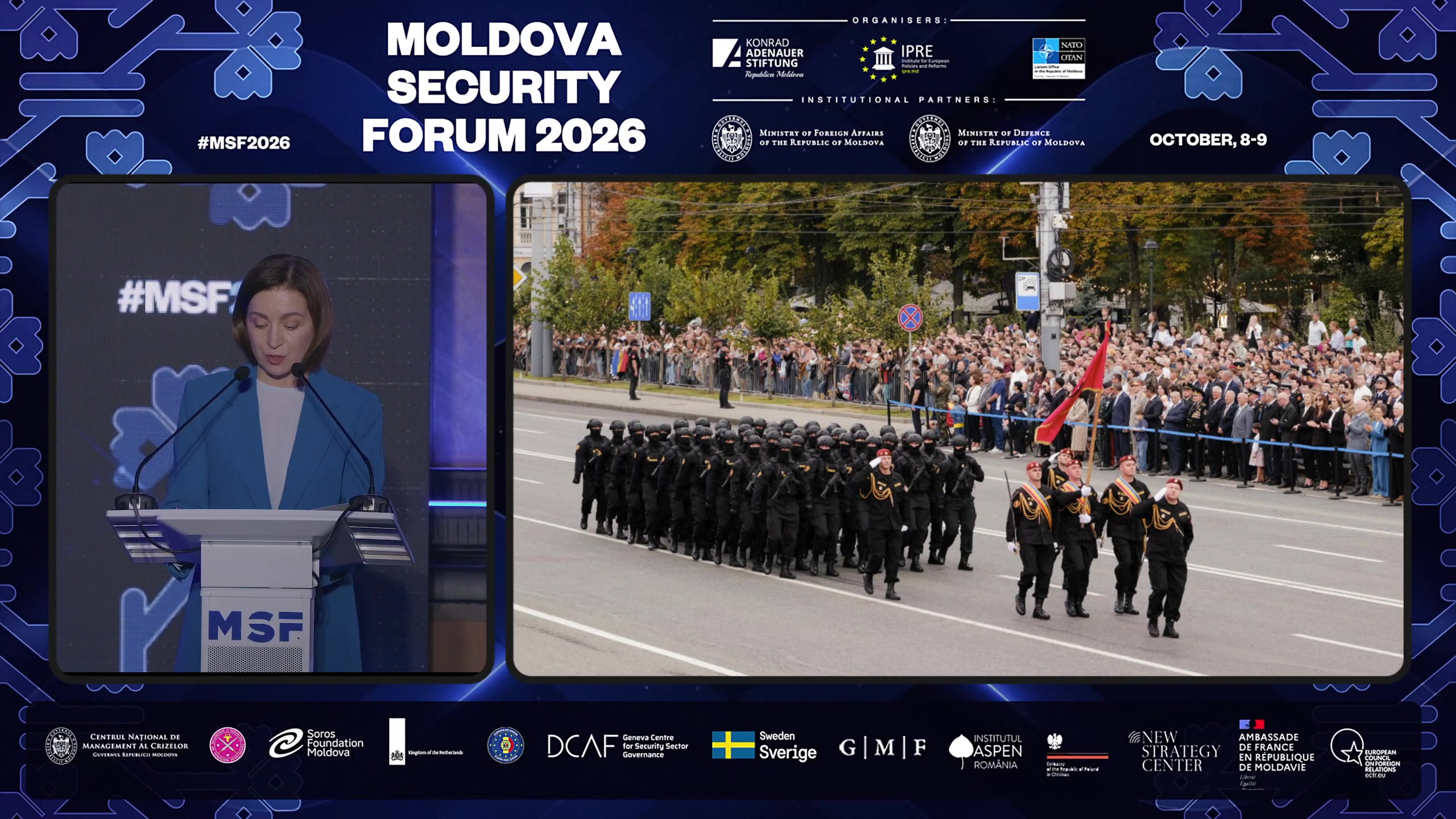
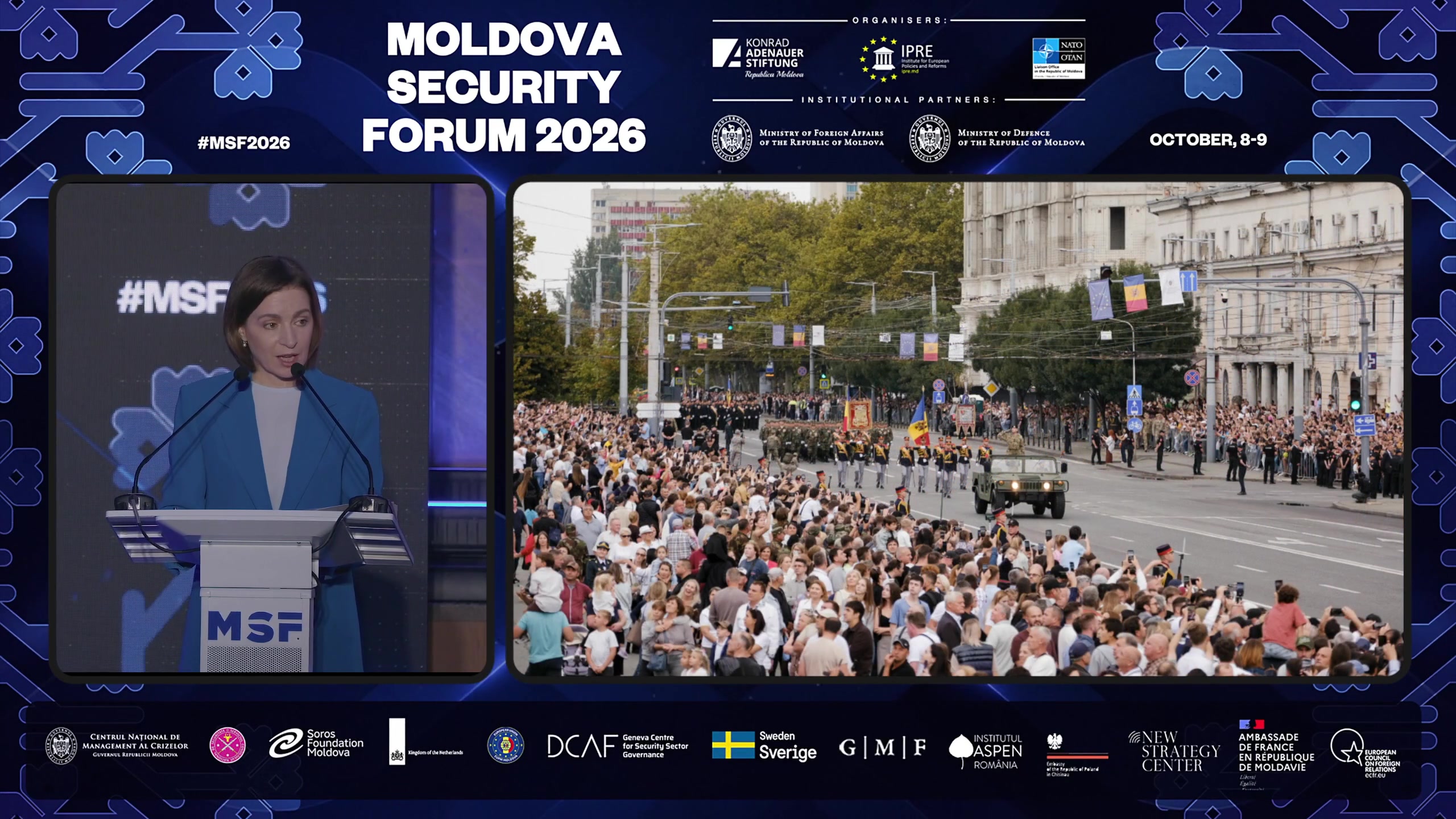
Cross-border crime grows in wartime and Russia uses it for intelligence and sabotage. So our border is a filter for Europe and we keep it tight. With the support of our partners, we have begun a modernization of our security and defense sector. We showed the results on the 35th Independence Day when more than 2,000 men and women in uniform marched on our largest parade in years.
Not only the national army, but police, intelligence officers, firefighters, prison guards, and the state guard, because security is the work of the whole sector. We wanted our citizens to see what their investment and our partner's support had bought, and we wanted our partners to see too. Flag groups from Romania, Ukraine, Germany, Lithuania, Italy, Poland, France, the Czech Republic, and the United States marched with us.
Modern equipment means we can act together with friends and partners. Our biggest priority now is air defense. Since 2021, the European Peace Facility has been the backbone of these efforts, and Moldova is the second largest beneficiary after Ukraine. We are very grateful for this support. We also see the limits.
Innovation cycles for drones and counter-drone systems are now measured in months, and offensive technology moves faster than the defenses against it. Much of what we need is simply not on the shelf. When it is, every country in Europe is queuing for it, and a small customer rarely stands at the front. Procurement rules written for peacetime take time, and time is what the drones do not give us.
Artificial intelligence changes the whole picture at once: information manipulation, cyber attacks, and the drones themselves. Keeping pace requires common rules, joint projects, and pulled resources. For Moldova, membership of the European Union is the natural platform for all three. A stronger Moldova gives back on our border with Ukraine, on the eastern flank of the European NATO, of the European Union and NATO, and well beyond.
Our forces have served in Kosovo since 2014, over 25 rotations, and since 2024, our carabinieri have served alongside them. We joined the peacekeeping mission in Lebanon in 2022 and the mission in Bosnia and Herzegovina in 2024. Moldovan officers have served in European Union missions from Mali to Somalia. For armed forces of around 6,000 people, this is a sustained national effort.
And for four summers in a row, Moldovan firefighters have gone to Greece to fight wildfires. Distinguished audience, ultimately, our resilience rests on people and on their confidence that all this effort, despite the security threats, despite very high energy prices, despite an economy strained by the war next door, leads to membership of the European Union.
We are doing our part. We voted for Europe twice under the heaviest pressure this country has known. We carry the energy shock and we keep building the institutions that will take us into the European Union. We went from full dependence on Russian gas to zero. We are reforming at speed and meeting every condition on merit.
Progress at home must be matched by progress in the accession process. Uncertainty is the opening our adversaries look for. In many areas of security, Moldova already acts as a member state. A Moldova inside the Union will further strengthen Europe's eastern border and secure Ukraine's southwestern flank.
A Moldova left in a gray zone gives Russia a permanent lever against us. Russia has tested our resilience in elections. It keeps testing us with drones, missiles, and lies. Each time, Moldova has held. And many of you in this room helped us.
But a small country on the edge of Europe can only hold the line for so long without the protection of a larger family. Moldova is a security provider today. Inside the European family, we will be a stronger one. Thank you for your interest and for your support.
Thank you. Thank you, Madam President, for the overview and having a better understanding of the challenges that Republic of Moldova faces in terms of ensuring our security and defense, but most importantly, the efforts that the state is making to ensure the prosperity and also the peace in our country.
Right now, it is my honor to welcome for a fireside chat to discuss about the security of Republic of Moldova and the vision. And it is my honor to introduce to you the moderator of the session, Alec Russell, who is the foreign editor of Financial Times. And also, it is my honor to welcome you back, Madam President, for this discussion.
[Alec Russell]
Mulțumim, doamna președinte. Mă bucur foarte mult să revin în Moldova, dar cred că e mult mai bine pentru dumneavoastră și pentru tuturor că acum noi vorbim pe englezește.
So, Madam President, you you rather you rather brilliantly preempted me by answering all the questions I had in your in your in your speech. So, thank you thank you for that. I want I I want of course to start with the war. Uh I I have actually, by chance, just returned from five days in Odessa.
And uh I I came back feeling very uh somber about the situation. Uh the ports, as you know, are closed, there are mounds of grain piling up that can't go anywhere. Uh the infrastructure is being hit night after night after after night. Um you you talked about your your fears for the coming winter. I wonder if you could start by um talking a little bit more broadly about how you see the state of the war at the moment.
[Maia Sandu]
Well, that's a very difficult question. We do see that the attacks on Ukraine and especially on some of the cities, important cities, Odesa, Kyiv, and others are intensifying. We do see that things are becoming much more difficult for the civilians. We know that on the frontline, Ukraine is doing better and probably also because of that, Russia is attacking so much the cities.
We know that Ukraine has the problem with the export of grains and not only, the economic sector of Ukraine has been damaged and Russia continues to to damage important sectors of Ukraine. So, the situation is very complicated and this just means that more support should come for Ukraine, more financial support because when the economy is being damaged to such an extent, it means that they need more financial support. And of course, we're very grateful to all the countries which have the resources and which are helping financially Ukraine. Um it's also about helping Ukraine to export and I've mentioned it that even though our capacities are small because we are a small country, but we have opened the roads and the railroads for the Ukrainian grains to go through Moldova, but the problem is again that there is that much that we can help with. We are very concerned and winter is coming and we know that Russia is trying to destroy Ukraine's energy sector and of course, all this put together present a very gloomy picture.
[Alec Russell]
Do you think there's a slight danger of of complacency in the West? You you speak to your fellow uh uh Western leaders, fellow European leaders a lot about the situation in your own country, but also in the environment. Is there a slight risk that that that there's a feeling um in my country and other countries, well, good old Ukraine, it's it's it's been fighting so valiantly for nearly five years and on it goes and we'll give them some weapons and and a bit of financial support and and so far, so sort of okay.
[Maia Sandu]
Well, actually I believe that most of the leaders do understand the situation and they do understand how complicated it is. At the same time, I do believe that there are still leaders who see escalation as problematic. And my own opinion is that the fact, I mean, that this probably was a mistake even at the beginning of the war, the fear of escalation from some leaders did not allow for the support for Ukraine to be more significant at the beginning. And I do believe that it would have been easier to stop the war in the first several years because now the Russian economy has been militarized, the innovations and of course Ukraine has been very innovative, but we have to recognize that some innovation is also taking place on the part of the Russia. And and all this complicates things and makes it more costly first of all in terms of the human lives, but also financial costs for the West. So the bigger the support now, the better for everyone.
[Alec Russell]
And and and what impact is that having on public support in your own country?
[Maia Sandu]
I've mentioned several examples, every time a drone violates our space, Russia is trying to turn it around through the thousands of Telegram channels and not only saying that this is because Moldova is a good friend of Ukraine, this is because Moldova is trying to improve its defense. Russia would like us to be helpless and you know, be totally dependent on them. They liked it when we were totally dependent on their energy and now, of course they're trying different ways to to have Moldovan fear Russia and and to have Moldova depend on Russia. We know that Russia cannot provide security, we know that Russia does not respect the internationally recognized borders, we know that Russia does not respect our neutrality because Russia has been keeping its forces on our territory against the will of the Moldovan people for many decades now.
[Alec Russell]
The the the other Russian sort of incursion or threat that you talked about powerfully from the podium is of course the hybrid threats to your democracy. About a year ago, uh I was actually speaking to I was interviewing your neighboring president, Klaus Iohannis in Romania and getting his opinion on on the elections that had just happened that led to his election as president. And and and he said that he'd concluded that that um uh that European governments uh had just not come to terms with the power of social media in um projecting false narratives and so on. And that that troubled him hugely. You've been dealing with this or confronting it for quite a long time. And I wonder what lessons you have learned about dealing with social media and and its powerful foghorn effect. What lessons possibly for other countries in Europe?
[Maia Sandu]
Well, first of all, we believe in exposure. Uh we worked uh in the government but also we had the free media exposing how Russia was hiring people in Moldova, training them, how to create this network of false information in the social media. And uh of course it takes time to prove the link uh between these non-authentic accounts or sometime even you know, accounts which are of real people but these real people are being paid by Russia. So it's um it's exposure, it's uh being aware of that but things get more and more complicated for us. It was a whole of society approach, it was a whole of government approach. The dialogue with the representatives of these companies owning the social media is not going very well I have to say. And uh for a small country like Moldova it's very difficult to impose any rules. Um we do hope that EU will be more successful in imposing some rules on social media. But we what we have seen is that it gets more and more complicated, more and more sophisticated because of the AI. So now it's much easier for those who are trying to manipulate people's minds here in Moldova to produce content, to distribute this content. So if you ask me what's the biggest danger to Moldova's next elections from this entire list that I mentioned and some of them I didn't mention because I didn't have time, it is the cognitive war. Uh of course cyber attacks are problematic, dirty money, attempts to buy politicians are high risks, but the biggest risk for Moldova and for all the other democracies is going to be cognitive war. Because it does become more subtle as I said, it's not going to be that obvious, it's not about, you know, praising Russia or the war, but it can make people trust less their institutions, trust less their democratic processes and even undermine trust within society. So I'm afraid I don't have very good or efficient uh solutions. We need to work together, we need to have this dialogue with the social media owners. Uh these non-authentic accounts have nothing to do with the freedom of speech and and they should not be allowed to continue as it happens today.
[Alec Russell]
Yes, well, thank you for that slightly sobering uh sobering response. Um you have been consistent uh in recent years in arguing that uh the best way for Moldova to guarantee its stability, security and to safeguard its democracy is ultimately to join the European Union. Uh and you have staked your own political position on on on that. Uh what's your current time frame, do you think? Your current viable time frame for this?
[Maia Sandu]
So our commitment to the Moldovans is to uh bring Moldova, I mean it's to finish all the work by 2028 for the signing of the treaty. So and we're working very hard uh to fulfill our part and we do hope that the EU institutions and the EU member states will also keep the pace with us. And uh again, the second commitment on this timetable is to have the country ready for accession by the end of this decade, 2030.
[Alec Russell]
So, given that time frame, uh how worried are you about uh the um French election next year which um uh, you know, there's obviously a sort of the idea now gathering momentum that that Marine Le Pen could win the election uh and that would dramatically change one would think the French government's approach towards Moldova's accession.
[Maia Sandu]
Well, there are several elections next year and there will be elections in other countries in 2028. So, you know, it's not just one country and one election. Uh on one hand, of course, we need to prove that our institutions are ready and our society is ready. On the other hand, we'll continue the dialogue uh with our partners and potential partners because I do believe that no one benefits from having gray zones here in our region and on the continent. I just tried to explain how much more difficult it would be for everyone uh if Russia would control Moldova and use it against Ukraine first of all, but also against the EU. So, you know, for security purposes, it is uh much better for the democracies on this continent and for the EU to make sure that there are no such gray zones and that these gray zones do not end up uh in the hands of Moscow and and be used against uh the democracies on the continent.
[Alec Russell]
There is another idea out there for how to secure Moldova's stability and and um keep it absolutely tethered to Europe and that is something that you yourself have have floated uh uh the idea of unification with with Romania. I mean, you said that if there were a referendum on that, uh you would vote yes. I just wonder if you could say how seriously is this idea being considered in Moldova?
[Maia Sandu]
I do believe that Moldova would be safer uh with Romania. And uh this discussion has started since day one of Moldova's independence because those who know our history and know what happened with Ribbentrop-Molotov Pact and so on, understand why we have this discussion. Uh there is a pretty big part of the society which supports this uh project for different reasons, some of them for identity reasons, some for economic, security reasons. Um so we have been having this discussion all this time since independence but now since the security threats are growing and they are so big, of course you have more people discussing it. You do need to have a majority of Moldovans who would vote for that. According to the polls, there is not such a majority today, uh but there is a majority for the EU integration and we do believe that even though EU is not a defense uh union, it would still make Moldova safer than today. And that's why we are pursuing the EU integration plan.
[Alec Russell]
And and just one one more on on the Romania unification idea. I mean, have there actually been informal discussions with with Romania about this?
[Maia Sandu]
Well, I don't know what you mean informal discussions. For instance, uh on the anniversary of 100 years since unification, the Romanian Parliament even approved the decision in their parliament. So different political parties in different times have had different discussions. But again, the major point here is that this is the decision of the majority of people and we do respect the majority.
[Alec Russell]
Romania is in in the midst of quite a a political upheaval at the moment trying to find a new government. How is the crisis there, the political crisis there affecting Moldova?
[Maia Sandu]
Romania is very important to us. Romania has been helping us again and again, especially during difficult times, but we also have significant projects with Romania on interconnecting our energy sector. I mean, like the diversification that we are implementing today, the energy diversification that we're implementing today, these are electricity lines which go to Romania. So we have very important economic relations. Moldova's biggest export or the biggest import from Moldova is Romania. So everything that happens in Romania affects us. We do have good cooperation with most of the political parties there. Of course, there are political parties which are against EU and these political parties do create some risks for Moldova's EU integration, but with with an important number of political parties, Moldova has good relations and this is helpful and we hope to preserve this relationship.
[Alec Russell]
Of course, the party that is highest in the opinion polls is AUR, which is an anti-EU party. How how would an AUR government affect Moldova?
[Maia Sandu]
Well, they say that they will not support Moldova, and yes, they I don't know what would be if they come to power, I don't know what would be their position on Moldova's EU integration. As of now, Romania is one of the most important advocates for Moldova's EU integration. If AUR would come to power, probably the situation would change.
[Alec Russell]
Well, what just just looking at Moldova's place in the world more more broadly, um one of the sort of great geopolitical themes of our time is is this idea that that that there's a sort of different world order emerging now that after, you know, three plus decades of an American-led world order that we're moving into a different uh a different era. And uh one of the one of the theories that is often sort of discussed is that for for uh countries that are not great powers, uh uh they have to it's it's a it's a tougher time now trying to work out how to navigate uh their course. What what's your um observation on this world world order? How difficult is it to navigate? What have you learned about navigating in in a new world order?
[Maia Sandu]
Well, it is true that the world is becoming less safe, especially for small countries. I do believe that even middle size countries might face issues, but uh for small countries definitely, the world is becoming less safe, especially in our region given Russia's uh aggressiveness. Um so that's why we are so determined and that's why we're working so hard to become part of the family because we believe that uh only having the chance to be part of EU, we can survive as a sovereign and as a democratic country.
[Alec Russell]
The the the only other time I've interviewed you, Madam President, uh was about three years ago and you said you said the the the following, um sometimes the situation looks hopeless and I just say I just say to your colleagues I think, I just say, there will always be an opportunity, you just need to be ready for it. Is is is do you still believe in that?
[Maia Sandu]
I have to. Um, yes, there are days when things look really bad and but then we look uh towards Kiev and towards Ukraine and we say that we have no right to feel tired or overwhelmed because nothing of what we face compares to what people in Ukraine face these days. So we just need to resist for our own sake, for the sake of Ukraine, for the sake of democracy and peace in the region.
[Alec Russell]
Well, thank you very much. On on that note, I think we should end. I was given very clear instructions that the most important thing about the Moldova Security Forum is to be on time and we are on time as you always are. Thank you very much.
[Maia Sandu]
Thank you.
[Moderator]
Thank you very much, Madam President. Thank you Alec Russell for this impressive discussion and fireside chat at Moldova Security Forum. Right now, it comes a very special time when we are making memories for life, so it's time for a family photo. For that, I kindly will ask you to please stand up and we will make a photo here from this room. The photographers will be on stage and shortly after, we will resume with the second panel. Thank you.