[Victoria Bucătaru]
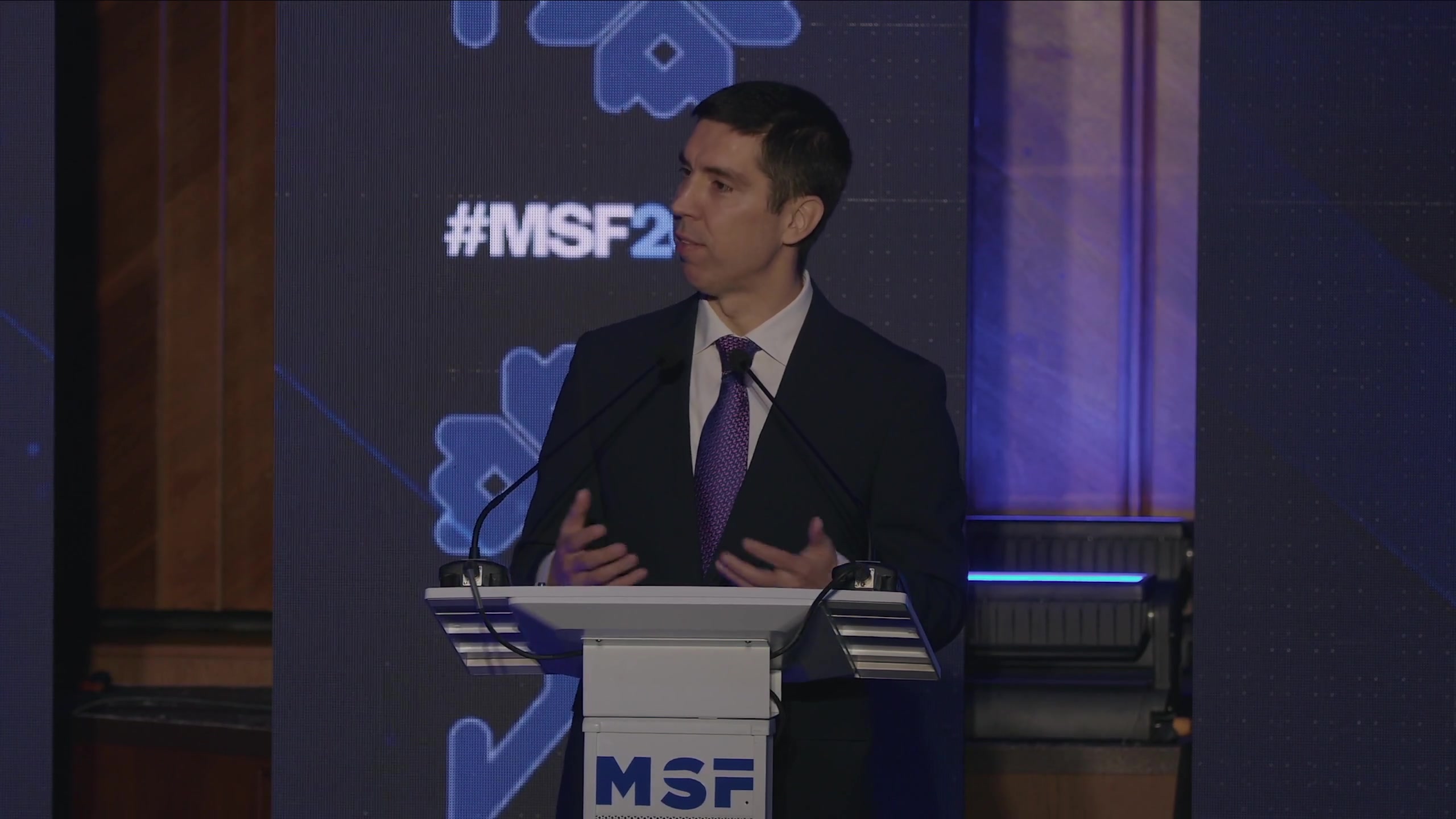
New Frontlines: How Moldova's Partnership Strengthened Resilience and Security. And it is my honor to introduce here on stage with a keynote address Mr. Mihai Popșoi, Deputy Prime Minister, Minister of Foreign Affairs of the Republic of Moldova. Mr. Mihai Popșoi, please. Thank you.
[Mihai Popșoi]
Dear friends, welcome to the third Moldova Security Forum. And it is a great pleasure to welcome a larger number of guests than last year. This seems to be a strong correlation between the scale of this forum and Moldova's defense capabilities. And if we look deep down, probably there is even some causation in there.
The Republic of Moldova has been going through difficult times. But it is thanks to the unity and solidarity of the Moldovan people and the support of our friends and partners that Moldova is stronger and more resilient today than just a few years ago.
It has become a cliché that security is indivisible. But it is Moldova's daily reality. What happens in Ukraine on the frontline increasingly affects Moldova.
What happens in Moldova and in the broader region, in the Black Sea region, directly affects Europe. And when it comes to the global food security, the Black Sea region is fundamental in maintaining global stability.
So, it has been no secret that our airspace has been violated increasingly often in the last few months. But at the same time, we are making sure that we are growing our capabilities to be able to defend our airspace.
But it is in the non-kinetic domain, in the hybrid operations, that Moldova has faced the largest challenges, but it is also the domain where Moldova has achieved the biggest success. In the last almost five years now, Moldova has been at the forefront of the Kremlin's hybrid operations.
Information warfare, cyber operations, attempts to sabotage and hijack our democratic political system, and they failed time and time again. We are now in a position, in a much more rewarding position to start to give back. The lessons learned that we gather here in Moldova, we are sharing with our partners.
And this cooperation and this success would not have been possible first and foremost without the support of the European Union and the member states. The Republic of Moldova is the first country to have signed a defense and security agreement with the European Union. After Moldova signed such an agreement, many other countries have followed, including Norway, Japan, Australia.
Moldova doesn't get to be ahead of Japan very often. But there are at least two things that we are ahead of Japan. The security and defense agreement that we signed first with the European Union, and the human grapevine that we had been homologated by the Guinness World Record book over the weekend on the Moldovan wine festival.
And Moldova continues to double down when it comes to our security. The European Partnership Mission in Moldova has been a resounding success. The civilian defense consolidation that we've seen when it comes to the strategic communication center that is now functioning well as a forefront at defending Moldova against the cognitive war that the president was mentioning.
The cyber capabilities that Moldova has gained also thanks to the cooperation and coordination with the UPM mission. And given this success, we should look at ways to widen and deepen the success of the UPM mission in Moldova.
At the same time, the European Peace Facility has been truly transformational for our defense capabilities. Only this year, 120 million euros for a mid-range air defense system will hopefully acquire in the years to come because it's not available ready on the shelf to to pick.
Moldova's investment in defense and security are front and center of our political agenda. And yes, there are attempts to interfere to undermine these efforts. But we are proud that the worst efforts of the Kremlin have not been able to deter us from the determined course that we've set for ourselves to take our defense seriously, like any sovereign country should.
The defense when we talk about our airspace, but also energy security. The support that we receive from our partners, including the United States, 130 million dollars for a high-voltage line that will put Moldova in a position to be a reliable partner for American and European investments in the energy security of the region. That Moldova will be a stable transit country going forward, which will increase security overall.
Our cooperation with the North Atlantic Alliance is also increasingly more robust. We are working to consolidate our defense capabilities, particularly when it comes to cyber domain, when it comes to combating FIMI, and we'll continue to work closely with our North Atlantic partners because security is indeed indivisible.
We will work hard also bilaterally. And here I'd like to thank all of our partners in the Euro-Atlantic community and beyond who have stood by Moldova. Because without the support of our friends and partners, we would not have been been able to remain the strong reliable partner to all of you, and first and foremost to Ukraine.
Moldova has welcomed the largest number of refugees per capita. About 5% of Moldova's population in this almost five years have been Ukrainian refugees. To put that in the context of the European Union, that is more than an entire Romania. Or to put that in the context of the United States, that's an entire state of Pennsylvania.
And the thing that we are most proud of is that Russian propaganda has not been able to divide us. Not able to build a wedge between us and our Ukrainian friends who have seeked refuge in the Republic of Moldova. We'll continue to work hard and double down on this effort.
Because the reforms that we are implementing are key to Moldova's future. We are implementing European reforms for EU accession like our future depends on it, because it does. Over the summer, we have worked overtime and in overdrive to make sure that we deliver on the commitments that we've made to our citizens first and foremost, and to our friends in Brussels and in member states.
And if only a while ago, our friends in the European Commission were telling us to hurry up and and and deliver on the benchmarks, it is now that we are telling our friends in Brussels that they would need to speed up the process to provide us feedback on the legislation that we've provided to them. So, Moldova is more resilient and stronger than just a few years ago thanks to the unity and solidarity of Moldovan institutions and Moldovan citizens alike.
Because Moldova's resilience is truly a team effort. An effort of Moldovan civil society, independent journalists, NGOs, trade unions, working hand-in-hand with the government and our international partners to keep Moldova standing tall, resilient, and democratic. And for that, I'd like to thank all of you. Thank you.
[Victoria Bucătaru]
Thank you very much, Minister Popșoi, for your wonderful speech. But also, I have to say thank you from the organizers of the Moldova Security Forum to the Ministry of Foreign Affairs of the Republic of Moldova, but also to the Ministry of Defense of the Republic of Moldova because you are institutional partners and also co-organizers of Moldova Security Forum. So thank you for the effort to make Moldova Security Forum possible.
And right now, it is my honor to introduce to you the ambassador of the United States of America in the Republic of Moldova, Mr. Joseph Mark Burkhalter. And also, welcome to Chișinău, and I hope you will have a great mandate here in the Republic of Moldova. Welcome. And please, we are waiting for your keynote address.
[Joseph Mark Burkhalter]
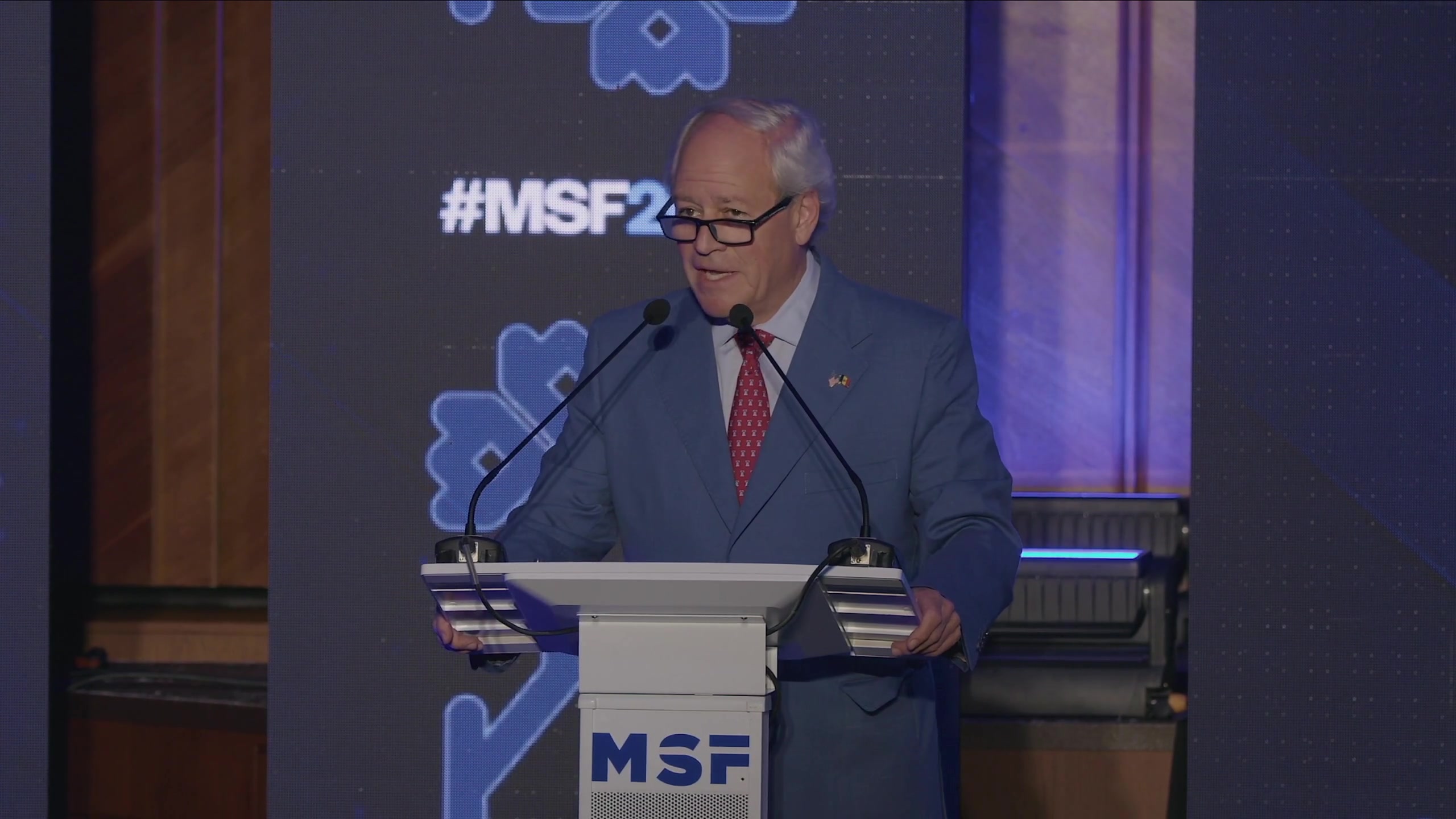
Well, thank you for the introduction. Good morning to everybody. Distinguished guests, colleagues, ladies and gentlemen. It's truly an honor to be here before you today at this security forum and share a few words with you.
Having been here as US ambassador for only a couple of weeks, it doesn't take long to realize how central security is to everything you're working to accomplish. Spikes in unauthorized drones, cyber attacks, attempts at election interference, all of these are unacceptable to any nation, and they're also unacceptable to the United States.
And let me be abundantly clear on behalf of the United States. The United States supports Moldova's democracy, their independence, and its territorial sovereignty. And let me tell you how we define territorial sovereignty, as I know Moldova does as well. It's not just your land, but it's everything above your land in your airspace. And we take that very seriously.
Since Moldova's independence, the United States has proudly supported our resilient friend with billions of dollars in defense and institution building, cyber security, energy security, border security, critical infrastructure, and recently with the Trump Liberty Line to assist with energy independence. And why do we do this?
Because this is an important country. It's in a very important place in the world, and it's also at a very important time in the history of the world. Some in this world, unfortunately, run from their friends when they have challenges or have needs.
But I will tell you one thing, the United States runs towards our friends when they have challenges and needs. And I want to be also abundantly clear in speaking on behalf of the President of the United States. He wants this war next door to end.
And I think you've seen recently some concerted, visible efforts with our special envoys and others to bring this sad phase in history to an end. And also with the First Lady, Melania Trump, and her efforts recently have ramped up, if you've noticed, to to work seriously on the a project of hers that's dear to her heart that deals with the children of the war and many of the lost children of the war. And it's no coincidence that all this is happening very recently.
Some said the United States forgot Moldova and because we didn't have an ambassador here for two and a half years. Well, let me tell you, we did have a Chargé d'Affaires who may have been one of the most talented Chargé d'Affaires in US diplomatic history, in my estimation. He's done a great job.
But there's also a subliminal or an overt message that you can take, and I think you ought to take it in in in in a more overt way, that President Trump chose a political ambassador for the first time in the history of our relationship since your independence.
I will tell you this, it's also very encouraging to see many of the European allies step up and also run towards their friend in Moldova in so many ways so recently. Let's continue this while we're at it, to continue to collaborate with airspace awareness, crisis response, regional information sharing, and coordination amongst civilian and defense institutions.
And only then can we ensure that our adversaries, and we know who our adversaries are, by the way, only then can we ensure that our adversaries won't grow even more aggressive. And on the note of the adversaries, we know who they are. They know who they are, but even better, they know that we know who they are.
And in closing, yesterday, Secretary of State Marco Rubio in Athens, Greece, I thought spoke some profound words talking about the West and our survival long-term and working together. And he said, and I'm going to paraphrase a little bit, but quote, and now today we find ourselves at a crossroads. The decisions that we make today will define the next decade. Let's keep collaborating and make those decisions. Thank you very much for everybody being here, and thank you for your time today.
[Victoria Bucătaru]
Ambassador, thank you very much for your welcome speech, and we are delighted to to have you here at Moldova Security Forum. And also, delighted to have you here at your first security forum in Chișinău in the Republic of Moldova. Right now, we will continue with our plenary session, the number one, focusing on the new frontlines and how Moldova can strengthen resilience through partnership and also through multilateral cooperation.
It is also my honor to introduce to you the moderator of this session, the wonderful Terry Schultz. Terry, it's it's great to have you here with us at the third edition of Moldova Security Forum. Terry is a freelance reporter, and we are very much looking forward to your session to understand better the importance of partnerships and resilience in Moldova, but also in our wider region.
[Terry Schultz]
There we go. Sorry. Okay, now I have to be wonderful. I'm a little nervous. Thank you very much, Sanda. As she said, I cover NATO and the European Union from Brussels, and therefore, as everyone in this room knows, I increasingly, like all other journalists in Brussels, cover Moldova because you are at the top of the agenda ever more frequently. I'm really privileged to be here. I've been trying to come for a couple of years, as the organizers know, so thank you for having me. And I think we've all been quite inspired by the speech of the president this morning to continue on the conversations at the same high level of information and just a situational awareness that we've already started with today.
I would like to already call up my panel, and we will get started on our conversation. First of all, Alexandra Mischenko, he is the Deputy Minister of Foreign Affairs of Ukraine. Come up, thank you. Kevin Hamilton, the Deputy Assistant Secretary General for Partnerships at NATO. Thank you, Kevin. Dorota Dłuchi-Suliga, she is, this is a very long title, worthy of a European Union official here. She is Head of the Division of the European Peace Facility, which we've already heard mentioned a couple of times this morning, and also Deputy to the Director for Peace, Partnerships and Crisis Management at the European External Action Service.
And we and we have someone everyone will know in this room, the former Prime Minister Dorin Recean. He is now the special envoy of President Sandu for development and resilience. And thank you. And András Rácz, he is the Deputy Director General for Research and Scientific Affairs at the Hungarian Institute of International Affairs. So, thank you everyone for joining us. I will sit here.
So, the title of this panel is quite interesting. We are not talking about just how partnerships make Moldova more resilient and secure. We are also talking about how Moldova makes those partnerships more resilient and secure. And I think that that's been a theme that we've heard in all of the speakers so far today, that Moldova is very much a security provider as well as a country in need of security from its friends and partners. And and when you speak about frontlines, of course, Moldova feels its closeness to the front line of Russia's full-scale war on Ukraine ever more increasingly. But of course, also, as the President said, Moldova does not suffer yet the same consequences as they see next door.
So, we're going to start with the Deputy Minister. Ukraine and Moldova share a border, they share the same aggressor. Mr. Minister, and strong ties to partners are important for both countries to survive. So we'd like to just welcome you. Thank you so much for coming when you have so many busy things to do at home, but bring us a snapshot now from Ukraine. What are the most urgent steps that need to be taken for your country, and how do you see this as also keeping Moldova more resilient and secure at the same time?
[Oleksandr Mischenko]
Yeah, thank you. Dear participants, dear ladies and gentlemen, friends and colleagues. It's a great pleasure to be back in Chișinău and to participate once again in Moldova Security Forum. Let me begin by thanking Deputy Prime Minister and Minister of Foreign Affairs, Mihai Popșoi, for the invitation, as well as our Moldovan friends and all organizers for bringing us together at this important moment for the security of our region. I would also like to express Ukraine's sincere gratitude to the Republic of Moldova and the Moldovan people for your continued support of Ukraine.
I take this opportunity to convey our deep appreciation to all of Ukraine's international partners for their steadfast and unwavering support. This solidarity has been and remains one of the decisive factors enabling Ukraine to defend its independence and protect the security of the wider European community. Looking at the situation today, I would like to highlight three fundamental factors that have enabled Ukraine to withstand the Russian aggression and continue its struggle for freedom and independence.
First, the heroism and professionalism of Ukrainian armed forces. Second, the resilience of the Ukrainian people. Third, the unwavering international support for Ukraine. These three factors are deeply interconnected. If even one of them is seriously weakened, the entire security architecture on which Ukraine's ability to resist depends is put at risk.
This is why, dear friend, I would like to use this opportunity to emphasize just how important your continued support is for the first two factors. This support is particularly important as we approach another winter. President Putin has tried rapidly to use the winter period as an opportunity to undermine Ukraine's resilience and force our society to accept conditions dictated by Moscow.
Let me state this clearly and with full responsibility. There will be no capitulation. Ukraine will continue to defend itself. We will continue to fight for our freedom, our sovereignty, and our right to exist as a free European nation. But the level and timeliness of international support can make a profound difference, first and foremost by reducing the number of Ukrainian lives lost, both on the battlefield and in our cities and towns that remain under constant missile and drone attacks.
There and there is another important dimension. The unity of the international community will be one of the decisive factors in convincing Putin that continuing this war will not bring Russia closer to achieving any of its objectives, but will only result in more people being killed and more suffering being inflicted. This raises a fundamental question. What is the purpose of continuing this war?
At a time when Putin is trying to undermine our unity, we must demonstrate it precisely the opposite, that the international community will not abandon Ukraine, will not accept aggression as a new normal, and will not allow the security of Europe to be determined by force. This unity is not simply an expression of solidarity with Ukraine. It is a deterrent.
Thanks to international supports, Ukraine has also significantly expanded and modernized its defense production, particularly in drone capabilities. We have already seen how this can happen in the battlefield. For almost last two years, the front line has remained remarkably stable. Despite Russia's enormous military efforts and the resources it has committed to its offensive operation, one of the major reasons for this has been the rapid development and effective use of Ukrainian drones.
But we now need to apply the same logic to the protection of our cities and our people. We must build the capabilities necessary to prevent Russia from believing that it can continue its campaign of terror. My participation here is above all an opportunity to convey one simple message. Ukraine must Ukraine must be seen as a fortress of our common defense against a common threat.
Ukraine is part of this European security community, and by defending itself, it is also defending the security of Europe. If this understanding is shared across our capitals, and here in Chișinău, London, Paris, Rome, Madrid, Berlin, as well as Washington, then our strategic position becomes fundamentally stronger. Our common task is to ensure that the unity of the international community is confronting Russian aggression does not weaken.
We must remain united and determined until the rule of law prevails over the law of force, and until an international order is restored in which the sovereignty and territorial integrity of every nation are respected as fundamental principles of global peace and security. Once again, let me thank our Moldovan friends, our international partners, and all of you for your steadfast and tireless support for Ukraine. Together we will win. Thank you very much.
[Terry Schultz]
Thank you. Thank you very much, Deputy Foreign Minister. Now, Kevin Hamilton, speaking there from from NATO headquarters, this very unpredictable security environment must change how you deal with partners. I mean, there's some of the countries you're working with have a very practical situation that they are dealing with here in Moldova, speaking about Ukraine. Now, the the situation is is so interesting. Ukraine wants to become a member of NATO, Moldova does not. And yet these are the partners that you're working with. So, tell us how a constitutionally neutral country works with NATO. They would have to change the constitution to come much closer to the alliance. What do you what do you do with Moldova and and how do they provide security for NATO at the same time?
[Kevin Hamilton]
Thank you, Terry, for the question and and thanks to all of you for for the invitation here. It's it's wonderful to be to be back in Chișinău. Yes, an excellent question. The entire Euro-Atlantic community, whether in NATO or a NATO partner or those who aren't affiliated with NATO, we are all facing the greatest security challenge certainly since the end of the Cold War, perhaps since the end of the Second World War. And Ukraine is clearly on the front line of all of that.
You know, what does that mean for our relationships with partners, including key partners like the Republic of Moldova? Well, first of all, we are changing and we are changing our concept of partnership. We no longer really talk in terms of security consumers and security providers when it comes to our partners. Increasingly, we talk about co-producers of security.
And even as NATO in some senses gets back to its core business of deterrence and defense of Euro-Atlantic space, the so-called NATO 3.0, that might suggest that our partnerships are somehow on the periphery or sort of a boutique idea or a luxury that we don't we can't afford anymore. Actually, the exact opposite is true. Partnerships are no longer at all peripheral to NATO's core business, because in today's day and age, NATO needs a more a diversity of security relationships.
So the old model was largely about NATO projecting stability outward. So helping partners reform and become interoperable and building institutions, that still matters and that work continues. But because today's threats travel in both directions across NATO's borders, so you all know the issues as well as I do, the hybrid activity, cyber disinformation, attacks on critical infrastructure, partnerships are increasingly helping to generate security for allies as well as for themselves.
So that means NATO's partnerships are becoming more demand-driven and strategically differentiated, let's say. So we don't look at our partners strictly through a geographic lens or in terms of flank, Eastern flank, Southern flank and so forth. Nor do we really look at them anymore through the old partnership instruments, so partnership for peace or EAPC, ANPs, this alphabet city of of acronyms.
We start by asking, okay, what is the security problem? And what can a particular partner bring to solving that problem? What vulnerabilities exist and what NATO and that partner can practically do together. So our partnerships are much more tailored in that respect. And the partners are no longer simply recipients of NATO assistance, increasingly, as I say, they are co-producers of of security.
And I think Moldova illustrates that trend line as well or better than any of our partners. Moldova gets it. Moldova gets it that the partnership is a two-way street. It is, of course, exposed to to many of the threats which define today's security environment. And by the way, because you alluded to alluded to Moldova's neutrality, NATO's purpose isn't to dictate Moldova's strategic choices.
Constitutional neutrality is Moldova's decision. But the question is how NATO can help Moldova be more resilient and capable of protecting that sovereign choice of neutrality. And the questions are comes to what NATO and allies can learn from Moldova's experiences on the front line of hybrid pressures. And we are learning a lot. The alliance is learning a lot from Moldova's experiences.
So, for me, this country illustrates the direction in which NATO partnerships need to evolve from something that used to be on sort of the outer edge of our strategic thinking to being core to the alliance's agenda. And we're having Moldova is integral to discussing how we generate security, but how we generate security together, inside the alliance and between the alliance and our partners.
[Terry Schultz]
Do you have the same problem that you don't move fast enough when Moldova wants an answer?
[Kevin Hamilton]
I mean, there are bureaucratic inefficiencies everywhere. But and we do have to adapt very quickly. The president was referring in her fireside chat to the fact that our adversaries are adapting quicker and use of AI and so forth. But we have capabilities as well. And we're getting better and we're getting faster.
[Terry Schultz]
Very good. Thank you, Kevin. Now, moving on now to Dorota. As as we all know who follow the European Union, it is becoming a defense union and that is good news for Moldova, but it also has so many more aspects of integration that Moldova is interested in and moving so quickly to achieve. And in fact, as Dorota will tell us, Moldova was the first country to sign a security and defense partnership with the EU, which is quite remarkable. And it's now the second largest recipient of funds through the European Peace Facility, which I think the president also referred to. So, quite on track, it seems at this point to achieve as the country aspires membership by 2030. And it sounds very much like that's in the EU interest as well, Dorota. Please tell us, what is the EU's interest in bringing Moldova closer? And how, again, as Kevin just referred to, is that a two-way street, good for the EU, good for Moldova? Thank you.
[Dorota Dłuchi-Suliga]
Thank you very much, Terry, and again, thanks to organizers for inviting me. I'm really happy to be at the Moldova Security Forum for the second time and to see how this event has grown over years. It also is testimony of importance of Moldova for the European security. In order to talk about our partnership and Moldova's contribution to European security, I want to go back to Russia's pressures and Russia's tactics because it's important to understand that Russia is constantly increasing pressure.
Pressure is more complex, but everything that they do is not isolated events. It's not isolated items, but it's a part of a broader strategy. The broader strategy that is not only targeted against Moldova, but also against the European Union. The strategy that wants to weaken institutions, democratic institutions, the strategy that wants to undermine public trust and divert Moldova from the European path and EU member states and population in the European Union against the European Union.
What is important is that Russia is testing many of those tactics in Moldova. It was already mentioned. So we learn here about how to respond and we work with Moldova hand in hand. This is why it's so important for us what is happening in Moldova. And this brings me to the European Union response. I think it's rare that we have security forum in any European capital where European Union is mentioned more often than NATO.
Sorry for this, Kevin. But this also shows how important the EU is here. And we are showing that Moldova does not faces those challenges alone. But equally important is Moldovan ownership in our cooperation. So it's Moldova in the lead in identifying challenges, setting priorities, and building capabilities to respond to the threats. This is this cooperation is partnership in real terms of this world. It's not only relationship between a donor and beneficiary.
It was mentioned already by by Deputy Prime Minister that indeed Moldova was the first to sign security and defense partnership. Just in brackets, I was listening to the president and to the Deputy Prime Minister and thinking my speech is being cut now because they used all the examples of the EU support, but it's of course I'm proud that this happened, but but it has also consequences for the speaker. Anyway, what is important is not only that we sign security and defense partnership.
Moldova was first, it shows the importance, but this partnership brings very concrete, real results on the ground. From hybrid threats and cyber where we cooperate with when we have here EU partnership mission on the ground supporting Moldova, to hard security. Because we believe that neutrality is not defenseless. Neutrality does not mean that the country is not prepared to defend itself.
And this is why we support the country with European Peace Facility. As it was already mentioned, this is the second biggest recipient among 27 our beneficiaries and we provided from logistics to air surveillance assets and we are now working on air defense as mentioned already. And we don't work only on on addressing imminent threats, but we are building long-term capacities because we are here not only to help Moldova to withstand the next crisis.
We are here to build long-term institutions and capacities that are able to anticipate future threats, to withstand the pressure and recover quickly. This is a long-term investment because we believe that Moldova will become the European Union member. And finally on on how we learn from Moldova. It was already mentioned. We learn from Moldova how they identified and addressed cyber hybrid threats, but also Moldova contributes to many missions, international missions, crisis management missions.
This all is important for the EU, but Moldova is not only sharing the experience with with us, with the European Union, but also with like-minded partners. And we are extremely grateful that Moldova sees international cooperation as part of its mission. So it's not only targeted towards its own security, it's the security of the European Union and the partners. And I hope that in future Moldova will be also able to do this from within the European Union. Thank you.
[Terry Schultz]
Thank you very much. And and in fact, the EU has moved very, very quickly on on Moldova and on Ukraine. And this has been something that, you know, it's not always given credit for doing, but when it comes to these accession negotiations, the opening the process, it truly has been lightning fast for for the EU. I wanted now to turn to Dorin Recean. So you you are now um responsible for tackling external threats. And I have to say that it was chilling to hear the president describe going into small villages and hearing this these stories that have been planted by adversaries um that the EU is going to take away land, that the EU is going to shut down churches. And I mean, that that really makes you think that memory is short, as she put it out. I mean, who shut down the churches, who took the land? Uh but but to to know that the information threats are trickling down out into the countryside, into the smallest villages is surely a very, very daunting task for you in your in your position and everybody who wants to support a fact-based society. So, I don't know if that's the biggest external threat that you are facing, but it certainly is at the base of a lot of others, isn't it?
[Dorin Recean]
Look, first of all, I very much wish Ukraine is in a much better position. I very much wish there are more resources allocated to Ukraine and I very much wish there is more awareness throughout our societies, not only Moldova, that defense is valuable and that defense should be collective.
[Terry Schultz]
That was supposed to be my next question to you. But but do you want to address the cognitive warfare that that the President was discussing?
[Dorin Recean]
Look, first of all, we we have to name that adversary. And that is Russia. And thanks to Ukraine, and again, we very much appreciate the strength and the will power and the fact that Ukrainians are dying every day for us to be having here such a conference and having the space to move on with the integration and with the with the reforms.
[Terry Schultz]
Can I just say something here, not to be rude, but the reason why I didn't name one country is because we know also from what NATO is doing and the European Union, that there are more than one. You know, it is primarily Russia in this region, but Iran and China are constantly listed as as purveyors of of disinformation, of, you know, purposeful misinformation. It's not just one.
[Dorin Recean]
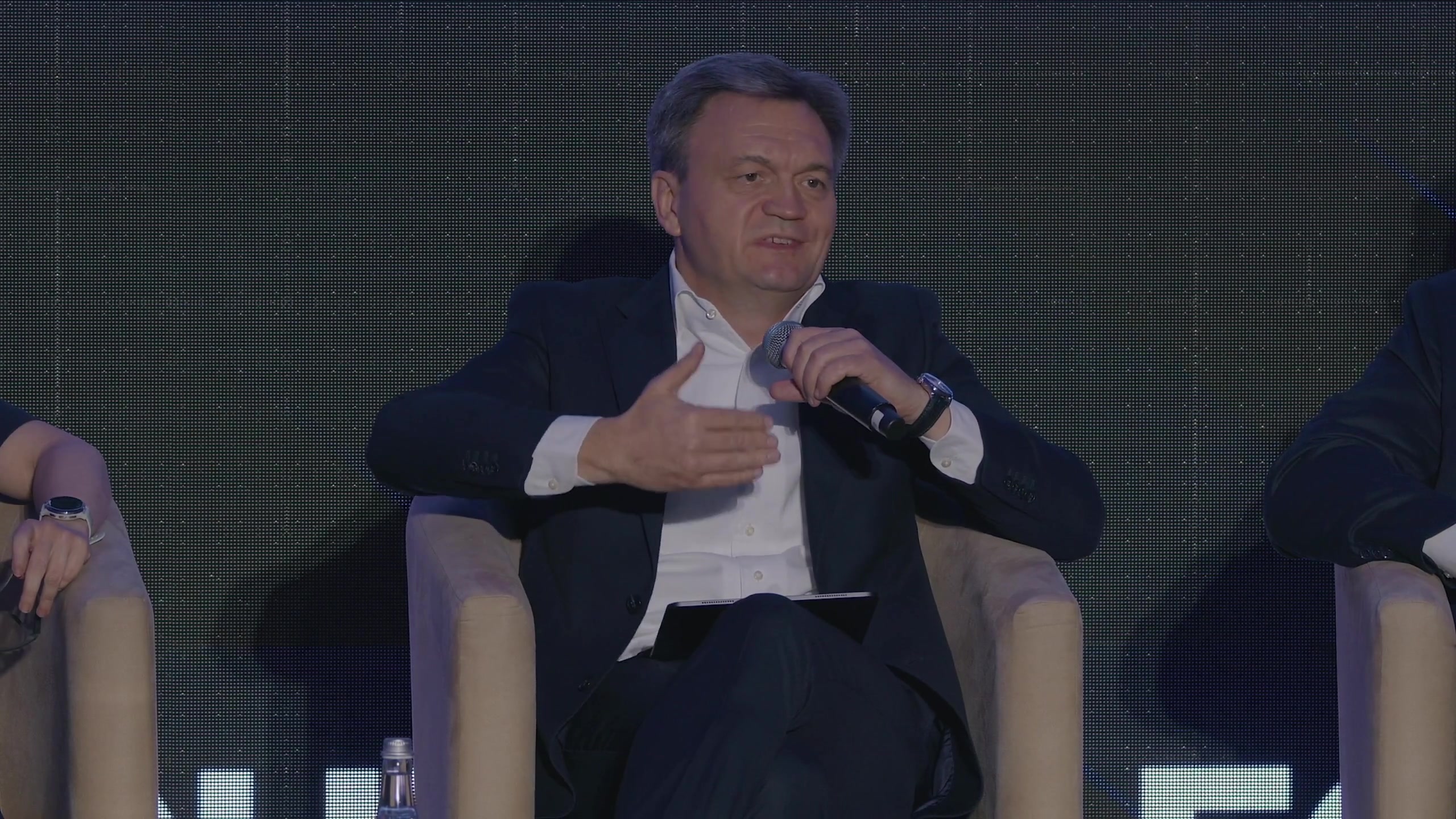
Right. If you look at the larger space, I was meaning in in in specific case of Moldova. Right. So what I mean to say because they couldn't us reach militarily, they tried to to subvert the democratic system in Moldova. And they they tested these instruments to deploy them elsewhere. And then we see them everywhere. So these threats are not only for Moldova that we have faced.
Now, we needed to adapt fast. And we are grateful to the partners that they helped us strengthen our capabilities. And here I would like to emphasize that Moldova never ever asked for our partners, being that EU or NATO or United States, or other friends to fight our fights. We only asked for help to develop our capabilities to fight these hybrid war, but also developing the capabilities to help other countries.
And this is what we have done. We also made it sure that we uh strengthen our capabilities to ensure the regional security. So with all pressure from Russia and challenges, Moldova is still safe having the Transnistrian region. Furthermore, we made sure that Transnistrian region has been devolved from a security threat for the region to capabilities that only can produce some incidents.
So Moldova worked on these capabilities to strengthen the security throughout the the region. And also we made sure that we do maximum possible to help Ukraine with the logistical chains, infrastructure of the road, railroads, the Giurgiulești port. I'd like to to mention one thing at a certain point in time in 2022, more than 25% of the fuel supplied to Ukraine were through Moldova.
It was a very a very important project of ours and Ukraine when we desynchronized from the Russian grid. It was an operation that happened in in a very, very short time back back then. And and obviously, like it has been mentioned today multiple times, we were at this front line of hybrid warfare. And now that we learned these lessons, we are ready to to to share.
I'll give you maybe one example that has not been given here. I remember very well six six weeks into the elections last year, we have learned about the attacks into our electronic systems. So, and in all honesty, some of the partners, our international partners said that, look guys, you have to move the elections. That was the seriousness of the penetration of our our system.
But again, we said, look, there is no option. We have to do it. And together with the partners, again, thank you very much. In two weeks, we made it greenfield. Normally projects that last at least six months to years. So we moved fast. So we all we have this experience and we can contribute and to together with the with the partners to to help others as well.
[Terry Schultz]
Thank you very much. I think it's important to keep pointing that out how much NATO, the EU, your neighbors are learning from the Moldovan experience and the successes that you are having in repelling this kind of effort to disrupt all your democratic processes. Now, Dr. Rácz, you've also watched these Russian operations for years. You're an expert in it. So how would you describe why Moldova is such a target for Russia? Obviously, Transnistria is a pretty interesting piece of property for Moscow, but are they testing Moldova as a piece of the eastern flank or is it really targeted at Moldova for its own for its own value? I mean, why why is so much effort being put into the Kremlin's efforts to destabilize Moldova?
[András Rácz]
Thank you very much for having me here. And I'm in the same shoes like Dorota. I had to cross out half of my speech, which is good because more time remains for the second half. As I'm the only non-official on the stage, I'm the only researcher. I'm really really grateful to this very much relevant question, very much to the point question. Whether Russian strategy is only about Moldova or about larger framework. Colleagues, the answer is both.
If one studies Russian strategic thinking, you realize that individual country strategies are always subordinated to the larger regional objectives, the larger regional strategies. And I'm honored to share the assessment of President Maia Sandu that what Russia has been doing here, it has been primarily right now, since 2022, has been subordinated to the war effort. For the Kremlin, the main priority is the war effort.
All their subversive efforts, hybrid attacks, they serve to the largest purpose of of winning the war in Ukraine according to their own terms. And here, Moldova's contribution to blocking those Russian efforts and to European security, it has been really crucial. And it's part of the game that many of the details will surface only decades from now. Because Moldova played a very, very key role, particularly in the first months of of that war.
And what to expect from Russia? Not only NATO is adaptive, Russians are also adaptive. They have learned a lot from their experience gained in in Ukraine. Regarding the upcoming winter, Russia has studied very much in detail the experiences of the strike campaign against Ukraine's critical infrastructure last winter. They started systematically attacking again with concentrated strike packages the energy infrastructure already two weeks ago.
They have done it in all the previous autumns of the war, but they always started it in the earlier years much later. Now they started attacking the energy infrastructure five weeks earlier than during the previous autumns. Why? Because they want to have the energy infrastructure ruined by the time the real cold arrives. They are using slightly less ballistic missiles than what they are producing.
The difference is something between 15 or 20%. Why? Because they are stockpiling these ballistic missiles for the larger concentrated strike campaigns, likely to start from late October, early November. And they are using a huge number of these jet-powered drones. And right now, in terms of drone warfare, strike drone warfare, they have the upper hand. It's a temporary thing.
Warfare always balances out itself. Ukraine is already working on jet-powered interceptor drones. There are several prototypes already in action. But it will take months to mass produce them. Until then, Russian strike drones will be a lot more dangerous and will inflict a lot more damage than the old style old Geran 2s have done. Russia is also learning the lessons.
So what to expect? Much more intensive and concentrated strike campaigns against the energy infrastructure, including cross-border energy infrastructure. President Sandu already said that Russia attacked border crossing points of Ukraine. These attacks will continue. From their perspective, it's entirely logical. And regarding the upcoming winter, of course, the key variable is the temperature. How hard this winter is going to be.
But if this winter is going to be the similarly hard like the last winter was, it was rightly said before, it's realistic to expect hundreds of thousands, possibly millions of Ukrainian citizens seeking temporary shelter abroad. So more refugees to come because the energy infrastructure is already in a very bad situation and it's going to get a lot worse. To give you numbers, and it's all open source, Ukraine's power generation capability is right now around 13-14 gigawatts.
This is less than one third of the pre-war capacity, and the largest strike campaign hasn't yet started. Russians are learning the lessons, they are adaptive, we really shall not underestimate them, and this increases the importance of our joint efforts together with our Moldovan friends and partners and allies. Thank you.
[Terry Schultz]
Thank you. That's a very very concerning, but does in fact wrap up everything that we've been talking about here. Before I take the privilege of asking another question, we do want to involve our audience. For those joining us online, you can't see but there are something like 700 people in this room. So it's really encouraging to see the interest in the Moldova Security Forum and we do want to involve those of you who are here today. I have other questions but I would like to take one from the audience. Does someone have a question here? I cannot believe it if you don't. Are there any hands? Yes. Take one question here. And also to those of you joining us online, you will see a Slido QR code there on the screen and you can also send in questions from wherever you're watching us. So, sir, please give us a short question because we have many speakers. Tell us who you are directing your question to and no speeches, just a quick question, please. Thank you.
[Nikita Pavlenco]
Thank you so much. And first of all, Slava Ukraini! Mr. Mischenko, and to whom are you, sir? Nikita Pavlenco is my name. So, Mr. Mischenko, I want to address you a question. Uh this panel brings together key European and transatlantic partners alongside Ukrainian and Moldovan leadership. How can our two nations best align their diplomatic efforts in Brussels and allied capitals to secure sustained complementary resilience support that addresses the specific security needs of both Kyiv and Chișinău? Thank you.
[Oleksandr Mischenko]
When we're talking about unity, we all time reiterated that successful story of movement of Moldova to European Union is also our interest. Establishment here European state, freedom and democracy, it's our interest of Ukraine. Presidents of Moldova said just before that Russia dreams about possibility to convert Moldova as pro-Belarusian type prototype of regime.
Why? Because spreading dictatorship regime here in neighboring country with Ukraine, it's part of tactic of Russia how to push Ukraine accept of capitulation. That's why our movement and our cooperation with Moldova towards to European Union is our common interest with our neighboring country. We have good relation, we have good cooperation with Moldova in sphere how together we movement for European Union.
We cooperate, we discuss many issues concerning such and such question concerning implementation of requirement of European Union. That we have good agenda and we implement and we have dialogue, common dialogue for this question. That's why when we consider about role of Moldova, we all time reiterated that NATO status of Moldova is not obstacles of our cooperation. Victory of Ukraine in war with Russia has huge complementary cases.
Logistic, probably there is said that logistic question is very important for us. Energy issue and accepting of Ukrainian refugees and giving them possibility to be in safety situation is also supporting of Ukraine. That's why we collect all of positive thinking, positive attitude concerning how to support Ukraine despite, for example, weapons. We have huge agenda despite weapons with Moldova. And together support each other in moment of European Union, in other questions concerning of our common security issue. Thanks.
[Terry Schultz]
It would be harder to imagine a starker contrast between two countries in the neighborhood between Belarus and Moldova. You could hardly get more different than these two countries. So that was an interesting thing to bring up. Does anyone else on the panel have anything to to add to this question? Otherwise, I will if I see no other hands, I will pick up the last point made by by Dr. Rácz and also by a couple of you. If this does happen, and I believe the president as well, if there is another huge outpouring of citizens from Ukraine because they simply cannot survive with the destruction of the infrastructure there through the winter. Is is Moldova ready? President Sandu said they are welcome. But how are you asking for help? Does the European Union already have a plan in place, Dorota, for how to help Moldova as one of the frontline countries who will be receiving more refugees? And also the EU's own plan. I mean, how secure is the status of Ukrainian refugees inside the EU? This is something that comes up for discussion. I don't know if that's really in your lane, your many lanes. But is this something that we need to worry about again? Yes, yes.
[Dorin Recean]
Look, this is this is in our planning, of course. And Moldova has the experience, Moldova has the contingency planning. We are looking a little bit beyond just this humanitarian crisis because there will be also our grids are interconnected. I mean the electricity grids. Correspondingly, we also have to invest and to protect infrastructure in Moldova that is relevant for Ukraine. So we will be acting on all these lines on humanitarian, on logistics, but also very important on on energy as well.
[Terry Schultz]
And can this may be an ignorant question, but can you help supply energy to Ukraine if they if their grids are completely destroyed, if their power centers are completely destroyed?
[Dorin Recean]
Our souls, no, but through Romanian grids and then transiting through Moldova to Ukraine.
[Terry Schultz]
And this is this is being made more resilient all the time, I presume.
[Dorin Recean]
Exactly, exactly. And and the EU is in it.
[Dorota Dłuchi-Suliga]
Yes, of course, EU is in it. First and foremost, we are trying to prevent this, so to make sure that Ukraine has as much air defense as possible and we are working on this on providing air defense for the critical infrastructure of of Ukraine. It's still not enough, the work is ongoing and this is our main objective. Secondly, we are really supporting energy network in Ukraine. Uh we provide generators, we work on on the worst case scenario not to happen.
And if this all will not work, we are also prepared to help countries like Moldova. And we have been helping since 2022 to build up the capacity of Moldova to to welcome refugees. Uh but also we are ready in the EU to act. So we are working on those three layers very strongly.
[Terry Schultz]
What about the cognitive warfare that he was referring to?
[Dorin Recean]
Look, first of all, first of all, we have to name that adversary. And that is Russia. And thanks to Ukraine, and again, we very much appreciate the strength and the will power and the fact that Ukrainians are dying every day for us to be having here such a conference and having the space to move on with the integration and with the with the reforms.
[Terry Schultz]
Can I just say something here, not to be rude, but the reason why I didn't name one country is because we know also from what NATO is doing and the European Union, that there are more than one. You know, it is primarily Russia in this region, but Iran and China are constantly listed as as purveyors of of disinformation, of, you know, purposeful misinformation. It's not just one.
[Dorin Recean]
Right. If you look at the larger space, I was meaning in in in specific case of Moldova. Right. So what I mean to say because they couldn't us reach militarily, they tried to to subvert the democratic system in Moldova. And they they tested these instruments to deploy them elsewhere. And then we see them everywhere. So these threats are not only for Moldova that we have faced.
Now, we needed to adapt fast. And we are grateful to the partners that they helped us strengthen our capabilities. And here I would like to emphasize that Moldova never ever asked for our partners, being that EU or NATO or United States, or other friends to fight our fights. We only asked for help to develop our capabilities to fight these hybrid war, but also developing the capabilities to help other countries.
And this is what we have done. We also made it sure that we uh strengthen our capabilities to ensure the regional security. So with all pressure from Russia and challenges, Moldova is still safe having the Transnistrian region. Furthermore, we made sure that Transnistrian region has been devolved from a security threat for the region to capabilities that only can produce some incidents.
So Moldova worked on these capabilities to strengthen the security throughout the the region. And also we made sure that we do maximum possible to help Ukraine with the logistical chains, infrastructure of the road, railroads, the Giurgiulești port. I'd like to to mention one thing at a certain point in time in 2022, more than 25% of the fuel supplied to Ukraine were through Moldova.
It was a very a very important project of ours and Ukraine when we desynchronized from the Russian grid. It was an operation that happened in in a very, very short time back back then. And and obviously, like it has been mentioned today multiple times, we were at this front line of hybrid warfare. And now that we learned these lessons, we are ready to to to share.
I'll give you maybe one example that has not been given here. I remember very well six six weeks into the elections last year, we have learned about the attacks into our electronic systems. So, and in all honesty, some of the partners, our international partners said that, look guys, you have to move the elections. That was the seriousness of the penetration of our our system.
But again, we said, look, there is no option. We have to do it. And together with the partners, again, thank you very much. In two weeks, we made it greenfield. Normally projects that last at least six months to years. So we moved fast. So we all we have this experience and we can contribute and to together with the with the partners to to help others as well.
[András Rácz]
Regarding the previous question about cognitive warfare, colleagues, it's fairly complicated to measure the effects of cognitive warfare. But in fact, we don't need to measure the effects because what matters is how cognitive warfare affects societal resilience, voting behavior, things like this. So, of course, countering lies individually, and I very much like the expression that cognitive warfare is a soft form of saying a lie. I may quote that later in my classes if you don't mind.
But instead of or in combination with countering each and every lie individually, what matters is to help countering their effect. So, instead of the input, we need to focus on the output of cognitive warfare, how it's affecting our society, resilience, voting behavior, readiness to stand up, readiness to show solidarity, readiness to contribute by work, by effort, in some countries by military service. This is where cognitive warfare tries to have an effect, and this is where we need to counter it. Not the input side, but the output side, how it affects our society. So, measuring itself is it's complicated. Thank you.
[Terry Schultz]
And that's part of the accession process, so you become ready as you complete the chapters, right?
[Dorota Dłuchi-Suliga]
That's true, but this is of course part of the accession process and the work on the economic convergence is ongoing. Growth plan was mentioned, but also the fact that Moldova is not reliant on Russian energy, it's part of this work on the economic convergence. But I also want to say about the opportunity when you are member, now not as civil servants, I'm Polish and I think everybody has seen how Poland developed thanks to the membership in the EU, despite the fears among the population before we joined that our economy would be taken over, our lands will be taken over and so on and so on, similar fears that are here.
Poland is a great example how in 20 years we flourished, even though you wouldn't say that there was economic convergence on the day of accession, but now you see where Poland is in comparison to other countries. So I think this is the only opportunity for for Moldova to to to get there with the European Union help.
[Terry Schultz]
We only have a couple more minutes, so I am going to have I'm going to pose a question that I would like each of my panelists to answer in one sentence, and I'm making this up as we go. So, they don't get any advantage on this. Um if we're coming back to Moldova Security Forum 2027, if we're looking ahead to that, what is the most important accomplishment for Moldova and its partnerships, both of them together? What is the most important progress we you would like to see in one year? I'll start on this side. I'll I'll actually end on the Deputy Foreign Minister. Okay, so András, I'll start with you. He was hoping for more time to to think by not looking at me, but I got him.
[András Rácz]
You know, I worked for seven years in Germany for the German Council on Foreign Relations. And if you come from a German language environment, MSF stands for Munich Security Forum or Munich Security Conference. I would like that more people would know that actually the abbreviation MSF, it means Moldova Security Forum. This is what I would like to see.
[Terry Schultz]
We're doing our share. Thank you. Okay, Dorin.
[Dorin Recean]
Look, first of all, I very much wish Ukraine is in a much better position. I very much wish there are more resources allocated to Ukraine and I very much wish there is more awareness throughout our societies, not only Moldova, that defense is valuable and that defense should be collective.
[Terry Schultz]
That was supposed to be my next question to you. But but do you want to address the cognitive warfare that that the President was discussing?
[Dorin Recean]
Look, first of all, we we have to name that adversary. And that is Russia. And thanks to Ukraine, and again, we very much appreciate the strength and the will power and the fact that Ukrainians are dying every day for us to be having here such a conference and having the space to move on with the integration and with the with the reforms.
[Terry Schultz]
Can I just say something here, not to be rude, but the reason why I didn't name one country is because we know also from what NATO is doing and the European Union, that there are more than one. You know, it is primarily Russia in this region, but Iran and China are constantly listed as as purveyors of of disinformation, of, you know, purposeful misinformation. It's not just one.
[Dorin Recean]
Right. If you look at the larger space, I was meaning in in in specific case of Moldova. Right. So what I mean to say because they couldn't us reach militarily, they tried to to subvert the democratic system in Moldova. And they they tested these instruments to deploy them elsewhere. And then we see them everywhere. So these threats are not only for Moldova that we have faced.
Now, we needed to adapt fast. And we are grateful to the partners that they helped us strengthen our capabilities. And here I would like to emphasize that Moldova never ever asked for our partners, being that EU or NATO or United States, or other friends to fight our fights. We only asked for help to develop our capabilities to fight these hybrid war, but also developing the capabilities to help other countries.
And this is what we have done. We also made it sure that we uh strengthen our capabilities to ensure the regional security. So with all pressure from Russia and challenges, Moldova is still safe having the Transnistrian region. Furthermore, we made sure that Transnistrian region has been devolved from a security threat for the region to capabilities that only can produce some incidents.
So Moldova worked on these capabilities to strengthen the security throughout the the region. And also we made sure that we do maximum possible to help Ukraine with the logistical chains, infrastructure of the road, railroads, the Giurgiulești port. I'd like to to mention one thing at a certain point in time in 2022, more than 25% of the fuel supplied to Ukraine were through Moldova.
It was a very a very important project of ours and Ukraine when we desynchronized from the Russian grid. It was an operation that happened in in a very, very short time back back then. And and obviously, like it has been mentioned today multiple times, we were at this front line of hybrid warfare. And now that we learned these lessons, we are ready to to to share.
I'll give you maybe one example that has not been given here. I remember very well six six weeks into the elections last year, we have learned about the attacks into our electronic systems. So, and in all honesty, some of the partners, our international partners said that, look guys, you have to move the elections. That was the seriousness of the penetration of our our system.
But again, we said, look, there is no option. We have to do it. And together with the partners, again, thank you very much. In two weeks, we made it greenfield. Normally projects that last at least six months to years. So we moved fast. So we all we have this experience and we can contribute and to together with the with the partners to to help others as well.
[Terry Schultz]
Thank you very much. I think it's important to keep pointing that out how much NATO, the EU, your neighbors are learning from the Moldovan experience and the successes that you are having in repelling this kind of effort to disrupt all your democratic processes. Now, András Rácz, you've also watched these Russian operations for years. You're an expert in it. So how would you describe why Moldova is such a target for Russia? Obviously, Transnistria is a pretty interesting piece of property for Moscow, but are they testing Moldova as a piece of the eastern flank or is it really targeted at Moldova for its own for its own value? I mean, why why is so much effort being put into the Kremlin's efforts to destabilize Moldova?
[András Rácz]
Thank you very much for having me here. And I'm in the same shoes like Dorota. I had to cross out half of my speech, which is good because more time remains for the second half. As I'm the only non-official on the stage, I'm the only researcher. I'm really really grateful to this very much relevant question, very much to the point question. Whether Russian strategy is only about Moldova or about larger framework. Colleagues, the answer is both.
If one studies Russian strategic thinking, you realize that individual country strategies are always subordinated to the larger regional objectives, the larger regional strategies. And I'm honored to share the assessment of President Maia Sandu that what Russia has been doing here, it has been primarily right now, since 2022, has been subordinated to the war effort. For the Kremlin, the main priority is the war effort.
All their subversive efforts, hybrid attacks, they serve to the largest purpose of of winning the war in Ukraine according to their own terms. And here, Moldova's contribution to blocking those Russian efforts and to European security, it has been really crucial. And it's part of the game that many of the details will surface only decades from now. Because Moldova played a very, very key role, particularly in the first months of of that war.
And what to expect from Russia? Not only NATO is adaptive, Russians are also adaptive. They have learned a lot from their experience gained in in Ukraine. Regarding the upcoming winter, Russia has studied very much in detail the experiences of the strike campaign against Ukraine's critical infrastructure last winter. They started systematically attacking again with concentrated strike packages the energy infrastructure already two weeks ago.
They have done it in all the previous autumns of the war, but they always started it in the earlier years much later. Now they started attacking the energy infrastructure five weeks earlier than during the previous autumns. Why? Because they want to have the energy infrastructure ruined by the time the real cold arrives. They are using slightly less ballistic missiles than what they are producing.
The difference is something between 15 or 20%. Why? Because they are stockpiling these ballistic missiles for the larger concentrated strike campaigns, likely to start from late October, early November. And they are using a huge number of these jet-powered drones. And right now, in terms of drone warfare, strike drone warfare, they have the upper hand. It's a temporary thing.
Warfare always balances out itself. Ukraine is already working on jet-powered interceptor drones. There are several prototypes already in action. But it will take months to mass produce them. Until then, Russian strike drones will be a lot more dangerous and will inflict a lot more damage than the old style old Geran 2s have done. Russia is also learning the lessons.
So what to expect? Much more intensive and concentrated strike campaigns against the energy infrastructure, including cross-border energy infrastructure. President Sandu already said that Russia attacked border crossing points of Ukraine. These attacks will continue. From their perspective, it's entirely logical. And regarding the upcoming winter, of course, the key variable is the temperature. How hard this winter is going to be.
But if this winter is going to be the similarly hard like the last winter was, it was rightly said before, it's realistic to expect hundreds of thousands, possibly millions of Ukrainian citizens seeking temporary shelter abroad. So more refugees to come because the energy infrastructure is already in a very bad situation and it's going to get a lot worse. To give you numbers, and it's all open source, Ukraine's power generation capability is right now around 13-14 gigawatts.
This is less than one third of the pre-war capacity, and the largest strike campaign hasn't yet started. Russians are learning the lessons, they are adaptive, we really shall not underestimate them, and this increases the importance of our joint efforts together with our Moldovan friends and partners and allies. Thank you.
[Terry Schultz]
Thank you. That's a very very concerning, but does in fact wrap up everything that we've been talking about here. Before I take the privilege of asking another question, we do want to involve our audience. For those joining us online, you can't see but there are something like 700 people in this room. So it's really encouraging to see the interest in the Moldova Security Forum and we do want to involve those of you who are here today. I have other questions but I would like to take one from the audience. Does someone have a question here? I cannot believe it if you don't. Are there any hands? Yes. Take one question here. And also to those of you joining us online, you will see a Slido QR code there on the screen and you can also send in questions from wherever you're watching us. So, sir, please give us a short question because we have many speakers. Tell us who you are directing your question to and no speeches, just a quick question, please. Thank you.
[Nikita Pavlenco]
Thank you so much. And first of all, Slava Ukraini! Mr. Mischenko, and to whom are you, sir? Nikita Pavlenco is my name. So, Mr. Mischenko, I want to address you a question. Uh this panel brings together key European and transatlantic partners alongside Ukrainian and Moldovan leadership. How can our two nations best align their diplomatic efforts in Brussels and allied capitals to secure sustained complementary resilience support that addresses the specific security needs of both Kyiv and Chișinău? Thank you.
[Oleksandr Mischenko]
When we're talking about unity, we all time reiterated that successful story of movement of Moldova to European Union is also our interest. Establishment here European state, freedom and democracy, it's our interest of Ukraine. Presidents of Moldova said just before that Russia dreams about possibility to convert Moldova as pro-Belarusian type prototype of regime.
Why? Because spreading dictatorship regime here in neighboring country with Ukraine, it's part of tactic of Russia how to push Ukraine accept of capitulation. That's why our movement and our cooperation with Moldova towards to European Union is our common interest with our neighboring country. We have good relation, we have good cooperation with Moldova in sphere how together we movement for European Union.
We cooperate, we discuss many issues concerning such and such question concerning implementation of requirement of European Union. That we have good agenda and we implement and we have dialogue, common dialogue for this question. That's why when we consider about role of Moldova, we all time reiterated that NATO status of Moldova is not obstacles of our cooperation. Victory of Ukraine in war with Russia has huge complementary cases.
Logistic, probably there is said that logistic question is very important for us. Energy issue and accepting of Ukrainian refugees and giving them possibility to be in safety situation is also supporting of Ukraine. That's why we collect all of positive thinking, positive attitude concerning how to support Ukraine despite, for example, weapons. We have huge agenda despite weapons with Moldova. And together support each other in moment of European Union, in other questions concerning of our common security issue. Thanks.
[Terry Schultz]
It would be harder to imagine a starker contrast between two countries in the neighborhood between Belarus and Moldova. You could hardly get more different than these two countries. So that was an interesting thing to bring up. Does anyone else on the panel have anything to to add to this question? Otherwise, I will if I see no other hands, I will pick up the last point made by by Dr. Rácz and also by a couple of you. If this does happen, and I believe the president as well, if there is another huge outpouring of citizens from Ukraine because they simply cannot survive with the destruction of the infrastructure there through the winter. Is is Moldova ready? President Sandu said they are welcome. But how are you asking for help? Does the European Union already have a plan in place, Dorota, for how to help Moldova as one of the frontline countries who will be receiving more refugees? And also the EU's own plan. I mean, how secure is the status of Ukrainian refugees inside the EU? This is something that comes up for discussion. I don't know if that's really in your lane, your many lanes. But is this something that we need to worry about again? Yes, yes.
[Dorin Recean]
Look, this is this is in our planning, of course. And Moldova has the experience, Moldova has the contingency planning. We are looking a little bit beyond just this humanitarian crisis because there will be also our grids are interconnected. I mean the electricity grids. Correspondingly, we also have to invest and to protect infrastructure in Moldova that is relevant for Ukraine. So we will be acting on all these lines on humanitarian, on logistics, but also very important on on energy as well.
[Terry Schultz]
And can this may be an ignorant question, but can you help supply energy to Ukraine if they if their grids are completely destroyed, if their power centers are completely destroyed?
[Dorin Recean]
Our souls, no, but through Romanian grids and then transiting through Moldova to Ukraine.
[Terry Schultz]
And this is this is being made more resilient all the time, I presume.
[Dorin Recean]
Exactly, exactly. And and the EU is in it.
[Dorota Dłuchi-Suliga]
Yes, of course, EU is in it. First and foremost, we are trying to prevent this, so to make sure that Ukraine has as much air defense as possible and we are working on this on providing air defense for the critical infrastructure of of Ukraine. It's still not enough, the work is ongoing and this is our main objective. Secondly, we are really supporting energy network in Ukraine. Uh we provide generators, we work on on the worst case scenario not to happen.
And if this all will not work, we are also prepared to help countries like Moldova. And we have been helping since 2022 to build up the capacity of Moldova to to welcome refugees. Uh but also we are ready in the EU to act. So we are working on those three layers very strongly.
[Terry Schultz]
And that's part of the accession process, so you become ready as you complete the chapters, right?
[Dorota Dłuchi-Suliga]
That's true, but this is of course part of the accession process and the work on the economic convergence is ongoing. Growth plan was mentioned, but also the fact that Moldova is not reliant on Russian energy, it's part of this work on the economic convergence. But I also want to say about the opportunity when you are member, now not as civil servants, I'm Polish and I think everybody has seen how Poland developed thanks to the membership in the EU, despite the fears among the population before we joined that our economy would be taken over, our lands will be taken over and so on and so on, similar fears that are here.
Poland is a great example how in 20 years we flourished, even though you wouldn't say that there was economic convergence on the day of accession, but now you see where Poland is in comparison to other countries. So I think this is the only opportunity for for Moldova to to to get there with the European Union help.
[Terry Schultz]
It would be harder to imagine a starker contrast between two countries in the neighborhood between Belarus and Moldova. You could hardly get more different than these two countries. So that was an interesting thing to bring up. Does anyone else on the panel have anything to to add to this question? Otherwise, I will if I see no other hands, I will pick up the last point made by by Dr. Rácz and also by a couple of you. If this does happen, and I believe the president as well, if there is another huge outpouring of citizens from Ukraine because they simply cannot survive with the destruction of the infrastructure there through the winter. Is is Moldova ready? President Sandu said they are welcome. But how are you asking for help? Does the European Union already have a plan in place, Dorota, for how to help Moldova as one of the frontline countries who will be receiving more refugees? And also the EU's own plan. I mean, how secure is the status of Ukrainian refugees inside the EU? This is something that comes up for discussion. I don't know if that's really in your lane, your many lanes. But is this something that we need to worry about again? Yes, yes.
[András Rácz]
I'm not a migration policy expert. If one there is something one learns as a scientist is don't think that you know everything. Ask your specialist colleagues. Uh so when it comes to the possible migration waves, here I would rely on the expertise of Ukrainian migration expert colleagues and IOM people, so who's task is to predict migration waves. However, what we know from the Russian strategy and operational lessons learned processes is that they will really try to make particularly the large cities unlivable.
Uh there is also technicality. These jet-powered drones, albeit more effective, they have shorter range. They have shorter range, so Western Europe, Western Ukraine is somewhat temporarily a bit more safer than it was last winter. But similarly, Kyiv and everything east and south of Kyiv is in a lot bigger danger than it was last year. But they will try to do in terms of the energy system, what they tried all the previous winters.
And again, they are trying to learn their lessons, is to break Ukraine's energy network apart. So to hit those key points of the energy network that results in the integrated functioning of the electricity network to seize or to break apart for shorter or longer times. They will hit transformers, they will hit both all the power generation capacity, they will try to hit transformers, and most dangerously, they started it last year, they don't hit the power nuclear power plants themselves.
But they hit those transformers which connect the nuclear power plants to the network. So thereby they cut off the nuclear power plants from the network. Uh this way they will continue doing and despite the evident risks of basically firing drones near nuclear power plants, this is this is part of their their risk calculus. So in terms of energy security, I expect a similarly hard winter to to happen like last winter was.
But to your question whether we should be worried, I think being worried doesn't help. Being prepared, calm, coordinated, with a cold mind, learning all the lessons, joining our efforts and do everything we can. Together we can do it. Ukraine can do it, we can do it. Russia is not invincible. We shall not perceive them as any kind of a nemesis, something like 10 feet tall. If Ukraine could survive all the previous winters in a much worse conditions, I'm I'm optimistic on that. It's not going to be easy, but it's manageable.
[Terry Schultz]
Kevin Hamilton, I want to bring you back in. Resilience is a word that we hear more and more at NATO. I mean, everyone is aware that it is not simply military might that keeps a country strong, that keeps an alliance strong. So, and in fact, just last month in September, NATO published, I believe, for the first time, sort of guidelines on resilience. It was in in September, definitely. And so I'm wondering what kind of and in fact, just last month in September, NATO published, I believe, for the first time, sort of guidelines on resilience. It was in in September, definitely. And so I'm wondering what kind of is this something that NATO can also do for its partners like Moldova? What kind of resilience lessons can be brought from countries that haven't been at war in a really long time to countries that are on the front lines of a new war?
[Kevin Hamilton]
So, as I said in response to your your first question, you know, we're learning from Moldova and and uh learning from their experience with resilience. But we're also learning within our alliance from those uh NATO allies, old and new, who have had this culture of whole of society resilience and so forth. So you think of the Baltic states, you think of our one of our newest members, Finland, who are world-renowned in terms of their capability to have their entire society prepared for a worst-case scenario.
That muscle memory may have been lost over the years in Western Europe and North America, but we're learning it again. And we're learning it as I say, from key NATO allies, particularly those on the Eastern flank, but also from our partners like Moldova. But also think further afield. Uh one of our most important uh partners and it's a deepening partnership is with South Korea. This is a country that's dealt with whole of society resilience for 70 years. And so we're learning from them as well. And so as I say, we have this diversity of security relationships that are making us stronger and and making us more resilient.
[Terry Schultz]
We only have a couple more minutes, so I am going to have I'm going to pose a question that I would like each of my panelists to answer in one sentence, and I'm making this up as we go. So, they don't get any advantage on this. Um if we're coming back to Moldova Security Forum 2027, if we're looking ahead to that, what is the most important accomplishment for Moldova and its partnerships, both of them together? What is the most important progress we you would like to see in one year? I'll start on this side. I'll I'll actually end on the Deputy Foreign Minister. Okay, so András, I'll start with you. He was hoping for more time to to think by not looking at me, but I got him.
[András Rácz]
You know, I worked for seven years in Germany for the German Council on Foreign Relations. And if you come from a German language environment, MSF stands for Munich Security Forum or Munich Security Conference. I would like that more people would know that actually the abbreviation MSF, it means Moldova Security Forum. This is what I would like to see.
[Terry Schultz]
We're doing our share. Thank you. Okay, Dorin.
[Dorin Recean]
Look, first of all, I very much wish Ukraine is in a much better position. I very much wish there are more resources allocated to Ukraine and I very much wish there is more awareness throughout our societies, not only Moldova, that defense is valuable and that defense should be collective.
[Terry Schultz]
So difficult. I know. Sorry.
[Dorota Dłuchi-Suliga]
Because already Dorin mentioned Ukraine, which is I think the most important. I would like that next year we will have a smaller catalogs of threats against Moldova's security, that we would be more talking about economic development and the security that we have to do.
[Terry Schultz]
Nice.
[Kevin Hamilton]
Um, well, they say that necessity is the mother of invention. And Ukraine is proving it. Yes. I would say crisis is the mother of resilience. And so by 2027, I would like to see Moldova resilient but post-crisis.
[Terry Schultz]
Nice.
[Oleksandr Mischenko]
First of all, I should like to dream about that next year will be a year of our victory, our common victory. And Moldova became more and more stage for discussion, for representative of some ideas how to work together for for this ideas. I wish prosperity of Moldova. We need strong European democracy, our neighbors for future cooperation between our two countries. Thanks.
[Terry Schultz]
Thank you so much. And thank you to all of you for being so constructive and keeping your answers nice and short so that we could cover so many topics. It's such a privilege. It was so so nice to be here and I I feel very lucky to have guided this conversation. And thank you to our audience as well. And I'm going to hand it back to, I believe. Thank you so much.
[Victoria Bucătaru]
A very technical announcement is that right now we have a very small break of 15 minutes. Afterwards, we will welcome you back here in this room. Just please note that on the first floor we have an expo zone. So while you are enjoying your coffee, you can also take a look at the expo zone and also enjoy some photos prepared by the Ministry of Foreign Affairs, Ministry of Defense of the Republic of Moldova.