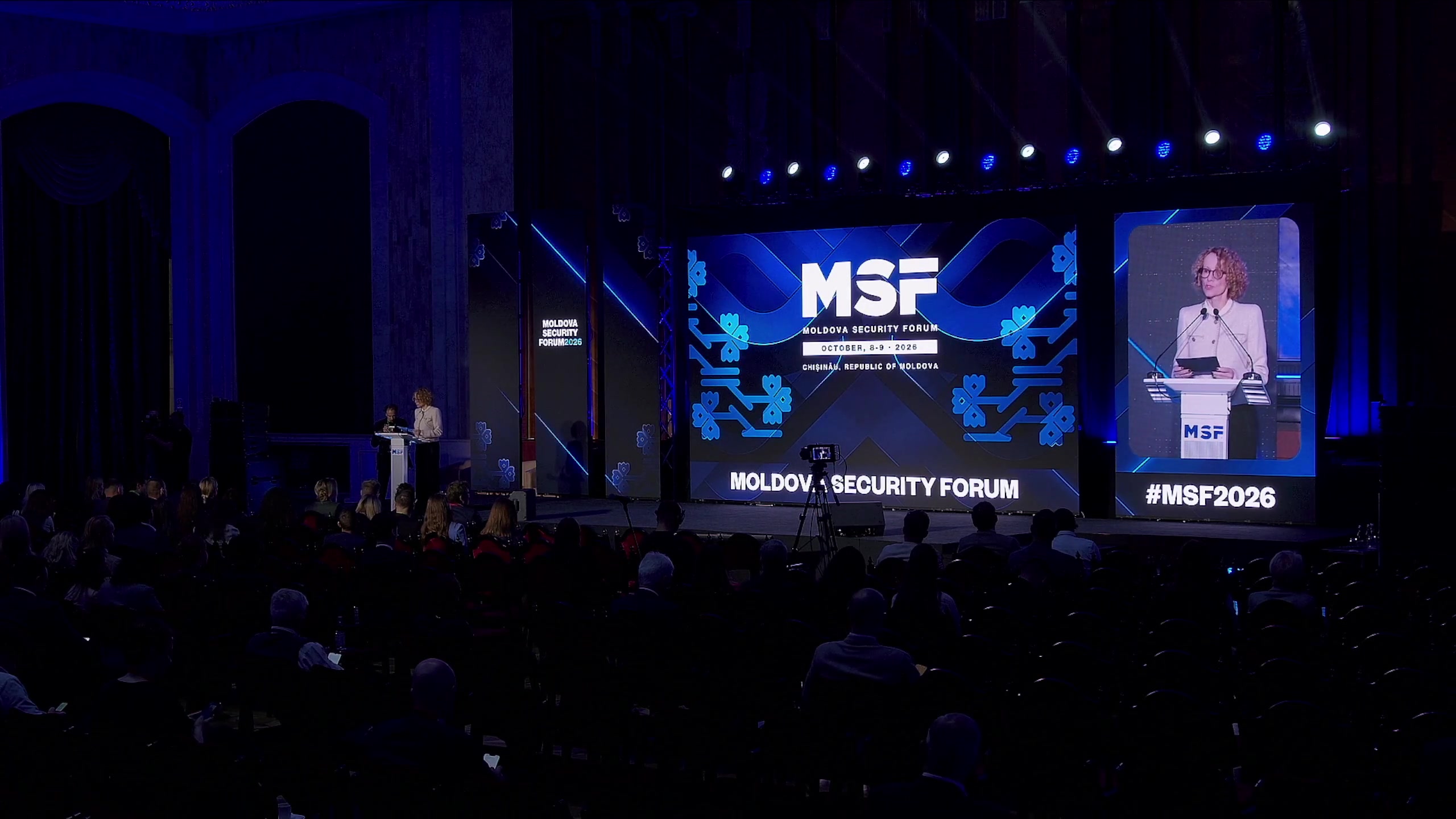
Good morning and welcome back to the second day of Moldova Security Forum.
Yesterday was about why. Why democratic resilience has become the real measure of security. Why one small country on Europe's edge now speaks to the whole continent.
Today is about how. And how we build the resilience in practice, and who we build it with. Before we go forward, let's have a look back how this forum opened yesterday.
[Video recap]
[Julian]
Thank you.
And thank you, Sanda, for guiding us through the day with such a steady hand. Thank you. Also, thank you dear friends. Yesterday, we reached 702 participants attending the first day.
And being thanks to our volunteers, interpreters, the entire organizing team, and of course our media partners for the hard work. Thank you.
One line from yesterday stayed with me. In hard moments, two friends do not step back. They run towards you. That is the spirit of this forum serves.
Day two takes a closer look to the ground. How the government stays standing with crises escalating, how the adversary reality operates, how illicit finance is used, and how cognitive warfare happens. And how innovation and social cohesion turn society into development, and how our society is becoming more resilient and produces security.
None of this is built alone. For Europe's eastern flank, two actors increasingly have moved forward. The European Union, laying the complementary industrial and financial foundations for European defense, and NATO, anchoring the capacity to deter and to defend. Where the two align, countries like ours stop being a dotted line. They become, we become part of a solid one.
It is fitting that the day two of the forum opens with both. It is my honor to welcome to the stage Deputy Secretary General of NATO, Ms. Radmila Shekerinska. Please.
[Radmila Shekerinska]
Thank you, Julian, and really congratulations on making Moldova Security Forum such a success in a very short period of time. The pictures and the videos of yesterday were telling.
Distinguished guests, it is really an honor to address you today and speak about the importance of democratic resilience in the face of hybrid threats. The Republic of Moldova understands these threats better than most. For years, you have stood firm against interference and intimidation from Russia.
Putin's regime has tried to undermine your free and fair elections with disinformation campaigns, with vote buying, but also with threats. They have launched cyber attacks and sabotage against your critical infrastructure. They have violated your airspace with drones and missiles, cut your energy supplies, and they continue to station troops on your territory without your consent.
Despite all these hostile actions, Moldova has stood firm and strong. And you have shown to the world that a small state cannot be bullied. You have written the playbook for resisting these kinds of aggression, using your ingenuity, using your grit to withstand these pressure tactics.
This is in a nutshell what resilience is all about. And therefore, I will start by saying we have a lot to learn from you. Today, NATO's allies, NATO's countries, are experiencing more and more of these hybrid attacks that Moldova has endured for years.
Russia is failing on the battlefield in Ukraine, while not gaining any momentum there, losing almost 40,000 soldiers per month. And when the regime is desperate, he becomes even more aggressive. This is why Putin continues to unleash even more brutal attacks against Ukrainian civilians, against Ukrainian cities, against their critical infrastructure. This is also why Russia has become even more aggressive in their hybrid action against NATO allies.
Cyber attacks, sabotage, arson, airspace violation, drone incidents, Putin is really trying to intimidate and divide us. And his main goal, of course, is to try and deter us from continuing our support to Ukraine.
But he will not succeed because our alliance has stood united. NATO will keep calm, carry on, and support Ukraine. Keep calm because we have what it takes to defend every inch of our territory. Carry on investing in our defense so that we can continue to grow stronger in our ability to deter and defend our territory and our citizens. And support Ukraine. Our response to Russia's reckless and dangerous actions is to provide even more support to Ukraine.
NATO's 32 allies work hand-in-hand with each other and with more than 30 partners across Europe and around the world. We train together, we cooperate with each other, we support each other, and we learn how to enhance our resilience.
Moldova is an important part of this wider network. NATO and Moldova have had a strong partnership for over 30 years. And this partnership is based on strong political dialogue, meaningful political dialogue, as we saw with the recent visit of NATO's political committee in August, celebrating Moldova's 35th anniversary of independence.
Our partnership is also based on strong practical cooperation to strengthen your resilience and also to strengthen your defense institutions. It is really an honor to use this venue to stress that Moldova is the largest recipient of funds from NATO's Defense Capacity Building Initiative, having received support worth nearly 50 million euros to date. Within this overall number, we have provided 12 million euros worth of modern body armor and helmets, which were enough to equip the whole Moldovan armed forces and leave also something for reserve.
We have provided 8 million euros for ammunition storage, over 4 million euros of IT equipment and software to help protect the integrity of your election process from cyber attacks. And we also helped develop a cyber defense facility within the Technical University of Moldova and a cyber response team within the Moldovan armed forces.
What's more, hundreds of Moldovan scientists have participated in NATO's science programs, developing mutually beneficial projects in domains as diverse as counterterrorism, cyber defense, CBRN defense, but also many other fields. We have run joint exercises to improve Moldova's ability to deal with man-made, but also with natural disasters.
And last but not least, we have helped enhance good governance in Moldova's armed forces and defense institutions, strengthening institutional resilience against the risk of corruption. All of this support from NATO has helped strengthen Moldova. But this is definitely not seen either by us nor by anyone observing as charity. A strong, stable, resilient Moldova contributes to stability and resilience on NATO's borders, and this this matters to us all.
And more than that, we see our partnership as a real two-way street. As I said, we do have also something to learn from you. Moldova helps strengthen NATO by sharing lessons which are valuable because they are first-hand lessons experiencing defending against hybrid threats, and we have really appreciated the strong cooperation in this field. Moldova is also very directly a security provider. Since 2014, Moldova has sent troops to support K4, our longest serving peacekeeping mission in Kosovo under a UN mandate.
Deploying troops to serve alongside with those from NATO allies and other partners helps to maintain peace and stability not only in Kosovo for the benefit of all communities, but also across the Western Balkans. It also enables Moldovan armed forces to gain valuable professional experience, but also develop the interoperability with NATO, with allies and partners. Therefore, I'd like to use the opportunity to thank Moldova for this contribution to K4, for your contribution to all other international missions, and to say that we really appreciate this long-standing, consistent engagement. Thank you also for your ongoing and strong support to Ukraine as it defends itself against Russia's war of aggression.
The people of Moldova, not just Moldovan institutions, but also the people of Moldova have shown tremendous compassion and solidarity with the Ukrainian people, hosting hundreds of thousands of Ukrainian refugees. Your work to secure transportation corridors for Ukrainian experts benefits Ukrainian economy, but also global trade. Your cooperation with Ukraine has helped build resilience against hybrid threats on both sides.
And Moldova's participation in the coalition of the willing will help ensure a just and lasting peace in Ukraine, backing up any future peace agreement with very strong security guarantees, something that Ukraine really needs. Many of these activities have been undertaken in cooperation with partners from the European Union. The Moldovan people have chosen a future in Europe, and you can count on our support as you continue on the path towards the European Union, support in practical terms, supporting your reforms as well.
Strong institutions are key for any successful, resilient, sovereign country. And this is what NATO, the European Union, and the Moldovan authorities are working to achieve. At the same time, we fully respect Moldova's constitutional neutrality.
Actually, national sovereignty is at the core of what we believe in and what we work for in NATO. Our alliance of democracies fundamentally believes in the sovereign right of free peoples to determine their own future. This is our core belief, and we support not only our rights, but also other countries' rights to decide on their sovereign choices. This is why we support Moldova's democratic resilience against Russia's interference. This is why we support Ukraine's brave resistance against Russia's brutal war.
And that is why we are deeply concerned by the ties between Russia, China, North Korea, and Iran. As they increase their cooperation, and we see it across the globe, so must those that believe in freedom and democracy, in the sovereign rights of our people to choose their future. We must stand together to promote peace, protect our shared security, and defend our democratic values. This is why I am here today, not only as NATO's Deputy Secretary General, but also as a proud citizen of my country, North Macedonia, which has walked in your shoes, and it still does.
We have been on a path of greater integration with other democracies, and we have seen how difficult it is, how sometimes frustrating it becomes. So, it hasn't been easy, but it has always brought more security, more stability, and more opportunities for our citizens and our people. Therefore, I really welcome, appreciate, and applaud the progress that Moldova is making along this path.
I will end with a story that I have discovered yesterday while I was visiting Moldova. I have initially noticed that a number of things here in Chișinău are called Făt-Frumos. I've seen a restaurant, I have seen a bookshop, and I heard that it's actually also in your on your national coins. So from what I was told, and this is thanks to my our team here in Moldova, the personality that you are frequently using in your everyday life is not big. It's not as powerful as the monsters and dragons that threaten him.
But he uses his smarts, he uses his ingenuity, help, courage, but also help from his friends to defeat these larger foes. And this is how I understood why such a character would be important in Moldova. Moldova may not be the largest country, most of us are not, but you are smart. As we heard today, you're very resilient, you're courageous, and you have many friends in NATO. And when you have all these ingredients, nothing can defeat you. So thank you for that resilience and thank you for showing the way.
[Julian]
Thank you, Deputy Secretary General. And from the Alliance, we turn to the Union, and from this hall to Brussels. I'm honored to present you the video message of the European Commissioner for Defence and Space, Andrus Kubilius.
[Andrus Kubilius]
My dear Moldovan friends, when I look at Moldova, there is a lot I recognize, and I feel a lot of emotions.
My country, Lithuania, and Moldova, we were occupied by the Soviet Union back in 1940s after the Molotov-Ribbentrop Pact. Your parliament was the first to recognize Lithuanian independence in 1990. Now we have around the same population.
We are both on the eastern border, and we both have problems with a big aggressive neighbor. 17 drones crashed in Moldova in August alone, nearly the same as the whole of last year. And the last elections in Moldova, the most blatant Russian interference with Russian money and Russian information warfare. Their goal, to undermine your sovereignty, independence, and European future.
But you resisted, and you won. Thanks to your strength and your resilience and your concrete actions, the whole of Europe can learn from Moldova, and we thank Moldova. You can count on our support. Moldova was the first country to conclude a security and defense partnership with the European Union, with real results.
The European Union Partnership Mission in Moldova, rapid response teams against cyber and hybrid threats, a military advisor at the EU delegation, and support for strong institutions like the National Crisis Management Center. After Ukraine, Moldova receives the most EU money for security and defense. In total, 317 million euro from the European Peace Facility to strengthen your armed forces. That includes 120 million for air defense announced in June.
You are a close ally in foreign and security policy. You are a front runner in enlargement. You are fast moving forward to join our European family, to join the European Union. The European future of Moldova and the European future of Ukraine are the greatest guarantees for long-term security and peace in Europe. Because you will be protected by the European family, and you will be able to create your success in this family, as we did when we joined the European Union. And because the success of Moldova and the success of Ukraine will show ordinary Russians there is a better way than the Putin way. So let's continue to deepen our cooperation on security and defense and towards our shared European future.
[Julian]
Thank you.
We have heard from Deputy Secretary General, Commissioner Kubilius, about the strategy and the foundations. Now, we go and we turn to the test of them. When a crisis arrives, it rarely respects a single mandate of governments or borders. Droughts, floods, energy shocks, cyber disruptions, they escalate, they cascade, and they have to be addressed, and we have to be prepared for them.
To open our fourth plenary on crisis management and civil preparedness, I invite the keynote speaker for this session, Mr. Sergiu Diaconu, Director of the National Center for Crisis Management. Please, Director.
[Sergiu Diaconu]
Thank you. Distinguished guests, colleagues, ladies and gentlemen. We no longer operate in an era of isolated crises. Today, disruption do not respect borders, do not respect institutional jurisdictions or bureaucratic timelines. While policy analysts often categorize crises as energy, cyber, environment, or natural disasters, citizens experience them holistically.
They experience them when critical infrastructure fails, schools close, or essential services collapse. Because vulnerabilities are deeply interconnected, our strategic response must be equally integrated. True nation's resilience is not measured by total prevention of shocks, but by the systemic capacity of our institutions and communities to maintain core functions when multiple cascading failures occur simultaneously.
Throughout 2026, Moldova served as a live testing ground for managing interconnected transboundary risks. In March, kinetic attacks on neighboring Ukrainian energy infrastructure instantly compromised our line, threatening our domestic power grid and proving that extraterritorial assets directly impact our nation security. Simultaneously, contamination of the river threatened drinking water across multiple municipalities, requiring immediate synchronized action across public health, environment, emergency services, and local government.
This event confirmed a vital structural truth. A crisis is not a technical problem for a single agency. It is a complex governance and resource allocating challenge. Institutional silos must not dictate the boundaries of our crisis preparedness. To address this reality, Moldova has fundamentally restructured our crisis governance framework by establishing a National Crisis Management Center, operating under the direct authority of the Prime Minister. The NCMC supports the National Crisis Management Commission.
It serves as a strategical integrator rather than a replacement for sectoral agencies, ensuring a unified situational picture and synchronized executive decisions. Today, the national platform connects over 70 institutions. It bridges the gap between the decision makers, technical specialists and local territorial hubs to ensure centralized policy translates to immediate action. A vital pillar of this architecture is enhanced civil-military cooperation.
By bridging civilian agencies with military logistics, conducting joint operational exercises, and pooling capabilities, we ensure faster decision-making cycles and more efficient resource deployment when time is most critical variable. We are building our system on three core capacities: common situational awareness, replacing fragmented institutional assessments with a single verified and real-time data stream; coordinated decision-making, setting clear strategic priorities and resource mapping across sectors when multiple crises and essential services are compromised at once; operational continuity, guaranteeing that the state maintains its core function and continuity of government even under extreme operational disruption.
State capability represents only half of the resilience equation. During large scale disruptions, central governments cannot act alone. True resilience requires an active ecosystem consisting of local authorities, private critical infrastructure operators, utility providers and civil society networks. Our strategy directly aligns with the European Union preparedness Union strategy, embedding a whole of government and whole of society methodology into our national fiber.
This framework shifts focus heavily towards population readiness, specifically cultivating the capacity of citizens to remain self-sufficient for a minimum 72 hour during a major breakdown. To institutionalize this shift from reactive management to proactive society readiness, I am pleased to announce the launch of Moldova Prepared. This is the targeted three-year national program designed to build practical civilian preparedness and societal resilience across the country.
This initiative will systematically empower households with clear, actionable operational protocols for temporary utilities or service outage, strengthening localized governance by tailoring emergency capacities to specific regional vulnerabilities, build cross-sector partnership, spanning academic institutions, private enterprises, media and volunteers network. As a foundation milestone of this initiative, we will execute Moldova National 72-hour preparedness campaign in November this year. The first 72 hours of an emergency are the most critical for the public infrastructure stabilization.
When households possess basic contingencies and verified information, it mitigates panic and frees emergency services to focus their high-value assets on the most acute life-saving priorities. This is not an admission of institutional limitation. It is an optimization strategy that makes state and society stronger together. In conclusion, resilience is not defined by the absence of crisis, but by the systemic capacities to anticipate risk, absorb shocks, maintain continuity of services, and recover rapidly. Through the NCMC and Moldova prepared framework, we are transitioning from a system of reactive emergencies response to a culture of permanent proactive national readiness. We are investing not in fear, but in the institutional confidence, stability, and enduring security of our nation. Thank you.
[Julian]
Thank you, Director, and thank you for the announcement you've made. We're looking forward to participate in the 72-hour preparedness exercise in November. Thank you, and thank you for accepting for staying with us with a panel and answering to the questions that maybe audience will have. With that, I'd like to invite Teodora Fuyor of DCAF to take over the moderation of the next panel. Please, Teodora.
[Teodora Fuyor]
Is this on? It's on. You hear me?
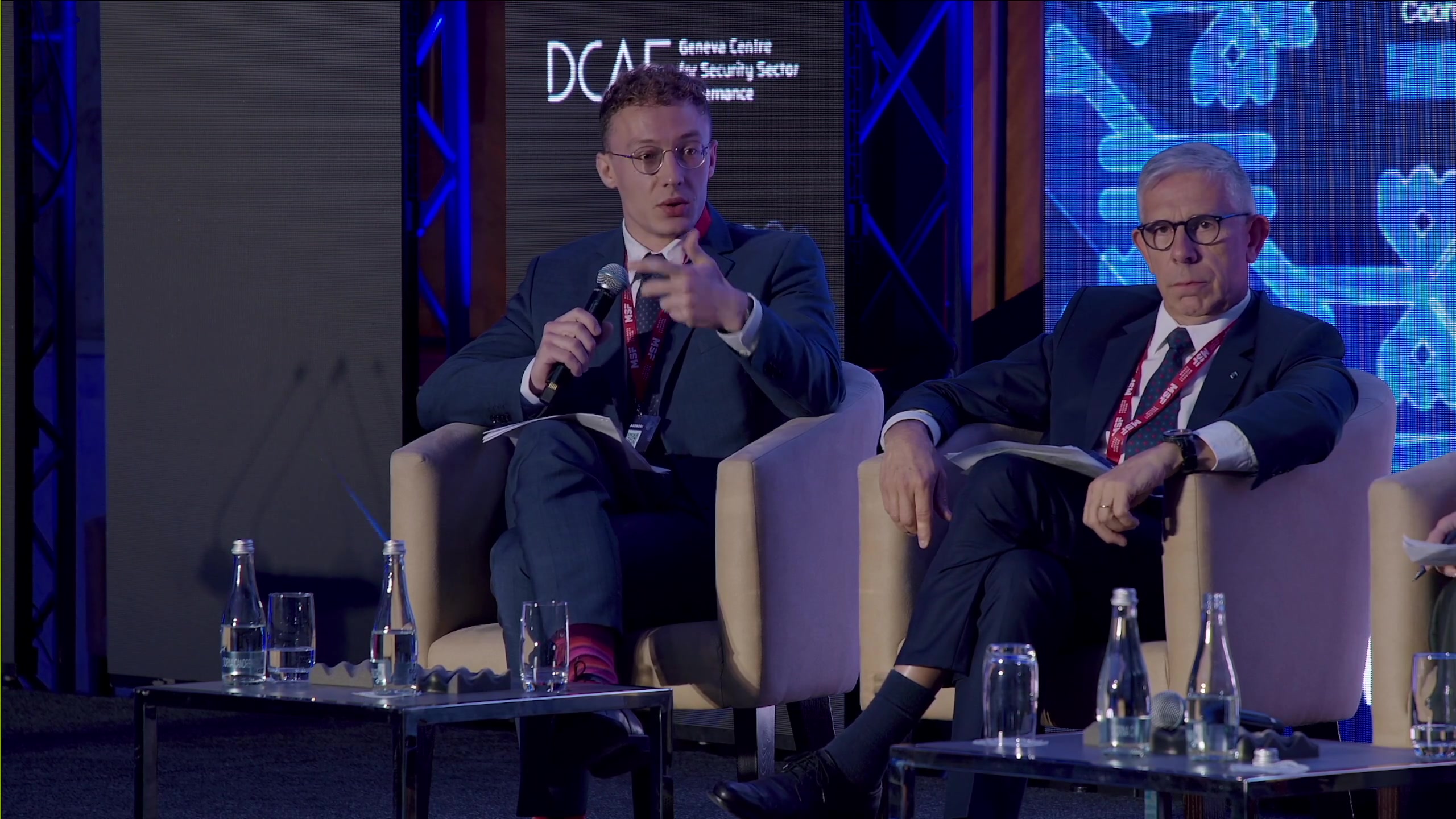
Good morning, everybody. So, my name is Teodora Fuyor. I'm leading DCAF work in Moldova on security sector governance. We are very glad at DCAF because this is the third year actually that we bring this discussion on the topic of crisis management into the Moldova Security Forum together with our partners from Moldova society.
It's interesting, I think, to reflect on how the discussion on crisis management has evolved during these last three years. It was also reflected, I think, in Mr. Diaconu's speech. In '24, we were talking about the need to shift from this reactive to the preventive paradigm in Moldova. Last year, we were talking about the benefits of having an integrated risk-informed institutional system in Moldova.
And today, we will have a conversation about how our crisis management systems are tested in reality, in real life. And hopefully, we will help identify some solutions, some lessons learned that can improve the effectiveness of our systems. In the opening of the forum yesterday, the Secretary General of CAS, Mr. Mark Spike, has asked a question that stayed with me. He said, "Can democracies offer the best answers to the people's problems?"
I think it's a very important question, and I think ultimately, this is the fundamental question that we will try to respond today in our panel, but also through the evolvement of the discussions that we will have. I think crisis management is an area where we can make this analysis in a very concrete terms. We can identify what features of democracy are making our societies respond and go through crisis in a different way, and we can compare how democracies respond to crisis and how their citizens pass through crisis in comparison with other political systems.
Our panelists will help us give concrete responses to this question. And I will now invite them all to join me on the stage. We will start with Davide Sanders from NATO. He's a resilience advisor to NATO Euro-Atlantic Disaster Response Coordination Center. Please, Davide.
Maybe it's best to sit there underneath your photo. Thank you. Then we will have my colleague from DCAF, Major General Philippe Butin. Philippe is senior security and strategy advisor at DCAF. We will have then Dr. Elena Mîrzac. She's executive director at PISA Moldova. PISA is the platform for initiatives in security and defense.
The former Prime Minister of Moldova, Mr. Recean, said yesterday something that we all know, that Nordic countries are really the champions in resilience, in civil preparedness. And we are very fortunate to have with us representatives of two Nordic countries, Sweden and Finland. First, I invite Mr. Carl Törning, who is from Sweden. He's from Swedish Agency for Civil Resilience and Defence. MSF is our one of our implementation partners here in Moldova. Thank you very much for for coming, for joining us. And then we have Mr. Axel Hegelstam from Finland. Thank you very much for coming. Please join us. He's the Deputy Director General for International Affairs and Analysis in the Finnish National Emergency Supply Agency.
Thank you all for joining.
Let me remind you the question that I have mentioned, which was asked yesterday in the opening of the forum. Can democracies offer the best answers to the people's problems? I think this is what we will try to respond, but to move from abstract theoretical discussions, we have discussed and we have prepared, I think, very concrete responses and very concrete information that our panelists will present to you about real-life crisis that happened in their countries in the last year especially. And we have seen how the climate change has become really a very important driver in our risk environment.
We have seen in the last summer extreme weather situations with heat, with droughts, with wildfires and and other extreme weather events that affected so much our communities and our countries. So several of our panelists will reflect on such concrete situations today. Let's start with Philippe Butin, who has a very rich and extensive experience that he he accumulated in his capacity of head of the Paris fire department in a time when France was passing through very critical times. So Philippe, based on your operational experience, when a severe crisis disrupts several services in the same time at once, what decision-making arrangements and institutional responsibilities help a society be effective in its response to crisis?
[Philippe Butin]
Thank you very much, Teodora. Good morning everyone and thank you really for inviting me for the second time to participate in this very important forum. So, just to be clear and one precision, I was the Paris Fire Brigade Commander in 2015 when the the terrorist attack happened in in Paris. And I'm telling you that just because there is a specificity in Paris, the firefighters are a military unit of 8,700 men and women. So, I'm a French general but with a specificity of being the head of the the fire department in Paris. To answer directly your question, I think it's the principles are almost the same as the one for the the law of war in the sense that Clausewitz established long time ago that we need to have the freedom of action, first, the second, the concentration of effort or capacity, and the third is to the economical use of forces. And when you decline that or when you you think about the reaction to a crisis, the crisis is always impacting different services, otherwise it's an isolated event and you you can manage that at a local level. When it's a crisis, it has an impact on on several several services. And the most important in my view is to understand who is responsible for what. So the leadership, the leadership must be very clear for all the layers in the in the crisis management chain. This is the first point. And then, when you have a clear explanation of that, what is also important is to understand what is the responsibility of each of the layers.
And when you consider the freedom of maneuver, that means that at the local level, all the details that must be fixed at the local level are not problems for the upper levels. So that's why the flexibility is is so important and the coordination must be absolutely permanent. But also the clear responsibility must be established in the sense that every level of responsibility knows precisely who will have to decide for what. And also, as we are acting in a crisis arrangement, you need to establish clearly who will replace somebody if in case you have somebody unavailable for whatever the reason to decide. I just want to illustrate that through an example. In 1995, in Kobe, Japan, it happened a very terrible earthquake. It was just before 6 o'clock in the morning, 7.2 on the Richter scale.
And normally, in the text, in the regulations, it was the responsibility of the prefect of Kobe to request for reinforcement, external reinforcement, I mean, coming from other cities in Japan and possibly from abroad. But the prefect was killed during the earthquake. It took four days for the Japanese authority to realize that nobody had requested the reinforcement. And in the end, the Japanese finished with more than 6,000 people killed in this earthquake. And when you know the level of preparation of of Japan, especially for this kind of terrible natural disaster, it's it's an indication of one detail because, in fact, in the text, it's probably a detail, but nobody was able to say who will replace the prefect if he died. So, this is the the limit of responsibility between the different level of of action. The the the third point, I think it's important also, is to understand that you need to coordinate.
You work with different services and impacting services is one question, but the response is impacting also several services, the police, the carabinieri here, the healthcare system, the energy supply and so on and so forth. And to coordinate that, the only solution, and it was clearly underlined yesterday, is to prepare people and you can prepare people only through exercises. And yesterday, the the the special envoy of the president for development and resilience underlined that clearly, and I'm happy to to to hear this morning that you will organize an exercise in November. So, this is the only way because one thing is to have the regulation written, but if you want to test that in all the administration in the world, you write a paper, you send the paper, you put a red stamp saying it's very important, and check two or three months later, only 20% of the guys involved will have read the paper. So, the only solution is to to involve people through exercises. And through exercises, you will realize how many details are not written in the regulation, and you will probably cover all the gaps, the phone rosters, updated or not. You discovered that, for example, the radio frequency are not the same between the police, the firefighters, and so on and so forth.
And all of that must be written in a in a emergency plan or in in whatever the plan. And also, you realize because that is my last point on that. Um, during a crisis, if you are very well trained, nothing will happen how you you have planned or imagine. You will lose 70% of your capabilities of thinking, and you will have to act with the first, the 30% remaining. This is the only way to react. And with those 30%, you will find solution if people in all the chains are prepared for that. Thank you.
[Teodora Fuyor]
Thank you very much, Philippe, for starting this conversation. So, I retained that it's very important to have the clarity of mandates, especially on the hierarchy in the decision-making. But it's also very important to to be to have the flexibility to adapt and to respond quickly and to have preparedness which can only be obtained via exercises. Let's continue this and I will turn towards Mr. Carl Törning. Carl, you have told us that you want to draw on a recent weather event in Sweden and to tell us what it has revealed about the the preparedness but also the defense civil capacities and about the supply. What can you share?
[Carl Törning]
Yes, thank you, Teodora. Um, indeed, I think it starts in the home. So, it starts with involving our youth, our children, when they're young in the preparedness, home preparedness. So, just to give an example from my own personal life, we we have a preparedness brochure that we send out to every citizen in Sweden, and twice a year, I I dust off that brochure and use it for one week, and and me and my teenagers and my partner, we live out of our reserves for for one week. They hate me for it, but we do it every week, and that's a way to start engaging and preparing at the home. But I would also like to echo what Elena has been talking about, but the importance of civil society. There's a lot of potential for youth to engage in civil society. In in my country, we have strategic relationships with civil society organizations that can perform a role in crisis management.
For example, providing first first aid and and first psychological aid to to victims of a crisis is something that the Red Cross provides and and we are working very strategically with them. So, so those are important. But I also think they have a role in in the public system, in our civil defense system. So, now, when you are 16 in my country, you are legally obliged to be part of the total defense structure. And and that's the year when you you go to the recruitment office for the military services, but now also for the civil defense services. So, here we have roles, civilian roles that young people can engage with to to perform an official part in in the total defense system. So, there are many ways and indeed an important resource in our overall structure. Thank you.
[Teodora Fuyor]
Thank you. Um I think it's very good to hear that um during exercises, one can see how different organizational cultures uh converge towards the same objectives and this kind of cultural differences uh between institutions but also probably between countries uh can be blurred. Um I think what you have said also confirms what we heard yesterday from another speaker that crisis is the mother of resilience. So we definitely need exercises uh in order to to become uh better prepared. I think uh each and every one of you highlighted some of the features of a democratic response to crisis. You have all talked about how important cooperation is, inter-institutional cooperation, but also trusted communication between institutions and also between state institutions and people and citizens. Um let's go now to a second uh round of interventions and maybe move from uh depicting a little bit the situation and what we do, what our countries uh put in place to respond different crisis towards what lessons have we learned uh and how do you think uh these lessons can be implemented into the the reality, into the practice, uh into the continuous adaptation that crisis management systems need to to do. Um I will go back to Philippe Butin. Philippe, um as Moldova puts uh its new crisis management arrangements into practice, um how do you think they should test um whether decisions can be taken quickly and effectively uh across national, local levels, uh if they have the capacity to to employ effective public communication also during crisis. So how how does one test this?
[Philippe Butin]
Thank you for your for your question. So, I think that it was explained clearly by all the colleagues here, it's a question of exercising the structure. So, I've seen all the progress made in the Republic of Moldova over the two last two, three years, and now you have a national crisis management center. So, it's absolutely key. But sometimes also, it is necessary to to be a pedagogue with the the lower levels and explain before exercising people what you are expecting from them. And I think that I don't know how it is prepared for for the next exercise in November in in in Moldova, but I would strongly encourage all the people in charge of preparing this exercise to go in the different municipality or in different regions and to explain what is expected from them and what is necessary to be tested.
Because you could miss also the the main objective of the of this kind of exercise. Just an example of that. There is a crisis in one of the municipality at 200 km from from Chișinău. Usually people have the habit to react. The mayor of the city will take the appropriate decision. But he's not aware of what is happening in two or three at 200 or 300 km far away from his city. And it is important at the national level to react if we are aware that there is an attack, there is a consequences of a damage for for a dam, for example, huge floodings in other place and so on. Because and especially in this moment with hybrid attacks, with hybrid threats, it is not impossible to imagine that on one country, in one part of the country, you have a specific disaster, and at the same time, at 200 or 300 km far away from there, another one. But only the national level can have a clear picture of what is happening and if it is natural or if it's provoked by by an attack. Because it's also possible that you have consequences that have nothing to do with hybrid hybrid threat. It was a case in Spain last year, if you remember, they had a switch off the electricity in two-thirds of the country. Immediately the the media started to say this is a hybrid attack by by the Russians. In the end, it has nothing to do with that. So, just to illustrate the fact that the level of understanding is usually at the national level. That's why it's crucial to first having a national crisis management center, and second, to explain to all the levels in the country why it's necessary to guarantee the trustable flow of information.
And the second point is that through this, this kind of exercise, you train your people to react. And it was several times underlined the the crucial moment of the first and 72 hours. If each of the citizen in a country are able to to prepare, let's say, water, food, and some let's say the daily support, they are not a problem because they ask the state to be defended, but it's the role of the military. But they ask also the state to be protected, and it's the mission of the rest of the public services. So, understand that each of the level that it is crucial to inform the top level and to inform with reliable communication.
Because at the end of the day, and it was underlined by our Hungarian colleague, say the truth. If the situation is very difficult, say the truth. If a village is isolated like it was the case for floodings, for example, for the first two days, people can find solutions on their own. But if it lasts for two weeks or three weeks, obviously it's a it's a mission for the state. It obviously it's a mission for with the reinforcement of the military. So, the level of coordination and another more word is very key, it's anticipation. And the level of anticipation is never or exceptionally the level of contact with the reality. The level of anticipation is at regional or national level. You know that, for example, you have floodings, you have the the weather forecast, you know that for the next five days, you will have heavy rains. So, it is not necessary to say the people that the situation will will be better, but say the truth. Second, and last point, and it was underlined by our colleagues, we are not alone in Europe. The Republic of Moldova is not member of the European Union, but is member of the European family. And we have in Europe the the civil protection mechanism that can be activated by the Republic of Moldova. It was the case in my country in France this this summer, we had very important wildfires. We activated this mechanism and we received the support of plenty of nations in Europe, including Ukraine, by the way. They sent firefighters to support the French firefighters. So, we have the chance to live on a continent where there is solidarity, international solidarity. And one key point, in this mechanism, it is also included who will pay, because a crisis has a cost. And believe me, at the end of the war, each each time you receive the the invoice. So, this is clearly established who will pay for the for the EU mechanism. And if I'm not wrong, it's not so precise with with NATO. And I spent some some years in NATO, especially four years in in Brussels, and we have some surprise with the use of, for example, the NATO response force sent to Pakistan for an earthquake, was the Spanish sent their soldiers and when they arrived with the invoice, the response of the North Atlantic Council was to say, "Hey guys, you send your soldiers, you pay." And and if you do that, you kill the the the process. So, I don't want to criticize NATO because I I spent seven years in NATO, but just to illustrate the fact that in the EU, this mechanism has been established, it is clear, and you can rely on that. Last point, communication, say the truth to the population and invite the population to be ready. Because we speak about resilience. I think the first 72 hours are not resilience, it's resistance. So, you can endure what is happening. The resilience is after that. So, you can continue to live even in a deteriorating environment with the support of the states, with the support of different services. And this is the role of the state, and that must be tested through exercises. Thank you.
[Julian]
Thank you, Teodora, for this very interesting panel. Now we will announce a break, but before that, let me provide you more details about the next parallel sessions. In this plenary hall, we will have our next panel on hybrid threats, illicit finance, cognitive warfare, and institutional subversion, organized in partnership with Aspen Institute and Radu Plunc will moderate. And in the Moldova Hall, we'll have a close session on emerging technologies, Black Sea connectivity, dual use value chains, and Ukrainian reconstruction, moderated by Alexandru Guzun, and that session is organized in partnership with American Chamber of Moldova American Chamber. So thank you very much. We will resume the sessions at 11:30 sharp. See you later.